
Boston Opera House
343 Huntington Avenue,
Boston,
MA
02115
343 Huntington Avenue,
Boston,
MA
02115
 2 people
favorited this theater
2 people
favorited this theater
Additional Info
Previously operated by: Shubert Brothers Theater Company
Architects: Parkman Haven
Firms: Wheelwright & Haven
Nearby Theaters


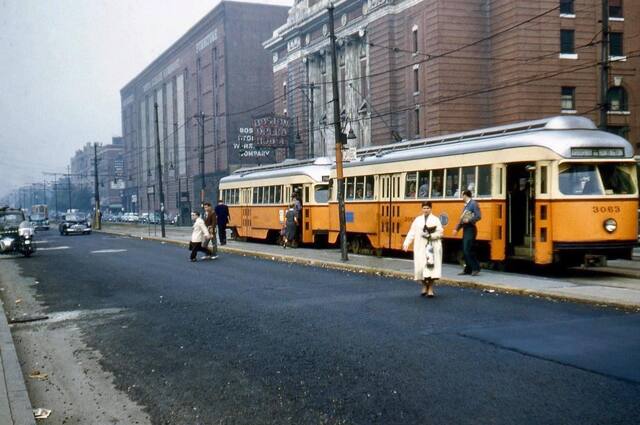
This large theater was built by department store heir and arts patron Eben Jordan for the new Boston Opera Company. It opened on November 8, 1909 and was located half way between Symphony Hall and the Museum of Fine Arts, on the same side of Huntington Avenue. On the staff of the opera company was a young Joseph Urban, who later bacame a famous scenic and costume designer for Ziegfeld and others, as well as a theater architect.
When the opera company failed for financial reasons, the big theater was sold to the Shubert brothers who operated it as a road-show house. Opera, ballet and big musicals predominated. But it was often dark. The theater was closed suddenly in 1956 per order of the city building inspector for alleged structural defects. Along with a massive brick storage warehouse on its west side, it was demolished in January-February 1958, and the land used for Northeastern University facilities.
The Shuberts frequently presented movies at their Majestic Theatre downtown, and in October 1914, the feature film “For Napoleon and France” opened at the Boston Opera House. It was accompanied by a stage show which undoubtedly was themed to the movie. It was a twice-daily reserved-seat engagement. A projection booth may have been installed in one of the center boxes (the theater had two full horseshoe tiers of private boxes with two balconies above.) Or, the projectors could have been located in the follow-spot booth above the second balcony. It’s very likely that there were other road-show film engagements there during the 1910s and possibly in the 1920s as well.
Contributed by
Ron Salters
 Want to be emailed when a new comment is posted about this theater?
Just login to your account and subscribe to this theater.
Recent comments (view all 15 comments)
I saw the first professional stage show of my life at this great theatre in 1948 – the Doyly Carte Opera’s “The Mikado”, which starred the legendary Martyn Green. I can still remember where we sat – my aunt took me and my cousin for our birthdays – and even a memory of the smell of the place. I believe the theatre was closed (prior to its being condemned) because of the Shubert’s consent decree with the US Government for holding monopolies in several cities. (Which is why they happen to own 17 ½ theatres on Broadway, when they once owned 35.)
The Opera House in Boston featured in that photograph, Warren, is this one: /theaters/23/
Since the Boston Opera House on Huntington Avenue was demolished in 1958, there can be no “recent exterior view” of it.
Your photo is of the former BF Keith Memorial Theatre on Washington Street, later called Savoy, and now called Opera House. Its CinemaTreasures page is here.
During its first 2 years of existence, the Boston Opera House’s neighbor across Huntington Avenue was a professional baseball park, the Huntington Avenue Grounds (1901-1911) which was made obsolete by Fenway Park in 1912. There is a nice illustration, which is half-map and half-aerial drawing, of the ball park with the Boston Opera House opposite, on page 14 of the book “Historic Ballparks” by John Pastier (Chartwell Books, 2006).
The seating capaciy of the old Boston Opera House was 2,750. Its stage facilities were considered the finest and most modern in the world in 1909-1910. The Boston Opera Company gave a season of 6 performances per week of about 25 operas from November until March annually from 1909-1914. A financially disasterous tour to Paris, April to June, 1914 and the outbreak of World War I caused the demise of the company. Various attempts in the next 4 years to establish another full time local company were unsuccessful. The Metropolitan Opera performed at the Opera House during its annual Spring Tour until 1957. The Chicago Opera also visited annually for 2 weeks from during the 1910’s to 1932.
There was a feature article “Ghost Opera” about the Boston Opera House in the Boston Sunday Globe, Nov. 8th. The occasion was the 100th birthday of the theater, which opened in November 1909. There were 2 photos of the auditorium, one with a full house present, even standees high up on the sides; and the other a demolition photo taken in January 1958.
Here’s a link to that article: Ghost Opera: The rise and fall of the original Boston Opera House – and the void it left behind
A persistent old legend is that the Haskell Opera House in Derby Line VT/ Stanstead PQ is a one-sixth -size replica of the Boston Opera House. This is preposterous. I have seen photos of both the exterior and the interior of the Haskell and there is absolutely no resemblance at all. Moreover, the Haskell opened in 1904, 5 years before the Boston Opera House, so it could not possibly have been influenced by the latter. The Haskell also contains a public library and straddles the international boundary between Vermont and Quebec. It’s a very interesting building but it has no relationship with the old Boston Opera House.
I have a Xerox copy of a 1909 seating chart for the Boston Opera House. I counted the fixed seating, and made an estimate of the number of chairs in the 78 boxes. (Some of the boxes had 4 chairs and some had 2 chairs). My results: Orchestra floor: 634; First Balcony: 842; Second Balcony: 708; Boxes:(estimated) 276. Total, 2,460 seats. This is close to the figure that Ed Burke posted above on 5-14-09. In addition, there were a total of 40-50 standing spaces high up in the 7th tier on each side.
There is a new book about Boston streetcars in the period 1950-1964 which contains many brilliant photos made from old color slides. There is a photo of an outbound trolley train on the Arborway line taken in front of the Boston Opera House. The right side of the facade shows, including the entrance to the second balcony at the right corner. There are 2 things that surprise me: the date of the photo, April 16 1958 and the fact that there is no demolition fence or barrier in place. At that time, I was in uptown Boston almost on a daily basis. In my trip log I noted “Jan. 13- Wreckers are on-site (at the Opera House)”; “Jan. 24 – Rear stage wall gone”; Feb. 3 (no notation). If the date on the photo is correct then it is amazing that the front of the theater was still intact as of April 16, 1958.