
State Theatre
320 S. Salisbury Street,
Raleigh,
NC
27601
320 S. Salisbury Street,
Raleigh,
NC
27601
 1 person
favorited this theater
1 person
favorited this theater
Showing 22 comments
Demolished in 1987.
Once operated by North Carolina Theatres.
March 1977 photo in below Facebook link.
https://www.facebook.com/olderaleigh/photos/pb.100063629260284.-2207520000../1516010768491203/?type=3
There were delays in its construction.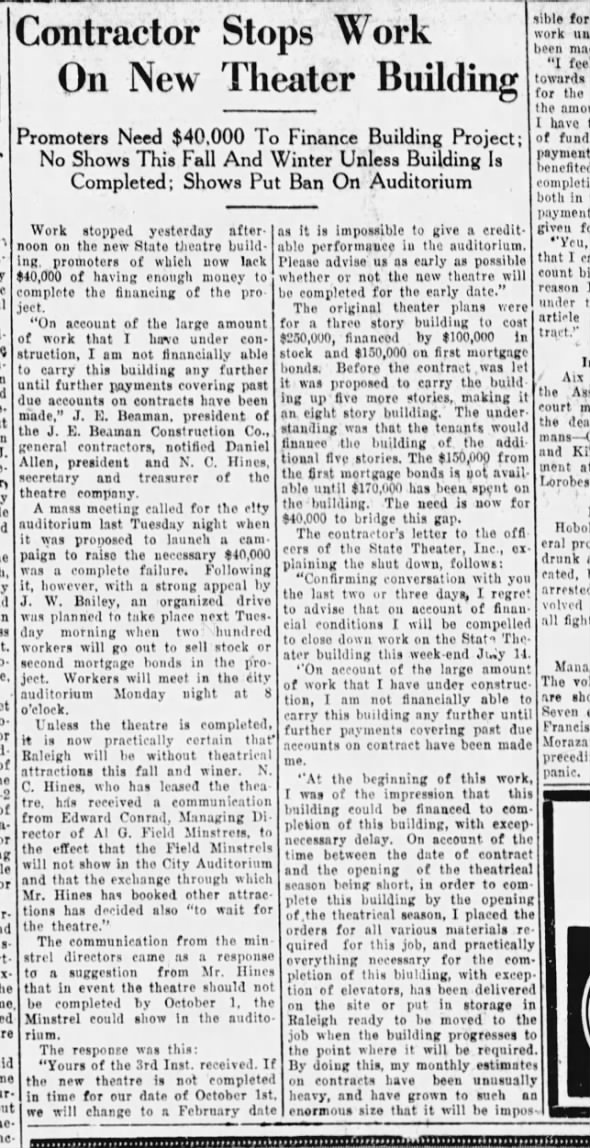 State theatre troubles Sun, Jul 15, 1923 – 11 · The News and Observer (Raleigh, North Carolina) · Newspapers.com
Opened on January 7th, 1924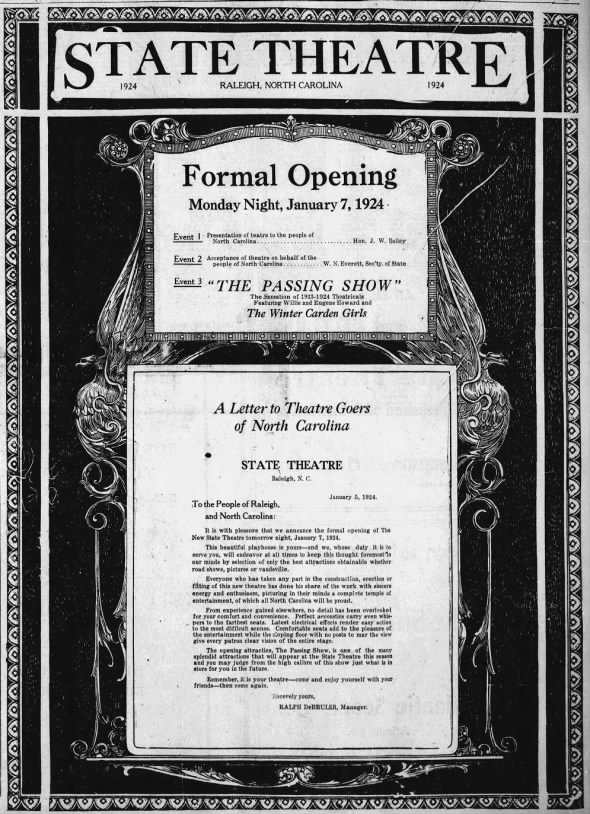 State theatre opening Sun, Jan 6, 1924 – 33 · The News and Observer (Raleigh, North Carolina) · Newspapers.com
A HARD DAY’S NIGHT played here first-run at Raleigh’s State Theatre on August 16,1964.
THE LION IN WINTER was one of two reserved seat engagement showings that made its Eastern North Carolina premiere at the State Theatre in Raleigh on April 12,1969. The other reserved seat engagement of THE LION IN WINTER was at Charlotte’s Capri Theatre on February 16,1969. These were the only two theatres in the state that presented it as roadshows. Other cities in North Carolina didn’t release it until the summer of 1969 as a general release.
Also to point out that the STATE THEATRE got a lot of the Warner Bros. product as well showing classic films as “My Fair Lady”, “The Wild Bunch”,not to mention brought in record crowds for its showing of the 1972 thriller “Deliverance”.
This theatre got a lot of the United Artists product with such films as “A Hard Days Night”,and “The Pink Panther”,not to mention the Bond films ranging from “Dr. No” to “Diamonds Are Forever” got first-run billing.
This theatre got a lot of the Universal product too. It’s run of “Airport” brought in record crowds,along with “The Sting”,and “American Graffiti” not to mention its showing of “To Kill A Mockingbird” and a lot of the “B” movie stuff too for Raleigh’s State Theatre.
Opened on January 15,1924.
Closed on September 12,1976 under Martin Theatres.
Cinemascope projection was installed in 1954 when the State Theatre was remodeled with new features and updated Stereosound system.
The State Theatre was one of two theatres in the state of North Carolina to be equipped with SENSURROUND sound systems for its December 21,1974 opening of the film “Earthquake!”
From the June 3,1966 ad from the Raleigh News and Observer…..on the showing of MY FAIR LADY at the State Theatre…. “DIRECT FROM IT’S EXCLUSIVE ROADSHOW ENGAGEMENT! FINALLY, RALEIGH CAN SEE "MY FAIR LADY” AT POPULAR PRICES AT THE STATE THEATRE…."
tory and chuck1231: FOR YOUR INFORMATION……….. The release of MY FAIR LADY didn’t come to Raleigh until June 3,1966 as a general release even though it was originally released in larger cities first on October 21,1964 in New York, Chicago and Los Angeles as a reserved seat engagement.
Charlotte’s Capri Theatre was the only showing of the film in the state that got the exclusive reserved seat engagement on January 28,1965…MY FAIR LADY when it came to Charlotte was the only theatre in the state that played it for a year. It was the only roadshow attraction in the Carolinas(full entrance music with intermission and exit music)……
Durham’s Center Theatre was also a reserved seat engagement for it’s Eastern North Carolina premiere on January 14,1966…MY FAIR LADY when it came to Durham’s Center Theatre in early-1966 was also a roadshow attraction (complete with full entrance music,intermission and exit music)………
Other cities like Asheville and Greensboro and even cities like Fayetteville and Raleigh got the general release of MY FAIR LADY….Durham and Charlotte were the roadshow engagements. I have the original ads for this if you need to see them via e-mail at
I don’t know who was the manager of the State Theatre in Raleigh when MY FAIR LADY played during its general release in the summer of 1966,but I do know that the film was a huge hit when it finally came out in the Capital City of Raleigh.
Hey I worked at the State Theatre in 1964 when “My Fair lady” was playing. Who was the manager/owner then?
This theatre got a lot of the United Artists product… The James Bond films ranging from “Dr. No” all the way to “Diamonds Are Forever” got first-run billing at the State Theatre.
Also played here first-run in 1964 were “A HARD DAYS NIGHT” starring The Beatles to sold out audiences.
“The Pink Panther” and its sequel “A Shot In The Dark” also played at the State Theatre first-run.
“MY FAIR LADY” played here at the State as a first-run Triangle exclusive on June 3,1966. It was not a reserved seat engagement.
Chuck1231: Sam Peckinpah’s 1969 western THE WILD BUNCH did not played here in the Triangle area as a exclusive engagement showing….The State Theatre was one of two cinemas in the Triangle on July 1,1969 that booked it first-run. The other was Durham’s Yorktowne Theatre.
“AROUND THE WORLD IN 80 DAYS” played here at a Reserved Seat Engagement at Raleigh’s State Theatre on November 21,1957 for its exclusive 14 week run.
Boxoffice of October 23, 1954, had a few before-and-after photos of the front and lobby of the State Theatre, which had been remodeled that year. Plans for the remodeling were by E.H. Geissler. Geissler was later one of the co-developers of the Ultra-Vision projection system that was installed in a number of Wilby-Kincey theaters starting in 1969.
definition of the term “roadshow"
http://en.wikipedia.org/wiki/Roadshow
Questions? E-Mail me at
The State Theatre closed for a period in the early 1950s and underwent an intensive interior renovation that included new seats, carpets and stage curtains. They made a big deal out of the reopening (I was there) and soon after started a series of talent shows.
They had an extra wide seat in the back row that was installed for a rather “hefty” assistant coach at a local college who loved going to movies. Anybody sitting in that seat when he came in would be asked to move.
The State once had a Style 49 Robert Morton 2/3 organ.
I was present when the State Theatre was torn down for the Wake County Jail in the summer of 1987 on Salisbury St. The theatre was in ruins. The building in front of the State Theatre facing Salisbury St. is called the Lawyers Building and it is still there.
The main entrance for the State Theatre was a foyer through the Lawyers Building. Surely someone in Raleigh remembers this and can reminisce on the long foyer you had to pass through to reach the State.
The State operated at least through the late 1960s, and possibly, into the early 1970s. The first movie I saw there was Tom Jones. The theatre had a triangular marquee, and there was a balcony. During the late 1950s and the 1960s, the State was one of only two downtown Raleigh theatres. The other was the more palace-like Ambassador, one block away on Fayetteville Street.
Lost Memory indicated the State was part of the Paramount chain. That might have been true through the 1940s. I know that during the approximately last 15 years of the State’s operations, it was NOT part of the Wilby-Kincy (Paramount) circuit. The Ambassador, Varsity, and Tower Drive-In were the only Wilby-Kincy Raleigh theatres at that time. I believe the State was an independent theatre. I know that sounds strange, because the State booked good movies, to include some Disney.
Civil rights protests were common in the early 1960s. In 1963, many theatres in the largest North Carolina towns agreed to voluntarily desegregate their facilities. This was prior to the 1964 Civil Rights Act enactment. The owner of the State refused to desegregate. I remember seeing a local TV news story about this. The State was showing Love Is A Ball with Glenn Ford and Hope Lange. The story indicated there were larger crowds at the State that day, suggesting that people came out to support the State’s decision, not necessarily to see the film.
Some type of nightclub operated in the State after it closed. I remember the advertisements, but I never went. I believe that venture was short-lived. Afterwards, the State sat empty for years. I haven’t been back in a long time and do not know the present status.