Photos favorited by JohnnyM

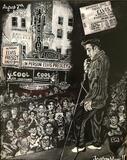
  • <p>This painting depicts Elvis Presley’s very first appearance in St. Petersburg, Florida, which was at The Florida Theatre, on August 7th, 1956.</p>
            
              <p>Although none of Elvis Presley’s 143 stage shows in 1956 were the same,
              his final 83 shows that year had a lot in common.
              Starting with his afternoon show in St. Paul, Minnesota, on May 13,
              and ending with his year-end performance in Shreveport, Louisiana,
              he toured under the banner of “The Elvis Presley Show.”
              The Colonel Parker designed and promoted format included an hour-long variety show, followed by an intermission leading up to Presley’s 25 to 30 minute appearance.
              No other “name” performer appeared on the bill, and Elvis sang a standard playlist
              that usually began with “Heartbreak Hotel” and always ended with “Hound Dog.”</p>
            
              <p>While Elvis performed his standard show over and over in dozens of arenas in 1956, thousands and thousands of fanatic and curious people in each city
              were seeing him live for the first time.
              Those audiences gave a unique character to each of Presley’s 1956 stage shows.
              The unpredictable crowd behavior and each spectator’s personal experience
              made every Elvis stage show a one-of a-kind event.</p>
            
              <p>The following is a profile of one of those crowds.
              Over 6,500 tickets were sold for Presley’s three shows in
              St. Petersburg, Florida, on Tuesday, August 7, 1956.</p>
            
              <p>The following account is a composite of accounts published in the
              St. Petersburg Times about the audiences for the 3:30, 7,
              and 9 p.m. Presley shows that day.</p>
            
              <p>Clare Carter and Donna Bemis were first in line at 4:15 in the morning,
              over 11 hours before the 3:30 p.m. opening show.
              All the $1.25 advance tickets were general admission,
              so the best seats would go to those at the front of the line when the doors
              of the Florida Theatre opened.
              Clare and Donna, armed with soft drinks, newspapers, and an Elvis fan book,
              laid claim to the first spot at the corner of First Avenue South and Fifth Street.</p>
            
              <p>At 4:45 a.m., they were joined in line by Elvis fans Anne Muncy and Nila Shea.
              The two blondes were disappointed to see Clare and Donna ahead of them.
              “We were the first in line to see him in Tampa and Lakeland,” one explained,
              “but this time we missed out.”
              Among others claiming spots near the front of the line were Glenda O’Brien
              and Donna Wyman, who arrived at 5:30, and Nancy Harper,
              Lin Peters, and Joy Cliett, who settled on the pavement at 6:10.
              By 9 o’clock those headed for work in the downtown area noticed
              a sizeable line of people snaking down the sidewalk away from the theatre.
              Made up mostly of teenage girls, the crowd seemed at its peak
              when a downpour hit at 11:50.
              The heavy rain started the line surging toward a small awning along the sidewalk.
              Most got drenched in the half hour shower, but none gave up their places in line.
              Times columnist Archie Dunlap noticed how the estimated crowd of 2,000,
              mostly girls and a few boys, stood its ground before the hard rain.
              “There must be something about Presley to have such a violent effect on teenagers,”
              he thought.</p>
            
              <p>• An orderly queue … until the doors opened
              Uniformed police officers kept watch over the waiting crowd, especially where it lined an alley where Elvis’s car was expected to arrive. The crowd remained orderly through the morning, but as entry time approached, excitement started to build. Chants of “We Want Elvis” began, and police reserves were called in when retraining ropes gave way under the pressure of the compacting crowd. Later in the day, police intercepted 14 teenagers trying to climb a fire escape to reach Presley’s dressing room.
              (One elderly woman back in line appeared ill and was allowed in early so that she could sit down. She chose a front row center seat, from where she could be seen cheering wildly when Elvis appeared.)
              The doors opened early due to the rain, and the crowd stampeded in, shoving and pushing to reach the seats closest to the stage. Police Captain “Robbie” Robinson took the rush in stride. “It was just like any bunch of kids all trying to get into the same place at the same time,” he observed.
              After the 2,500 seats in the theatre were filled, recordings of Presley’s hit records were played over the theatre’s sound system to sooth the excited nerves of his fans. Only occasionally did they clap or yell “We Want Elvis.” Any slight motion or sound from backstage brought shrieks of anticipation from the audience.</p>
            
              <p>• Some adults in the crowd
              A visual sweep of the audience prior to the opening acts revealed an unexpected number of adults scattered among the sea of teenagers. “I brought my 17-year-old niece,” explained Mrs. Frank Dickie. “She didn’t want to come by herself. She’s visiting here from Michigan.” Mrs. George Saunder and Mrs. M.A. Stewart professed to be there strictly out of “curiosity.” A couple of other adults came clean. “I’m getting a kick out of all this, too,” admitted Tex Bobbitt, who came with his son. Mrs. Frank P. Caldwell Jr. confessed, “I’m thrilled to be here simply because he’s famous.”</p>
            
              <p>Another adult set a bad example for the impressionable teenagers there. A mother and her teenage daughter had taken seats in a row close to the stage. Before the show started, the daughter went out to the refreshment stand to get something to eat. While she was gone, a gray-haired woman forced her way into the girl’s seat, even after being told the seat was taken. When the girl returned, the woman wouldn’t budge. An usher summoned by the mother failed in his efforts to get the bandit out of the stolen seat. Then a policeman came and spoke with the woman. When she still refused to leave, the officer moved away, unwilling to create a scene.</p>
            
              <p>• “Kill the Square!”
              Before the live opening acts started, a short, musical film featuring bandleader Louis Prima played on the theatre’s move screen. It drew some jeers of “kill the square” from the audience. The crowd settled down and sat patiently, even applauding politely, for the singers and comic-magician who then paraded across the stage. Last before intermission, the Jordanaires received the most applause among the opening acts.
              While the audience in the theatre endured the long stream of performers, a 20-year-old female reporter for the Times made her way backstage to interview Presley. After admitting her to his dressing room and answering all her questions, Elvis kissed her and showed her to the door. She didn’t realize that an open dressing room window gave her fellow reporters a full view of what happened from the newspaper building across the street. When she got back to the office, the city editor suggested she write a story on her impressions of kissing Presley.” She blushed … then responded, “I’d better not.”</p>
            
              <p>• Hands outstretched in worship
              When the sleeve of a kelly green sport coat through the curtains signaled Elvis’s arrival, the entire audience rose to its feet with the girls screaming en masse. While the girls tore at their hair, the boys looked about in awe. Those who had waited from early morning for the “privilege of leaning across the rail at Elvis’ feet” were engulfed by a wave of others rushing up from behind. “All hands were outstretched as though in worship of a pagan god,” observed 17-year-old Times writer Sally Simmons. She was then knocked in the head by cluster of girls tumbling backwards and yelling, “take it off, Elvis, take it off!”</p>
            
              <p>Microphone problems on stage rendered Elvis silent for a while, but the uproar from the audience continued. Just seeing Elvis was enough for them.
              City police officers, both in uniform and plain clothes, were tasked with controlling the crowd and keeping Elvis from being swarmed over by fans. “I can’t stand it, I can’t stand it,” a 15-year-old girl yelled at Patrolman Jim Krupp. “I can’t stand it either,” he responded. Firemen treated six girls for “heat prostration and fainting spells.” Fire Marshal John Gidley declared, “I hope we never have anything like this again.”
              After about a dozen songs, Elvis made his usual quick exit, but it took some time for the pandemonium inside and outside the theater to subside. Police were kept busy calming down hysterical girls running from the theater. When a teenage girl begged Patrolman Jim Liddle to let her go backstage to get Elvis’s autograph, he gave her the one he had gotten earlier for his sister.
              Late on the evening of August 7, 1956, the Florida Theatre was empty and locked up. The crying and moaning sounds had faded from the surrounding downtown streets of St. Petersburg. A throng of 6,500 had taken home memories of having seen Elvis Presley on stage. Many of them would have a chance to rekindle those memories 20 years later, when a much different Elvis Presley returned to St. Petersburg for another show
              on September 3, 1976. — Alan Hanson | © August 2015</p>
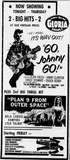
  • <p>Urbana, OH - September 16th, 1959</p>
            
              <p>“GO JOHNNY GO” was on the screen with the legend that is
              “PLAN 9 FROM OUTER SPACE”.
              This was possibly the most played pairing
              with the Ed Wood film.</p>
  • <p>Los Angeles Premiere (March 24th, 1942)</p>
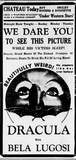
  • <p>A newspaper advertisement for a double feature
              at the Chateau Theatre, starring Béla Lugosi in
              “Dracula” alongside the Western film “Under Western Stars” featuring Roy Rogers.</p>
            
              <p>The classic 1931 Universal horror film that defined
              the cinematic vampire.</p>
            
              <p>This specific advertisement is for the historic
              Chateau Theatre located at 15 1st Street SW
              in downtown Rochester, Minnesota.</p>
  • <p>Original “Creature from the Black Lagoon” lobby card advertising the 3D effects.
              “Creature from the Black Lagoon” opened at the Needham Cinema on Friday, March 5th, 1954.</p>
  • <p>A 1970’s advertisement for
              “Lucky To Be A Woman!” (1956, Documento Films),
              original title; “What A Woman”,
              starring Sophia Loren.</p>
  • <p>Summertime in Provincetown, 1932.<br>This image is facing East on Commercial Street.</p>
            
              <p>photo credit to Peter Lincoln Family</p>
  • <p>“Citizen Kane” Opening, 1941 photo courtesy of Chuck Kuenneth, who was a manager at the Woods in the `70’s.</p>
  • <p>Advertisement for “Dracula” (Universal, 1931)
              at The Pheil Theatre.</p>
  • <p>Amongst the patrons of the fabled Twilight Drive-In Theater
              in La Porte, Indiana, is a roster of monsters of the infamous American International Pictures.
              They include the fiends of such box office delights as
              “It Conquered The World” (1956), “The She-Creature” (1956), <br>
              “I Was A Teenage Werewolf” (1957),  “Invasion Of The Saucer Men” (1957),
              “I Was A Teenage Frankenstein” (1957), “Blood of Dracula” (1957),
              “The Screaming Skull” (1958),  “How To Make A Monster” (1958),
               “War Of The Colossal Beast” (1958), “Earth Vs. The Spider” (1958),
              “Attack Of The Giant Leeches” (1959), and “The Angry Red Planet” (1959).
              This painting was first revealed at the Halloween Art Show at the Tonga Hut
              in North Hollywood, California (October - 2013).
              The alternate title of this piece is
              “Baby-Boomer Breeding-Ground”.</p>
            
              <p>This original painting was part of the
               “Stage and Screen” Art Show at the
              Carter Sexton Gallery in September 2014</p>
            
              <p>“Baby-Boomer Breeding-Ground”<br>was featured at The Aquarium of The Pacific’s<br>‘Night Dive’ event<br> on Friday, November 21, 2014,</p>
            
              <p>From the private collection of Beth Stelter.</p>
  • <p>The Star Theatre was located at<br>286 and 288 Commercial Street<br>in Provincetown, Massachusetts.</p>
            
              <p>It was an early cinema that was opened by 1914.
              It had closed by 1926.</p>
            
              <p>The false front on the two-story building at 286-288 Commercial Street looks nothing like its gable-roofed neighbors.That’s because it was built as a theater — the Star Theater —<br>Provincetown’s first movie house.</p>
            
              <p>The theater was developed by Albert Zerbone (±1872-1959),
              who’d come to New Bedford from the Azores when he was four years old and began his career as an exhibitor in Provincetown by showing movies
              at the Masonic lodge.</p>
            
              <p>Zerbone’s projectionist was his cousin,
              Antone Joseph Viera.
              The theater was leased beginning in 1918, to Frank Knowles Atkins (±1877-1940),
              proprietor of the town’s second movie house,
              the Pilgrim Theater, at 293 Commercial Street.</p>
            
              <p>It is of certainty that John Bunny comedies were screened at the Star Theatre, as his popularity was on the rise in 1914, until his death on April 26, 1915, at aged 51.
              “The Pickwick Papers”, and “Bunny Dips Into Society”, are two popular titles from 1913,
              and it likely that they were screened at the
              Star Theatre, before it’s closure (1919?).</p>
            
              <p>In time, the theater was converted into the Bowlaway,<br>a five-lane bowling alley.</p>
            
              <p>Today, it is where Ronny Hazel’s infamous
              “Shop Therapy” is located.</p>
  • <p>“Mighty Joe Young” (1998) premiered at Hoyt’s Cinema (after Jerry Lewis Cinemas and before Regal Cinemas)
              on Christmas Day, December 25th, 1998.</p>
  • <p>Alongside of the walkway entrance to the Metro Cinema, was the Metro Café. Pictured here in 1980, Jonathan Morrill is bussing tables. Ten years later he would premier Provincetown’s first feature-length monster movie, “Johnny in Monsterland”, at the same location, as the Euro Café.</p>
  • <p>“Jailbait Summer” entirely filmed in Provincetown, and starring many locals, premiered at the location during the Euro Café years (1992).</p>
  • <p>Motion Picture Director, Jonathan Morrill, has had three features have their New York City premiers at Anthology Fil Archives;
              “Johnny in Monsterland”,
              “The Left Side of My Brain”, and
              “The Brides of Johnny in Monsterland”.</p>
  • <p>“The Brides of Johnny in Monsterland” was part of a double-feature Halloween bill, that premiered Johnny in Monsterland (1990) and it’s sequel, to Manhattanites, for the first time, in October of 1992. In attendance were director Jonathan Morrill, and star, David Bishop. Feminist film-maker, Jeanine Corbet, screened several short subjects that she directed, in-between the features.</p>
  • <p>Newington Drive-In Theatre advertisement in<br>‘The Portsmouth Herald’, from July 29th, 1961.</p>
  • <p>Advertisement for E. M. Loews Civic Theatre,
              which was at the same location,
              for the most part,
              where the Portsmouth Music Hall stands today.</p>
            
              <p>This advertisement in the evening edition<br>of ‘The Portsmouth Herald’, dated August 31st, 1956.</p>