
Times Cinema 283 Bourke Street, Melbourne, VIC - 1935
Uploaded By

Featured Theater

Melbourne, AU
More Photos


Photo Info
Uploaded on: October 3, 2026
Size: 356.7 KB
Views: 201
License:

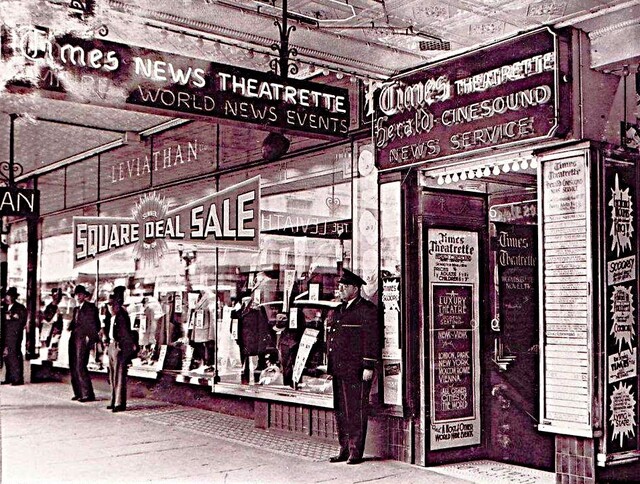
In the “Golden Age” of cinema—spanning from the 1920s through the 1950s—going to the movies was treated as a grand, theatrical experience.
At the center of this spectacle in downtown Melbourne was the Cinema Commissionaire, an imposing, elegantly dressed figure stationed right on the footpath outside major picture palaces.
The year is 1935 & the commissionaire was the public “face” of the cinema, tasked with generating excitement and managing the crowds directly from the street.They wore impeccable, military-style uniforms—complete with gold braiding, polished buttons, peaked caps, and sometimes white gloves. Their appearance was designed to mirror the architectural opulence of Melbourne’s premier entertainment districts, particularly along Bourke Street and Collins Street.
Standing on the bustling city footpaths, they functioned as an outdoor master of ceremonies. They barked out session times, ushered patrons out of the elements and into the grand foyers, marshaled the long queues that wrapped around the block, and kept street traffic moving smoothly. They were a blend of public relations, crowd control, and hospitality.
The commissionaire on the footpath was just the first step in a highly structured, immersive customer service chain that defined early Australian cinema:
The Commissionaire organized the crowd and drew them in from the street. Patrons entered lavish, carpeted lobbies, overseen by the theater manager. Uniformed usherettes took over inside. They used discreet torches (flashlights) to guide patrons down pitch-black aisles to their exact seats, tore ticket stubs, and kept an eye on audience behavior.
By the late 1950s and 1960s, this elaborate front-of-house culture rapidly vanished due to two major shifts: When TV broadcasting launched in Australia in 1956, it triggered a massive, sharp decline in cinema attendance. Cinemas could no longer afford to employ such vast, specialized, uniformed crews.
As older single-screen picture palaces were multiplexed, torn down, or modernized, ticket boxes were moved deep inside the foyers. Footpath kiosks were eventually phased out by city councils to clear pedestrian congestion on modern sidewalks.
Today, organizations like the Cinema and Theatre Historical Society of Australia (CATHS) in Melbourne preserve the oral histories, photographs, and architectural archives of these forgotten street-side showmen.
Contributed by Greg Lynch -
 No one has favorited this photo yet