Search

Theaters News Links

Advanced search
 

Theater Guide

Now listing 26,505 theaters & 1,598 photos… more
Browse by...
 

Add Your Cinema Treasure!

Add Theater
Add Photo (offline)
Add Theater News


Recent Comments

Nov 07 Warner Theatre (52)
Nov 07 Garfield Theater (3)
Nov 07 Olympic Theater (3)
Nov 07 Scott Theatre (28)
Nov 07 Capitol Theatre (633)
Nov 07 Imperial Theatre (62)
Nov 07 Kam Drive-In (5)
Nov 07 Strand Theatre (3)
Nov 07 GCC Citadel Mall… (3)
Nov 07 Columbia Square… (59)


  Discover. Preserve. Protect.
Also known as Boston Music Hall, Empire, Loew's Orpheum, Aquarius

Orpheum Theatre

Boston, MA
1 Hamilton Place
, Boston, MA, United States
(map)
Status: Open
Screens: Single Screen
Style: Adam
Function: Concerts
Seats: 2763
Chain: Unknown
Architect: Thomas W. Lamb
Firm: Unknown
Orpheum Theatre
Exterior view of the Orpheum (circa March 2000)
Photo courtesy of Ian Grundy
The Orpheum is one of the oldest Cinema Treasures in the country.

Opened in 1852, the theater has hosted everything from vaudeville to symphony to movies and is now a rock concert venue.

The original entrance was on Washington Street (just down the street from the old Paramount and RKO Keiths/Opera House), in the heart of Boston's downtown shopping district, but that entrance was turned into a retail store and patrons now must walk down a back alley to get in.

The Orpheum was host to a now-famous U2 concert and has hosted innumerable acts over the years.

It has remained one of the most popular concert venues in all of New England.
Contributed by Ron Newman


YOUR COMMENTS

 
The original address of the Loew's Orpheum Theatre was 413 Washington Street and it seated 2890 people. In the mid 50's it was part of the Loew's Theatre chain.
posted by William on Nov 20, 2003 at 3:41pm
The web site is now at http://boston.cc.com/orpheum.asp , and includes some history and photos.
posted by Ron Newman on Dec 11, 2003 at 8:38am
Originally it had 3 entrances, the one mentioned on Wash. St., the current one from the alley called (I think) Hamilton Place, and one off Winter Street via the alley called 'Music Hall Place'. The theater was first a music hall, then had a mezzanine and balconies added by architect Clarence Blakhall, around WW I; he also had his offices somewhere in the building. (He designed the Colonial, the Tremont Temple, the Wang Ctr, etc). The area at the Music Hall Place entrance is now part of the food court for a conglomeration of retail stores called 'the Corner', which replaced Gilchrist's dept. store in the 80s. A friend told me they used to have ballroom dancing on the lower level of the current food court, so people could make a night of it when they went to the Orpheum. I went to many first run movies there as a teenager in the late 50s and early 60s. One reason we kids liked it was it was easy to sneak in! There were stage and fire exit doors unguarded at the alley off Bromfield St., and they were often left open from one group of kids to another.
posted by Boris on Mar 13, 2004 at 9:22pm
You need to update the address and seating capacity on this theatre.
posted by Chuck1231 on Mar 14, 2004 at 12:36am
...and that address is 1 Hamilton Place and seating capacity is 2800.
posted by Roger Katz on Mar 14, 2004 at 5:30am
The Orpheum was called the Music Hall in the 19th Century and was the home of the Boston Symphony Orchestra until it moved to its new concert hall at the corner of Huntington Avenue and Massachusetts Avenue in Back Bay, namely Symphony Hall.
posted by Gerald A. DeLuca on Mar 30, 2004 at 8:33pm
As a regular cinema, no! Symphony Hall was built as a concert hall. But films have been shown there in the past, especially during the silent era. There is a display case inside showing some of the films from that were shown there...such as a silent versions of CARMEN, some Russian silents like POTEMKIN. Also more recently when the Boston Symphony performed Prokofiev's film-cantata "Alexander Nevsky", Eisenstein's film was projected and the live orchestra was used in place of the recorded soundtrack film score.
posted by Gerald A. DeLuca on Apr 7, 2004 at 5:13am
After a renovation, this house re-opened as a performing venue under the name The Aquarius Theatre in either 1969 or 1970. Sammy davis was the first show under that name.
posted by Brian Kinney on May 8, 2004 at 7:11pm
From "Boston: A Guide Book" by Edwin M. Bacon, published by Ginn & Company, 1922:

Looking up Hamilton Place, opposite Park Street church, we see the side of the old Music Hall, now a theater. This is a building of pleasant memories. It was erected in 1852, projected chiefly by the Harvard Musical Association, then the representative of classical orchestral music in Boston. Nearly thirty years later (1881) the Boston Symphony Orchestral began its career here, under the generous patronage of Henry L. Higginson. Once the hall had in its "great organ" one of the largest and finest instruments in the world, but this was permitted to be sold and removed at a time when the hall was undergoing alterations. For some years, during the later part of his life, Music Hall was Theodore Parker's pulpit; and at a later period that of W.H.H. Murray, after he had been a pastor of Park Street Church.
posted by Ron Newman on Dec 25, 2004 at 10:40am
Does anyone know when the Orpheum stopped showing movies, and when it disaffiliated from the Loew's chain?
posted by Ron Newman on Jan 3, 2005 at 12:39pm
I believe that it stopped showing movies around 1968 - but I think it was a Loew's up until near the very end. All of Loew's Boston area theaters were held by a subsidiary called (appropriately enough) Loew's Boston Theatres, Inc.

The only other Loew house in Boston at that time was the Loew's State, though previously Loew's operated the St. James Theatre around the corner from the State on Huntington (presumably the State was a replacement for the older St. James at the time the State was constructed.) Since the Loew's State was sold by Loew's in (if I recall correctly) 1966, it is possible that the Orpheum was sold at the same time, when Loew's decided to get rid of it's Boston holdings.
posted by Ian M. Judge on Jan 3, 2005 at 1:08pm
I believe that it stopped showing movies around 1968 - but I think it was a Loew's up until near the very end. All of Loew's Boston area theaters were held by a subsidiary called (appropriately enough) Loew's Boston Theatres, Inc.

The only other Loew house in Boston at that time was the Loew's State, though previously Loew's operated the St. James Theatre around the corner from the State on Huntington (presumably the State was a replacement for the older St. James at the time the State was constructed.) Since the Loew's State was sold by Loew's in (if I recall correctly) 1966, it is possible that the Orpheum was sold at the same time, when Loew's decided to get rid of it's Boston holdings.
posted by Ian M. Judge on Jan 3, 2005 at 1:08pm
The headers for this theatre need updating as follows;

Architectural Style : Adam
Chain: Loew's
Architect: Thomas W. Lamb

In 1900 the Orpheum replaced the Music Hall when the auditorium was totally turned around, now with a new stage and proscenium at the north end. For 15 years the Orpheum was a leading vaudeville theatre.

In 1915 Marcus Loew acquired the site. The theatre was gutted - only the north and south exterior walls are original from its days as the Music Hall. It opened on 20th January 1916 with 7 'family' vaudeville acts. A Frazee 3 Manual/25 Rank Opus. 30. theatre pipe organ was installed (which had a reputation of having a notoriously slow action). The auditorium was in an early Adam style design by the architect Thomas Lamb, the proscenium being back-lit which was unusual for a Lamb theatre.

The Orpheum played movies for many years, sorry, I don't know when these stopped, but in the 1970's it was the home for Sarah Caldwell's Opera Co. of Boston before they found a new home at Keith's Memorial Theater.

Its opening seating capacity was 2,927, today as a concert hall it seats 2,763.
posted by KenRoe on Jan 3, 2005 at 1:08pm
If Loew's divested its Boston theatres in the late 1960s, they didn't stay away from the city very long. By the early 1970s they ran the Abbey Cinema near Kenmore Square. Once that closed, Boston didn't see Loew's again until they bought USACinemas (formerly Sack Theatres).
posted by Ron Newman on Jan 3, 2005 at 1:41pm
I believe the Orpheum had one last shot at a movie run in the 80s when a Paul McCartney film bypassed USA Cinemas and played there for a week or two.
posted by BJY on Jan 28, 2005 at 12:58pm
One of the oldest cinema treasures in the country? Opened in 1852!WOW!
posted by Patsy on Feb 4, 2005 at 12:01pm
Strange, such an old theatre but you never hear anyone mention it as historic or even treasured part of Boston.
Perhaps because it is used so much and never seems in danger of being closed or demolished.
posted by BJY on Feb 8, 2005 at 12:05pm
Unless you go to rock shows, or occasionally jazz or country music shows, you don't really think about the Orpheum. It isn't used anymore for movies, opera, ballet, legit theatre, or anything else.
posted by Ron Newman on Feb 8, 2005 at 1:57pm
The side-alley location of the Orpheum's only entrance also puts the place out of sight and out of mind for many people. It used to have an entrance on busy Washington Street, and later it still had at least a marquee there, but now even that is gone.
posted by Ron Newman on Feb 8, 2005 at 2:48pm
re: "It isn't used anymore for movies"
Well, technically that's not entirely so. On November 2, 2002 I saw Godfrey Reggio's "Koyaanisqatsi" here in a special event with composer Philip Glass conducting a live performance of his score for the film. I don't know if the projection equipment was specially installed for that show or if there is still equipment in the booth. From the visual and musical standpoint I thought the whole event was top-notch.
posted by Gerald A. DeLuca on Feb 8, 2005 at 2:55pm
On page 77 of Kevin Lynch's book The Image of the City you will see a photo of Washington and Summer Streets in Boston. The photo is undated, but the book has a 1960 copyright. In the foreground is Gilchrist's department store (now The Corner Mall). Behind it is E.B. Horn Jewelers, and behind that is a five-story-high vertical sign reading "LOEW'S". Below the vertical sign is the Loew's Orpheum marquee, but the photo is too small for me to make out what is advertised there.
posted by Ron Newman on Mar 14, 2005 at 8:05am
According to an unpublished 1968 draft manuscript by Douglas Shand-Tucci entitled The Puritan Muse (available in the Fine Arts room of the Boston Public Library), what was originally the Boston Music Hall briefly changed its name to the Empire in 1904. It changed its name again, to the Orpheum, in 1906. Loew's took it over on January 19 or 20, 1916.
posted by Ron Newman on Mar 19, 2005 at 8:39pm
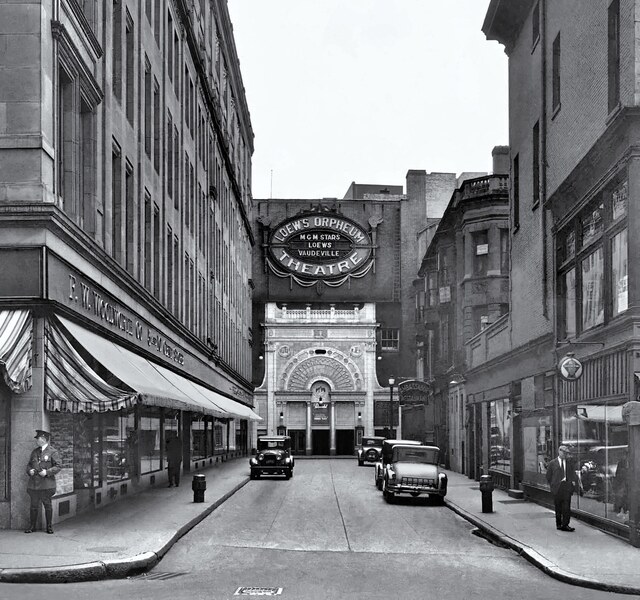
Here's a photo of the Orpheum Theatre entrance on Hamilton Place, from 1926, along with an accompanying description of the photo.
posted by Ron Newman on Mar 20, 2005 at 6:28am
Another Orpheum photo on Hamilton Place, this one from 1934. Description here.
posted by Ron Newman on Mar 30, 2005 at 6:15am
The Boston Music Hall's former organ now resides in the Methuen Memorial Music Hall which was built especially for that purpose.
posted by Ron Newman on Mar 30, 2005 at 11:32am
An 1898 photo of the same scene as the last two photos, described here.
At this time it was still the Boston Music Hall.
posted by Ron Newman on Apr 1, 2005 at 6:39pm
Does anyone know where i can find hisotrical photos of the inside of the orpheum?
posted by Faluna on Apr 13, 2005 at 5:45am
Good point. I remember being inside about 30 years ago, and there was lots of white, very ornate, and a long entry hall with gold handrails, marble steps, and a smaller lobby. Wouldn't color photos of the insides of these old theatres be great?
posted by dwodeyla on Apr 13, 2005 at 6:21am
Here's a 19th century photo, from when it was still the Boston Music Hall. The accompanying description is definitely in error, since it dates the photo to 1979. I've told the Bostonian Society of their mistake, and they are now trying to determine the photo's correct date. They now believe it was taken some time after 1884, after the Music Hall's organ was removed.
posted by Ron Newman on Apr 14, 2005 at 5:31am
Here are some photos of the former side entrance on Music Hall Place, off Winter Street. This entrance is no longer used, and Music Hall Place now leads instead to The Corner Mall's food court.

Music Hall Place, 1890: photo and description

Music Hall Place, 1900: photo and description

Music Hall Place, 1965: photo and description. The description says we are looking at an entrance to Gilchrist's department store, which closed in the 1970s and was replaced by The Corner Mall.
posted by Ron Newman on Apr 14, 2005 at 6:59am
Got my only look inside the Orpheum during First Night activities several years ago. This theater, in addition to its other firsts over the years, has to be the original for stadium style seating.
posted by AlLarkin on May 7, 2005 at 11:13am
Two stereograph photos of the organ in the former Music Hall, some time before 1884:

photo #1 (description)

photo #2 (description)
posted by Ron Newman on May 29, 2005 at 10:14am
From the Boston Public Library's photo collection:

Washington Street showing Loew's Orpheum, 1925
posted by Ron Newman on Jun 23, 2005 at 12:54pm
Music Hall Interior opposite Platform, July 4, 1876
posted by Ron Newman on Jun 23, 2005 at 12:56pm
According to Donald C. King's new book The Theatres of Boston: A Stage and Screen History, the Boston Music Hall opened in November 1852, seating about 2500 patrons. When it opened, it had three entrances: Hamilton Place (off Tremont Street, still used today); Bumstead Place (off Tremont Street); and Central or Winter Place (later Music Hall Place, off Winter Street).

After the Boston Symphony Orchestra departed for a new Symphony Hall in the Fenway, the Music Hall needed a new use. William Morris had it converted into a vaudeville theatre. It reopened on Labor Day 1900, advertising "Continuous Refined Vaudeville - NOT CONTROLLED BY A TRUST". The Bumstead Place entrance was closed.

It was substantially remodeled yet again and reopened as the Empire Theatre on Feburary 12, 1905, with an additional entrance added at 415 Washington Street. On September 3, 1906, it became the Orpheum, still presenting vaudeville. On Sptember 13, 1909, it briefly became the American Music Hall, but in 1910 it was once more the Orpheum. William Morris sold it and his other theatres to Marcus Loew, and it became Loew's Orpheum, featuring "pictures and vaudeville, 10-15-25 cents".

Loew closed the Orpheum in 1915, then gutted and rebuilt it with 3320 seats after acquiring additional land. He reopened it on January 20, 1916 with continuous vaudeville and movies, whose titles were initially not advertised. The Music Hall Place entrance was abandoned; it eventually became part of a department store.

By the early 1930s, the Orpheum had dropped vaudeville and instead played first-run double-feature films. Gone With the Wind played an exclusive long run at the Orpheum in 1939.

Loew's Theatres abandoned the Orpheum on January 18, 1972. It reopened as the Aquarius, but by 1974 was once again the Orpheum. Sarah Caldwell's opera company performed here while searching for a more permanent home. The Orpheum eventually lost its Washington Street entrance.
posted by Ron Newman on Jun 23, 2005 at 5:08pm
The Orpheum is listed in the 1966 annual report of Loew's Theatres, Inc., but not in the 1967 annual report. This leads me to believe that Loew's divested this theatre considerably earlier than the 1972 date given by King.
posted by Ron Newman on Jun 28, 2005 at 3:12am
An Aldo Shoe store is listed in the Boston phone book at 413 Washington Street. The store itself has no street number posted, nor do its neighbors. It is long and narrow, with a canopy-style sign over the sidewalk that looks like it may have once been a marquee. At the back of the store, an EXIT sign leads to a long flight of stairs. Perhaps these go up to the theatre, but I wasn't able to explore.

A separate sign above the store now advertises The Corner Mall (next door), but I'm pretty sure it used to advertise the Orpheum, even long after this entrance had been converted to retail use.
posted by Ron Newman on Jun 28, 2005 at 4:53am
Here is a current photo of the Orpheum Theatre.
http://i4.photobucket.com/albums/y147/Chuck1231/Massachusetts%20Theatres/OrpheumTheatreBostonMa.jpg
posted by Chuck1231 on Jul 30, 2005 at 1:43pm
The photo must be at least a year old, because the 'Fleet Pavilion' advertised on the marquee is now called the Bank of America Pavilion.

(Actually, it was called the FleetBoston Pavilion, before that the BankBoston Pavilion, and before that Harborlights.)
posted by Ron Newman on Jul 30, 2005 at 4:11pm
The photo was taken in 2004.
posted by Chuck1231 on Jul 30, 2005 at 8:43pm
This is a 2002 photo of the Orpheum Theater.
posted by Lost Memory on Sep 20, 2005 at 4:35pm
Tremont Street is higher in elevation than Washington St, so that's why one had to walk up a flight of stairs from the Orpheum's entrance on Washington Street in order to reach the foyer which is at street level on Hamilton Place, off Tremont. I went to the movies at this theatre often, starting circa-1950. It was a busy house and in good condition right into the 1960s. A good view of the south wall can be obtained by going to the Virgin Records store on Winter St. on a sunny afternoon. Go to the front of the 2nd floor, west end.The alley you see is Music Hall Place. The orange-brick wall is the original from the 1852 Music Hall. The entrance to the Corner Mall at the head of the alley is an old entrance to the Music Hall. Lining the right side of the alley were poster boards for the Hall. At the corner, circa 1910, was a vertical sign for the Orpheum. Inside the entrance, in Music Hall days, there was a ticket office, and staircases. One staircase led up to the Hamilton Place lobby. One or more other stair cases led up into the auditorium. These had metal gates across them that were opened prior to the performance. Also down at that level was Bumpstead Hall, a smaller venue and part of the Boston Music Hall. As a performance hall and lecture room, Bumpstead Hall apparently went out of use after 1900. The area eventually became part of Gilchrist's dept. store, and later the Corner Mall. The Music Hall's stage was at the south end of the building. The stage was really a concert platform, like that of Mechanics Hall in Worcester, and did not have a proscenium arch. (Although they had a portable arch there which could be set up by request.) I'm not positive, but I think that the stage door of the Music Hall was the last door on the right as one stood in Hamilton Place looking at the entrance. The Music Hall was somewhat unique in that two major entrances, at Hamilton Place and at Music Hall Place, were both at the stage-end of the building. Most theatres and concert halls have their entrances at the audience-end of the structure !
posted by Ron Salters on Nov 12, 2005 at 8:05am
In the mid-1990s, the 1880-era building at Tremont St and the north side of Hamilton Place was demolished to make way for the new Suffolk Univ. building now on the site. This exposed, for the first time ever, the 1915 west wall of the Orpheum. It remained exposed for 2 or more years, perfectly lit by the afternoon sun. I hope some of the local Orpheum fans got photos!
posted by Ron Salters on Nov 14, 2005 at 9:35am
The reference above to the "Virgin Records" store on Winter Street should refer to the HMV Records store at 24 Winter St., directly across from the Music Hall Place alley.
posted by Ron Salters on Nov 15, 2005 at 7:16am
Unfortunately, the downtown HMV Records has closed. I think it's been gone for at least a year.

The closing of Harvard Square's much larger HMV store has reduced foot traffic around the Brattle Theatre, contributing to its financial difficulties.
posted by Ron Newman on Nov 15, 2005 at 8:37am
Here is a summary of the changes made to the building in 1900 and 1915. The auditorium was similar to that of Symphony Hall- a rectangle with 2 balconies each with long side galleries, with half-circle clerestory windows high above. There was a hip roof and on the west side a 3-story wing. The south end of this wing contained the Hamilton Place entrance. During the summer of 1900 the Hall was converted into a vaudeville theatre. The 2 balconies were removed and replaced by a proscenium stage. The concert platform was replaced by 2 new balconies. The side galleries were converted into loges. The rear of the orchestra floor under the 2 new balconies was stepped or sloped. The ceiling remained the same. The lobbies and lounges were all redecorated. After Marcus Loew took over, he hired Thomas Lamb to completely rebuild the Orpheum. Lamb removed the hip roof and built a new, higher roof with an elevated stage-house. He demolished the old west wing and built a new west wall on the outer edge of the property line. The Orpheum today has an auditorium which is higher and wider than the original. He designed a new entrance at Hamilton Place which is in the same location as the old entrance in the old west wing. After he got through in early-1916, there was not much left of the old interior except maybe for some spaces in the basement ?? If you go down the alleys off Bromfield Street and look at the north wall, you can see the 3 clerestory windows high above (which are bricked-up) and the remaining section of the cornice which ran around the north, west and east walls in 1852. There was once a pedestrian way which ran from Tremont to Washington streets and ran right along the north wall of the Boston Music Hall. That was in the 19th Century, long before Loew's Orpheum.
posted by Ron Salters on Nov 29, 2005 at 7:22am
I have a program for the Orpheum Theatre for the week of Monday January 4, 1909. The theatre then was under the direction of the up and coming William Morris. The program mentions that tickets are sold at both the Washington Street and the Hamilton Place entrances. It's also possible to arrange a weekly subscription for tickets. There is elevator service to each floor of the theatre, and a diagram of exits shows that there are 2 balconies, and there is a "dress circle" at the rear of the orchestra. At the right rear is an exit to Washington St., and at the left rear is an exit to Hamilton Place. The first half of the program consists of 5 assorted acts, preceeded by an overture from the house orchestra. After the intermission, there are 3 more acts, including the headliner, Vesta Victoria, the British music hall star. At the very end is "Morriscope", a series of motion picture comedy shorts. Next week's headliner is Harry Lauder. There is a note that last week at the Orpheum there were 25,672 admissions. There were 2 shows, 6 days a week. Plus a concert on Sunday evenings.
posted by Ron Salters on Dec 14, 2005 at 8:32am

With the inception of the Boston Symphony Orchestra in 1881, the need for more stage space in the Music Hall brought about the removal of the great organ, now in Methuen, in 1883. In 1900, it was Henry Lee Higginson's intent to maintain Boston Music Hall as the name for the new building, since there were plans to demolish the old one to make way for a road. Since this didn't happen, Higginson avoided confusion by naming the new venue Symphony Hall; however, if you look at the ends of the stair handrails in the Mass. Avenue lobby, you'll notice silver plates engraved with the initials "BMH".

The old building served the city well, and acoustics were reportedly excellent. Architect George Snell's efforts were concentrated on the interior, and since the building was surrounded by other structures, the exterior was kept rather plain. The great fire of 1872, sparing
the Hall by one block, brought to attention a stark reality. With 3000 people involved, limited egress could have turned a fire emergency into an unimaginable disaster, especially with gas lighting used until the end of the nineteenth century. Under subsequent and present ownership, stringent city fire codes have certainly made this problem a thing of the past.
egress from the building could
posted by JackOBrien on Dec 29, 2005 at 6:12am
Yes, one reason that Symphony Hall was built was because city planners in the 1890s had decided to put yet another street running from Tremont to Washington by extending Hamilton Place right through the demolished property of the Boston Music Hall. That news sent the trustees of the Boston Symphony off on a search for a new site on which to build a new concert hall. Fortunately, the street extension project was dropped, and we still have the Orpheum today.
posted by Ron Salters on Jan 2, 2006 at 7:49am
I recently re-read parts of a 1978 paper entitled "The Boston Rialto". It was written by Douglass Shand Tucci and was intended as a guidebook for walking tours in Boston's theatre district. The paper was published by the City Conservation League and sold for $2. This paper was the basis for Chapter 9 of the author's book "Built in Boston - City and Suburb" published by the New York Graphic Society in 1978. In the source notes at the end of the paper, the author mentions that he found City of Boston building permit # 2333 issued on 1 June 1915, a permit for "alterations" at the Orpheum Theatre, estimated to cost $100,000. This was the permit for the work supervised by Thomas Lamb. Even in 1916 dollars, $100K was not a lot of money for construction work. He mentions that other remodeling work was performed in 1900 and 1904/5. The work done in the summer of 1900 converted the building from a concert hall into a vaudeville theatre and was well documented by a long and detailed article in one of the Boston newspapers when the house reopened in early September 1900. The work in 1904 was supervised by architect Arthur Vinal and it's unclear to me exactly what was accomplished. Following this work, Vinal designed the new Washington Street entrance and staircase in 1905. That entrance lasted until the Aquarius Theatre days in the 1970s. I wonder if some of the work which I attribute to Thomas Lamb in 1915 may have been accomplished by Arthur Vinal in 1904-5.
posted by Ron Salters on Feb 15, 2006 at 7:36am
The theatre is visible as "BOS MUSIC HALL" on this 1895 map, right in the middle of the block bounded by Tremont, Winter, Washington, and Bromfield streets. Two dead-end streets run into the building: Music Hall Place (from Winter Street) and Hamilton Place (from Tremont Street). The latter is still the theatre's public entrance today.

(Actually, a third alley also runs to the building from Bromfield Street, but this alley has no name on the map.)

On this 1928 map, it is the ORPHEUM THEATRE, owned by Loew's Theatres Company. Loew's is also shown as the owner of a long and narrow adjoining building which fronts on Washington Street; presumably this was the theatre's added entrance on Washington Street.

To get your orientation, note that the 1895 map has north at the top, while the 1928 map has west at the top.

(Warning to dialup users: the map images are huge and will take a long time to load)
posted by Ron Newman on Feb 19, 2006 at 2:20am
correction to the above: the 1895 map has west at the top. The 1928 map has north at the top.
posted by Ron Newman on Feb 19, 2006 at 2:28am
I was researching the Orpheum a couple of weeks ago and found this web site by accident. What a great site. I've just read Donald King's book on Boston Theatres (thanks to this site) but found it a little confusing with all the constant theatre name changes. I was disappointed not to find a map with the book. Have any of you ever tried to map the theaters historically in downtown Boston? I might try, but thought I'd see if anyone had already done it.
posted by Mitchell D on Feb 21, 2006 at 7:01am
To Mitchell D.: There is a fold-out map of downtown Boston and the Back Bay inside the 1978 book "Broadway Down East" by Elliot Norton, published by the Boston Public Library. Theatres are noted on it with numbers, a key to which is in the margin of the map. The accent is on stage theatres. Unfortunately, there are errors on this map !Elliot Norton was a famous Boston newspaper drama critic for many years (he died about 3 years ago at the age of 100). His is the only theatre map of Boston that I know of.
posted by Ron Salters on Feb 21, 2006 at 7:25am
Thank you, I'll try the library first. I'm familiar with Mr Norton. He reviewed for the Herald, I think.
posted by Mitchell D on Feb 21, 2006 at 7:29am
Elliot Norton reviewed for the Record-American/ Herald. And before that, for decades at the old Boston Post. He was considered a "Show Doctor" and his advice was valued by those "trying out" a new show in Boston. He tried to be positive and helpful, instead of nasty and negative like Frank Rich of the NY Times was.
posted by Ron Salters on Feb 21, 2006 at 7:59am
I don't know of any such map of all the Boston theatres. But I'm gradually posting links to the 1895 or 1928 maps for each theatre that appears on either one.
posted by Ron Newman on Feb 22, 2006 at 4:39am
Thank you both very much. I think I have already seen the Norton book. If I remember correctly, the map does refer to plays, not movie theatres. Incidentally, I remember seeing Shirley Bassey at the Orpheum in the late '60s. I was more interested in her than the theatre at the time, but I do remember being impressed with the interior.
posted by Mitchell D on Feb 22, 2006 at 6:10am
Yes, Norton's book is about live-stage theaters. However, many former stage theatres became movie theatres, and vice versa.
posted by Ron Newman on Feb 22, 2006 at 6:37am
Back in the 1980s, the Orpheum interior was somewhat shabby in a quaintly funky sort of way which suited its role as a Rock concert hall. Today the place is a total dump inside - badly in need of some basic rehab work.
posted by Ron Salters on Oct 15, 2006 at 7:25am
As the Boston Music Hall, the Orpheum is listed in the 1897-98 edition of Julius Cahn's Official Theatrical Guide, an annual for roadshow producers and stage managers. The manager was L.H. Mudgett. The seating capacity was 2,397 but that figure is slightly different from the breakdown-- Orchestra: 1257, Balcony: 680, Gallery: 466, total: 2,403. There is a note that a proscenium arch can be erected if needed and that scenary can be used once the portable proscenium is in place. (I wonder how long it took to put it up.)The comment is also made that the auditorium is on the ground floor, which it was on the Hamilton Place side (it was one flight up from the Winter St. entrance, and later, from the Washington St. entrance.) The Guide also says that the Music Hall had electric illumination.
posted by Ron Salters on Nov 26, 2006 at 8:10am
The MGM Theatre Photograph and Report form for the Orpheum in Boston has an exterior photo taken in 1941. It was Loew's Orpheum at that time. The photo shows the Washington St. entrance. Attractions on the compact marquee, in white letters on a dark background, are: Irene Dunne and Cary Grant in "Penny Serenade" plus "The Trial of Mary Dugan". The underside of the marquee is studded with bulbs and just above the doors is an additional board with 2 lines of white letters on a dark background with the titles of the movies posted. The Report states that the theatre has been presenting MGM product for 25 years, that it's in Good condition; and has 1659 orchestra seats; 1048 balcony seats, and 220 seats in the loges; total: 2,927 seats.
posted by Ron Salters on Dec 9, 2006 at 7:37am
Here is another photo of the Orpheum taken in 2006.

posted by Lost Memory on Aug 23, 2007 at 11:59am
Just in time for Halloween, Smashing Pumpkins at the Orpheum Theater.

posted by Lost Memory on Oct 16, 2007 at 7:06pm
Does anyone have any information on the artwork on the ceiling of the Orpheum Theatre in Boston?
posted by ALC on Nov 9, 2007 at 5:36am
This is another recent photo of the Orpheum.

posted by Lost Memory on Mar 25, 2008 at 6:29pm
The photo posted above by Lost Memory on March 25 shows the Hamilton Place entrance. Note the new doors and the generally well-maintained look of the facade. Unfortunate that the interior is such a dump. The building on the left with the big cornice "looks old" but was actually constructed by Suffolk University in recent years.
posted by Ron Salters on Apr 6, 2008 at 11:00am
Specifically, the building on the left is the Suffolk Law School.
posted by Ron Newman on Apr 6, 2008 at 11:01am
Here is an April 2008 night view.

posted by Lost Memory on Apr 30, 2008 at 8:49am
The operator of the Orpheum, Live Nation, will reportedly soon start booking music acts into the reopened Wilbur Theatre several blocks to the south (next to the Wang Theatre). The Wilbur, a small legit house nearly 100 years old, will be the new home of the recently closed Comedy club in the Fanieul Hall marketplace downtown.
posted by Ron Salters on Jun 5, 2008 at 11:19am
That is good news for the Theatre District. The Wilbur went dark because LiveNation (Broadway in Boston) pulled out of it a year or two ago.

Do you know if either the Wilbur or the Shubert ever showed movies? They are not listed at CinemaTreasures because nobody has yet found evidence that they did.
posted by Ron Newman on Jun 5, 2008 at 11:37am
Ron- I have all the info necessary to create pages here in CT for the Wilbur and the Shubert in Boston but there is no history that I can find that they ever presented movies. Unlike the Orpheum which was a first-run cinema for decades before becoming a live theater today. Too bad that CT does not have some sort of a link to a sub-program called Stage Treasures or Live Treasures where theaters like the Wilbur and Shubert could be listed.
posted by Ron Salters on Jun 6, 2008 at 10:15am
The attraction at the Loew's Orpheum during Christmas week of 1921 was the movie "The Little Minister" plus News and Comedy Shorts; while there was a vaudeville program on stage. Their ad reads "Continuous 915AM - 1030PM."
posted by Ron Salters on Jun 16, 2008 at 11:10am
What a neat little Theatre the Orpheum is! I saw Gordon Lightfoot in concert there back in the mid-1980's, and he was excellent.
posted by MPol on Sep 30, 2008 at 7:55pm
I wouldn't call the Orpheum "little".
posted by Ron Newman on Sep 30, 2008 at 8:10pm
I recently talked with a gal from Jamaica Plain who told me that she had attended a performance at the Orpheum of a folkloric dance troupe from Brazil and that she was shocked at the condition of the Orpheum's interior. "I had a mind to report the place to the Board of Health", she said, adding "I would rather go to the bathroom in the street outside than to use the ladies washrooms in the Orpheum." We both wondered what well-known entertainers such as Robin Williams and Jackie Mason must think when they first see the trashy dump which they have been booked into.
posted by Ron Salters on Dec 1, 2008 at 10:48am
I'm directing a show that'll go up in the Orpheum on New Year's Eve as a part of First Night, and you can bet I'm definitely interested in taking a look all around the place while we're there for our load-in and tech runs. Hearing that it's in sad shape kind of makes me sad, but I'm real curious about backstage more'n anything. Will bring pix.
posted by Rob Noyes on Dec 8, 2008 at 12:07pm
R. Noyes - while you're there backstage at the Orpheum, go out to the alleys in back. Stand back and look at the rear stage wall - it's the original wall from the 1852 Boston Music Hall. Note the old cornice high up, and also the 3 bricked-up semi-circle windows. All original. Go around to the pedestrian alley off Winter St. and you can see the south wall composed of dull-orange brick. It's also orignal from 1852. So both the north (stage) and south walls are 1852 originals on the exterior. The wings at stage-right and the tall loading door there date from the 1916 reconstruction. You should keep in mind that in the Boston Music Hall the concert platform was at the south end of the building; the stage was constructed in the north end of the building in 1900 when the place was converted into a vaudeville theater.
posted by Ron Salters on Dec 9, 2008 at 10:55am
I visited the Orpheum on the 19th before the big snowstorm, and had a good afternoon's worth of climbing around the place and talking with the operations manager. The house is absolutely beautiful. Original marble furnishings, gorgeous backlit stained glass proscenium, original murals, and woodwork everywhere. The ceiling is amazing, the curves a treat to view, the acoustics pretty damn impressive (I was hearing regular spoken conversations onstage from the front mezz) and the columns that help separate the box seats are very dramatic. I was most intrigued by the inset wood panels on either side of the proscenium, where the vaudeville act placards used to be displayed. The cut-out ceiling in the back of the orchestra is also unique, providing a balcony for those accessing the mezzanine. It was also absolutely fascinating to stand on stage and imagine the whole auditorium facing the other way in its original configuration.

That's the good news. The bad news is that the place is falling apart. A lot of this neglect is due to the fact that the Orpheum is now primarly a rock venue, and the audience at rock shows don't quite treat the place nicely. The (original!!) seats are a wreck, held together with duct tape and jostled off their mounts and broken in so many places, giving the front orchestra rows the appearance of a very BAD set of teeth. The lobby is trashed, given over to the sale of alcoholic beverages, and the ladies' lounge is now primarily used to hold kegs and other concessions supplies. At first glance it appears as if this theater hasn't been used in years.

Of course, the rock crowds aren't responsible for the peeling paint on the ceiling, the deterioration of the murals on the mezz/balcony walls, the crumbling plaster, or the fact that a lot of the original trim has been painted so many times over that the details are almost obscured in the layers of paint (now an odd shade of blue.)

I didn't get to make it out to the alley to look at the original Music Hall walls, but I did poke around the three levels of dressing rooms backstage. Any remnants of history (names on walls, etc) have been covered over by wood panel renovations, but boy that toilet on the second floor looked original. The place is also drafty as all hell, and you can hear the birds perched outside the fire exits as plain as if they were inside. I wonder how many times those rooms have been trashed by petulant rock stars. I also wondered which rooms the Marx Bros. et al had.

I'm not sure what keeps this building from getting the same treatment the Opera House (formerly BF Keith's) got, seeing as how both are owned and operated by LiveNation. One of my theories is that the Orpheum is the rock music venue and not a primarily theatrical one. Why put all that money into giving the place its glory back if you'll still have to deal with drunken crowds who have to be repeatedly told not to smoke or crowd the back aisle or do anything destructive? (The warning signs are all over the place.)

The OM would love to have the place restored. She said it was her dream from the moment she stepped up into the auditorium and looked it over for the first time. She knows it can be done with the money and the inclination, and indeed the place is not Beyond Hope. But the touring theater and movie scene in Boston is low, and two nearly 3000-seat houses so close to each other must fulfill different needs and not step on each other's toes too much if they're going to both remain financially solvent. I'm glad the Orpheum still has a purpose and has not yet gone dark (even though if you walk into the place these days, you may not be convinced that's the case.)

Still, my god. I'd love to see that gorgeous proscenium restored to its full glory. I'm putting my pictures up on Flickr now and will post a link to the full photo set, but I will mention that I'm using a new cameraphone for my pictures and so far its capabilities stink on ice. Still, cruddy pics are better than no pics.
posted by Rob Noyes on Dec 22, 2008 at 8:21am
R. Noyes- glad that you had such a productive visit. If you think that the Orpheum still looks beautiful today, you should have seen it when it was a Loew house, up until the mid-1960s. It was kept in very good condition inside, and even had carpeting. There was, of course, a seperate entrance downstairs on Washington Street. One difference between the Opera House and the Orpheum- Live Nation owns and operates the Opera House, but they only manage the Orpheum; as far as I know it is owned by a large realty company.
posted by Ron Salters on Dec 22, 2008 at 11:45am
Ron, you're right about the ownership issue. D'oh. I misspoke there. I remember the OM giving the name of the real estate maven who owns the Orpheum building outright, but I can't remember the name. I'll ask when I go back.

Here's my set of Orpheum pictures from Friday. Again, I apologize for the crummy cameraphone pictures, but I'm still learning how to use this new camera which doesn't appear to have an auto-iris like the last one did.
posted by Rob Noyes on Dec 23, 2008 at 7:01am
Nice photos, cameraphone or not. If you have the chance, see what remains of the old projection booth up behind the lighting booth.

The old lobby entrance on Washington Street is now an Aldo shoe store; I knew someone who worked there and he said in the back/storage room the marble stairs to the Orpheum are still there.

The Orpheum seems to be stuck in a place where it is not cost-efficient for the landlord to spend the money to renovate, and the tenant does not feel the need to push for anything like that. It is a mediocre middle ground, but it beats being knocked down for condos (like the Pilgrim) or knocked down for a vacant lot (like the Publix/Gaiety.)
posted by Ian M. Judge on Dec 23, 2008 at 7:33am
Ian- regarding the shoe store on Washington Street in the former Orpheum lobby entrance. Many times in the 1980s and 1990s, when walking past it on cloudy days with no sunlight outside,if the rear door was open I could clearly see the original marble stairs leading up to the Orpheum foyer; they used those steps to hold rows of shoe boxes. R. Noyes- you need not apoligize for the quality of your recent photos- they are very nice and, if anything, make the Orpheum look good ! A few corrections to your text. The Orpheum never had more than 3000 seats even when it was new. Thomas Lamb was in charge of the 1915-16 reconstruction, and by that time the stage had already been moved to the north end of the building - that happened during the construction work in the summer of 1900. He designed the entire interior as it appears today, as well as an entire new west wall, the side of the building nearest to Tremont St. (The Orpheum auditorium is wider than the Music Hall auditorium). As for ownership, I think that it is owned by the Druker Company, but I'm not sure of that.
posted by Ron Salters on Dec 23, 2008 at 11:07am
Thank you very much for helping clear up for me when Lamb went in and did his stuff, Ron. I've updated my introductory text on that gallery with the information.

And I'm glad to know the Orpheum can still look good in the right light (and resolution). :)
posted by Rob Noyes on Dec 26, 2008 at 6:40am
When you were touring the Orpheum, did you happen to notice whether the theatre still has a working projection booth?
posted by Ron Newman on Dec 26, 2008 at 6:47am
I have some intimate knowledge of the Orpheum. My dad was the head of house maintenance for most of the 90s (head being relative as he had 1-2 guys below him, and sometimes that guy was me). It took a lot just to keep it running. It was cool to be able to see almost every aspect of the building, though I never went into the service area in the ceiling. Didn't like the possibility of a long drop should there be a structural deficiency.

To answer a few questions: the building is owned by the Druker Company while the theatre is operated by LN. As far as the projection booth is concerned, last time I was there (a long time ago) the equipment was not in working condition. Whether that has changed I don't know.

R. Noyes - My dad would be burning up at hearing about the condition of the seats. That was his biggest pet peeve while he was there. He actually ordered seats from a former theatre in Vermont just so he had the parts to fix them, even though they would fall apart anyway. He once had to fix a seat in the front row while Bob Dylan was performing, and managed to draw Mr. Zimmerman's scorn because he now had to sing over power tools! But those seats would be fixed!

I wonder if the 5th floor of the backstage is still the way I last saw it. Last time I was up there, it was all beer bottles and organ pipes. So many stories, so little space.
posted by Tom McLaughlin on Jan 18, 2009 at 7:40pm
Oh yeah, the fifth floor is still unfinished and contains a bunch of old junk-like stuff. I don't remember seeing any organ pipes, tho, cause I would've taken pictures like a madman.

There were some telltale cigarette butts and empty packs around an open window, though. Hooray for the rules applying only to -some- people!
posted by Rob Noyes on Jan 21, 2009 at 1:10pm
The Boston Herald today has an article on the new Boston House of Blues which is set to open very soon. It's located on Lansdowne Street near Fenway Park in uptown Boston. Central to this club is its music hall which has a capacity of 2,400 and includes a balcony with "stadium seating". (Well, don't most theater balconies have stadium seating by default?) Live Nation owns it and already has 57 attractions booked into it within the next few months. They have only 6 attractions booked into the Orpheum. The article is headed "New House of Blues fills Hub club void" and is written by Jeb Gottlieb. He suggests in it that the days of the Orpheum Theatre downtown may be numbered.
posted by Ron Salters on Feb 13, 2009 at 11:04am
> Well, don't most theater balconies have stadium seating by default?

No. For instance, I don't think either the Somerville's or the Brattle's balconies would be considered 'stadium seating'.

Also, I believe there will be no seats on the main floor of House of Blues, only standing/dancing area.
posted by Ron Newman on Feb 13, 2009 at 11:12am
The 2,400 capacity for the new House of Blues music hall is the limit of number of patrons who can be admitted. The only fixed seating will be in the balcony. The capacity is almost as high as the Orpheum.
posted by Ron Salters on Feb 13, 2009 at 11:31am
You can't blame Live Nation for pulling out of the Orpheum. Last time I was there (about 2 years ago) it was the most decrepit venue I had ever been in. When the organ player blasted away at his Hammond B-3, a chunk of plaster fell out of the ceiling onto the stage. You can see where it must have been breattakingly beautiful in it's day but that day is long past. It has always seemed to be a busy venue but no money was ever reinvested and even basic cleaining wasn't done. Amazing what greedy people will do to a treasure such as the Orpheum.
posted by AlbanyGregg on Mar 11, 2009 at 2:04pm
Who says Live Nation has pulled out of the Orpheum? They have a Hall & Oates concert scheduled there tonight.
posted by Ron Newman on Mar 11, 2009 at 2:07pm
I was at the Orpheum theater website earlier and it said no shows were scheduled for this venue. Perhaps I had an incorrect web site. If so, sorry!
posted by AlbanyGregg on Mar 11, 2009 at 2:52pm
http://www.livenation.com/venue/orpheum-theatre-boston-ma-tickets/ lists scheduled concerts. The venue review at the bottom of the page is fun.
posted by Ron Newman on Mar 11, 2009 at 8:10pm
Did I mention that I saw Gordon Lightfoot at the Orpheum in concert roughly 23 years ago? He was excellent.
posted by MPol on Mar 11, 2009 at 8:43pm
I am very interested in Boston's theatre history and have gained great knowledge and insight from what people share on this site- so thanks! Wanted to say that I've been to the Orpheum twice, once around 2001-2002 for a Pet Shop Boys concert and then again last night for a Hall & Oates concert. Last night I was seated in Row O of the scary Orpheum balcony and got to view up close the once-magnificent architectural details of the place, the procenium and some (what I guess) were huge beautiful murals flanking either side of the building. Sadly, the murals are barely visible under a layer of dirt and grime and the layers of dark paint are peeling in huge chunks from the ceiling and walls. While I am so happy that this gem is still open, the place is quite dirty and disgusting. I've heard many stories about the Orpheum balcony being quite unsafe, friends even telling me they've felt it move under their feet, which wouldn't surprise me.
posted by SgtPickles on Mar 12, 2009 at 9:52am
Ron, Thanks for the website info. I looked at the website listed at the top of this page, which needs to be updated. The venue review was right on the money!!

SgtPickles, Most balconies have some movement in them. It's the same principle as the sway in tall buildings. I went to a concert at the Proctor's Theater in Schenectady NY where the balcony swayed so hard that the crowd sat down!
posted by AlbanyGregg on Mar 13, 2009 at 6:12pm
According to WBZ-TV Boston local news today, Live Nation has given up management of the Orpheum ; an unnamed entity will manage the theater and Live Nation will continue to book attractions there.
posted by Ron Salters on May 5, 2009 at 4:07pm
The Boston Globe and Boston Herald websites both report that Live Nation has sold the Orpheum, the Opera House, and the Paradise Rock Club (in Allston) to the newly organized Boston Opera House Ventures LLC , owned by Don Law and David Mugar. Law is president of Live Nation New England, but his new company will operate separately from Live Nation, according to the Herald.

I hope Don Law and David Mugar invest some money into fixing up the Orpheum. Its current condition should make them embarrassed to own it.
posted by Ron Newman on May 5, 2009 at 8:20pm
According to today's Boston Herald story about the transaction, the Orpheum is to close this summer for renovation work performed by its owner, the Drucker reality company. Concert promoter Don Law and his partner David Mugar purchased the operating contract for the Orpheum from Live Nation. Renovation work and just plain basic maintenance are long, long, long overdue at the Orpheum, for sure !
posted by Ron Salters on May 6, 2009 at 10:49am
Whereas today's Boston Globe article says:

"For consumers, the latest ownership change is unlikely to have a significant impact on the programming or ambiance of the three venues. Law said he does not anticipate making significant renovations to any of the facilities."

Who to believe here?

posted by Ron Newman on May 6, 2009 at 10:52am
The Boston Herald story today, by Donna Goodison, says "Law said the Orpheum will undergo renovations this summer by owner Ronald Druker. 'The discussion is ongoing, but my sense is that they will be significant' Law said." Let's hope they do something to fix up the sleazy dump.
posted by Ron Salters on May 6, 2009 at 11:35am
The Boston Herald today says that Druker will spend about $1M this summer for repairs at the Orpheum which will include the washrooms, carpets, painting, and some of the seats. "Next Fall, I think the Orpheum will look much better" Don Law was quoted as saying in the article written by Donna Goodison. The deal for Don Law's organization to take over Live Nation's management contract for the theater should close sometime in the July-Sept quarter.
posted by Ron Salters on May 7, 2009 at 10:39am
The year given for this photo is 1968.

posted by Lost Memory on May 14, 2009 at 6:51am
The marquee in that photo advertises what appears to be a triple-bill concert on October 24, which was a Thursday in 1968:

KAREN WYMAN
HOLIDAYS
MICKEY FREEMAN

but I don't know anything about these performers. Do any of you?

While the big vertical sign says ORPHEUM, a small sign to the left of and below the marquee says 'aquarius'.

To the right of the theatre entrance is a store called "I.J. Fox". To the left is Gilchrist's Department Store.
posted by Ron Newman on May 14, 2009 at 7:03am
I don't know anything about Karen Wyman either. Here she is on YouTube.

posted by Lost Memory on May 14, 2009 at 7:14am
The 1968 photo shows the Washington Street entrance. The theater was called the Aquarius then. I.J Fox to the right was a furrier which had been in that location for many years. (What a Politically-INcorrect business that is today!) Gilchrist's dept. store occupied the corner location; its rear was in the bottom level of the old Boston Music Hall. Today, Gilchrist's is The Corner mall.
posted by Ron Salters on May 14, 2009 at 11:21am
The Boston Herald entertainment section today has a list of some upcoming music concerts in the Boston area for Sept and Oct., and there are 2 listed for the Orpheum for late-Sept. Someone told me that he heard that not a lick of work was done in the Orpheum this summer - no repairs and no refurbishment. I hope that's not true.
posted by Ron Salters on Sep 4, 2009 at 11:10am
Comment
*

Notify me when someone replies to my comment?
Note: Please read our comment policy before posting. Comments which are off-topic, obscene, spam, or personal attacks will be removed. Help us keep the discussion productive!