Search

Theaters News Links

Advanced search
 

Theater Guide

Now listing 26,505 theaters & 1,598 photos… more
Browse by...
 

Add Your Cinema Treasure!

Add Theater
Add Photo (offline)
Add Theater News


Recent Comments

Nov 07 Capitol Theatre (632)
Nov 07 Imperial Theatre (62)
Nov 07 Kam Drive-In (5)
Nov 07 Strand Theatre (3)
Nov 07 GCC Citadel Mall… (3)
Nov 07 Columbia Square… (59)
Nov 07 Lake Theatre (45)
Nov 07 Warner Theatre (51)
Nov 07 F.M. Kirby Center (12)
Nov 07 Gordon Theatre (12)


  Discover. Preserve. Protect.
Also known as Hillstreet Theatre

RKO Hillstreet Theatre

Los Angeles, CA
801 S. Hill Street
, Los Angeles, CA 90014 United States
(map)
Status: Closed/Demolished
Screens: Single Screen
Style: Unknown
Function: Unknown
Seats: 2890
Chain: Unknown
Architect: G. Albert Lansburgh
Firm: Unknown
RKO Hillstreet Theatre
Circa-1951 exterior view of the RKO Hillstreet
Photo courtesy of William Gabel
The RKO Hillstreet was the sister theater of San Francisco's Golden Gate Theatre.

Today what once was the site of the RKO Hillstreet Theatre sits a bank branch and a parking lot.
Contributed by William Gabel


YOUR COMMENTS

 
The architect for the RKO Hillstreet and San Francisco's Golden Gate Theater was G. Albert Lansburgh.
posted by BHousos on Mar 24, 2002 at 2:00pm
The RKO Hillstreet gave up the ghost in 1963. One of the last films to show there was Marlon Brando in "The Ugly American".
posted by David Thompson on Jul 27, 2002 at 3:02pm
The RKO Hillstreet Theatre was located at 801 S. Hill Street. It seated 2890 people, it had a large balcony. And on the main floor it had 5 aisles. The Hillstreet Theatre opened with a Moller 3/13 (opus#3128)and then on 10/18/1928 then installed a Wurlitzer (opus#1972)style 240 organ.
Today what once was the site of the RKO Hillstreet Theatre sits a bank branch and a parking lot.
posted by William on Oct 20, 2003 at 5:35pm
To see a 1945 photo of the RKO Hillstreet marquee click here:
http://jpg1.lapl.org/pics05/00002109.jpg
To see an interior view of the Hillstreet Theater at the time of its 1922 opening click here:
http://jpg2.lapl.org/theater2/00015344.jpg
To see another 1922 view of the Hillstreet Theater auditorium click here:
http://jpg2.lapl.org/theater2/00015339.jpg
posted by David Thompson on Nov 22, 2003 at 8:55pm
Wow a beautiful theatre it once was.
posted by SNWEB.ORG on Nov 23, 2003 at 6:07pm
In 1947 the RKO Hillstreet Theatre went through a remodeling. The primary aims in remodeling the front and lobby of the RKO Hillstreet Theatre in Los Angeles were two: 1)to eliminate the gothic architecture in the lobby and 2) to open the lobby to the street, so as actually to bring the theatre entrance into the street.
The first part was accomplished by designing a dome containing a spiral indirect-lighting cove starting from the center of the dome to the outer rim and continuing at the center down a structural column. The design looks very simple but required extensive study to make it work. The second part was accomplished by demolishing the two side box offices and stripping the column at the entrance down to a minimum, with the result that there is now 60 feet with clear opening from street to lobby againist 45 feet before modernization. The box office is anchored to the center column and its location is ideal from the standpoint of design and efficient operation.
The wall surfaces are polished terrazzo with display frames and mirrorsso arranged to get maximum efficiency for displays in keeping with good taste. The ceiling is kept at the same level as the marquee to carry out the idea of bringing the lobby into the street. The lighting of the lobby is accomplished with floodlights reccessed into the ceiling showing just sufficient source of light to show an interesting pattern of this lighting.
The floor is non-slip terrazzo designed in a pattern indicating traffic lanes from sidewalk to entrance doors. Entrance pilasters are streamlined, each containing two standard display frames in simple but effective stainless steel frames. All display frames are illuminated indirectly. Large wall frames are exceptionally deep to permit three dimensional displays. All trim was dispensed with leaving terrazzo returns into the display. This arrangement focuses attention to the display proper. On the opposite side of the large wall frame (20 feet long by 6 feet high) is a wall mirror showing the reflection of the large frame. The large frames are equipped with sectional sliding plate-glass doors.
Entrance doors are simulating a glass screen giving maximum vision to the inner lobby. The doors are heavy polished plate glass set in narrow nonferrous frames. This type of door screen is known as the Wanhein screen.
The inner lobby was recently streamlined and contains some interesting features. The new ceiling contains a seriesof coves and domes, cleverly designed to meet all requirements and unusual conditions. One side wall contains a candy stand reminiscent of a candy box with bold modern baroque outlines, Plexglas and catchy display of merchandise. The popcorn machine is built in inconspicuously as part of the design. The opposite wall is all mirrors reflecting the candy stand. Built into the mirror wall are are all glass jewel cases for three dimensional displays. The dated wrought iron railing was replaced with a cast aluminum rail of modern design. The finished work was the result of the combined efforts of the Operating and Construction Departments of RKO Theatres and the Heinbergen Decorating Company of Los Angeles.

The RKO Golden Gate Theatre did not get as large of a remodel as did the Hillstreet Theatre. If you go to the Golden Gate Theatre, you can see how the Hillstreet Theatre once looked like before the remodel in 1947.
posted by William on Dec 17, 2003 at 2:00pm
This theatre survived a little past 1963, as it was still in operation in the fall of 1964. I believe Josephine Baker played there at some special prsentation shortly before its demise. I believe "Love Has Many Faces" with Lana Turner played there before it was destroyed and replaced by the ugly parking garage.
posted by barton on Jul 26, 2004 at 6:23am
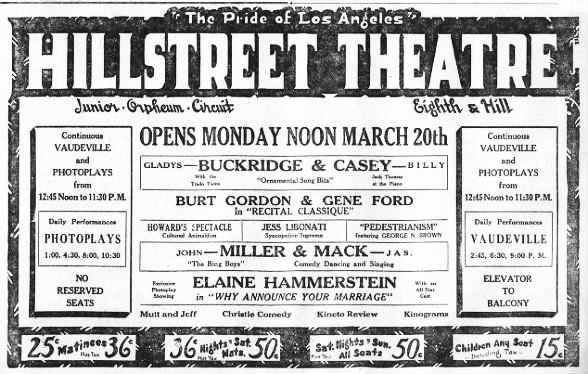
The Hill Street Theatre opened on March 20th, 1922. It was built by the Orpheum Circuit as one of their "Junior Circuit" houses, which featured continuous Vaudeville shows of five acts, with only one headliner, alternating with movies, all day long. (The regular Orpheum Circuit theatres were two-show a day houses, strictly for Vaudeville, with more acts, more headliners, more elaborate staging and costumes and, of course, higher ticket prices.)

It was re-opened as the RKO Theatre on September 11th, 1929, but popular usage of the earlier name led the RKO circuit to begin advertising it as the RKO Hillstreet Theatre.

In its later years, it was operated simply as the Hillstreet Theatre by Metropolitan Theatres, which occasionally used the big stage for live music shows, but mostly ran movies. As downtown movie going declined in the late 1950s, the Hillstreet suffered more, and earlier, than did the somewhat smaller theatres on busier Broadway. I attended movies there several times from 1961-1963, and even on Friday and Saturday evenings, the sparse audiences, sometimes no more than a few dozen patrons, were lost in the cavernous auditorium. The closing of the Hillstreet was announced in a Los Angeles Times article of April 29th, 1963. It was demolished not long after.

The Hillstreet was not the most beautiful of downtown theatres, but I miss it as much as any of them, as it is the first theatre other than my neighborhood house of which I have any clear memory, dating from the late 1940s- early 1950s, when we went to an occasional matinee there. I can still see the shiny aluminum railings of the stairway to the balcony (where we never sat, which made it all the more desirable), and the five big oval reveals in the orchestra floor ceiling under the balcony, each lined with lights concealed in its coved edges and under a pendant fixture in the center of each reveal, so that each was a big, oval doughnut-shape of soft light. At the age of five, I thought it was about the most beautiful thing I'd ever seen. I'm glad that I had the chance to refresh my memory by seeing it again, a dozen years later, before this theatre was taken away forever.
posted by Joe Vogel on Dec 28, 2004 at 5:11am
It appears that the bank branch that fronts the parking garage is vacant.
posted by Manwithnoname on Jan 27, 2005 at 5:34am
The Hillstreet Theatre in Los Angeles was erected bt the Orpheum Circuit and planed along the same lines as the State-Lake Theatre in Chicago. It opened March 20th, 1922. At the time no expence was spared to make the Hillstreet the most beautiful and up-to-date theatre on the Pacific Coast, as well as one of the largest.
posted by William on Apr 20, 2005 at 8:54am
CALLING ALL THEATRE / MOVIE ENTHUSIASTS!!!

T'he Los Angeles Theatre' on South Broadway, LA is playing host to the UK television show 'Dead Famous LIVE'. We are currently looking for people who would like to come along as part of the studio audience.

'Dead Famous LIVE' is a studio entertainment show all about Hollywood History and the paranormal. We will be welcoming celebrity guests on to the show and investigating famous locations around Hollywood which are rumoured to be haunted including the Los Angeles Theatre itself.

This is an invaluable chance to get access to the Los Angeles Theatre, the place where Charlie Chaplin's 'City Lights' premiered in 1931 and to have a thoroughly great day out! (And its free!!)

We're transmitting 'Live' back to the United Kingdom so expect it to be exciting and fun!

We will be filming on three days from 11th - 13th November between 11.30am - 4pm. If you are interested in coming on one or all of these days then email me for tickets!

george.hughes@twofour.co.uk

I look forward to your responses!
posted by UKuser on Nov 2, 2005 at 12:47am
Two more interior photos from 1928, via the LA Library:

http://jpg2.lapl.org/theater2/00015342.jpg

http://jpg2.lapl.org/theater2/00015341.jpg

posted by ken mc on Dec 3, 2005 at 4:16pm
The LA Library dates this photo as May 5, 1947, but the shot is clearly from the late 20's or early 30's:

http://jpg1.lapl.org/pics34/00036956.jpg
posted by ken mc on Dec 26, 2005 at 9:38am
Here is a 1939 photo from the USC archive:
http://tinyurl.com/kvexo
posted by ken mc on Jul 13, 2006 at 3:13pm
ken mc: This is the first time I've seen the 1928 pictures to which you linked on December 3rd. The auditorium looks pretty much the same as it did in the theatre's last years, except I recall the decoration being less noticeable due to it having been repainted mostly in a single shade of off-white (or maybe it was white after the 1947 renovation and it had just accumulated a coat of grime by the early 1960's.)

The interesting photo to me is the one of the mezzanine area that gave access to the balcony. It was the longest such room in any downtown L.A. theatre, and the only one I recall that followed the curve of the auditorium back wall, and the total effect was very impressive. The renovation in the 1940's had stripped the ceiling of its elaborate decoration and I believe the wainscoting was removed as well, and the whole space seemed even longer in the streamlined style it then received.

My memory of the details is dim after 40+ years, but I think the lighting had been changed too. I don't remember those ornate chandeliers being there, and I think there had been some modern indirect cove lighting installed. I hope someday to come across a picture of this room as it looked after the 1940's renovation.
posted by Joe Vogel on Jul 13, 2006 at 5:12pm
Here is a 1930 photo. Try to focus on the theater and not on the unfortunate individual plunging to the street below:
http://tinyurl.com/glrha
posted by ken mc on Sep 1, 2006 at 3:56pm
Signs of the times: The woman is picketing a football movie in front of the RKO during the blacklist era:
http://tinyurl.com/q4bsm
posted by ken mc on Sep 1, 2006 at 4:42pm
The one and only Steven McQueen in:

http://i6.photobucket.com/albums/y231/billhuelbig/lablob.jpg

posted by Bill Huelbig on Sep 10, 2006 at 3:47pm
Here is a 1931 photo:
http://tinyurl.com/pyw7u
posted by ken mc on Oct 4, 2006 at 10:00am
Does anyone know what theater is halfway down the block with the black marquee sticking out in the photo that ken mc posted on Oct. 4, 2006?
posted by vokoban on May 18, 2007 at 9:19am
The theatre on the west side of Hill Street between 7th and 8th was the Alhambra.
posted by Joe Vogel on May 18, 2007 at 2:10pm
Here is an undated photo from the LAPL. I believe this is the RKO:
http://jpg3.lapl.org/pics37/00068244.jpg
posted by ken mc on May 18, 2007 at 2:23pm
This is from the LA Times dated 3/14/65. Who says irony is dead?

Self-Park Structure to Replace RKO Hillstreet

Another step in the revitalization of the downtown Los Angeles area will get under way April 1 with the demolition of a famous Los Angeles landmark, the RKO Hillstreet Theater building.
posted by ken mc on May 25, 2007 at 5:14pm
Sickening.
posted by vokoban on May 25, 2007 at 7:33pm
Here is a 1930 aerial photo of downtown Los Angeles, looking north, with Pershing square at center. Follow Hill Street (on the right side of of the square) south for two blocks and you can see the Hillstreet Theatre on the left, with its corner dome. The side view shows how deep the building was, extending more than halfway through the block toward Olive Street.
posted by Joe Vogel on Jul 11, 2007 at 4:04pm
Joe, if you go back two pictures from 730 to 729 and 728, you will see more aerial photos, also of the Pershing Square area. Interesting to try and pick out the different structures. Thanks for the tip.
posted by ken mc on Jul 11, 2007 at 4:14pm
#728 is interesting. At the lower right it gives a novel view of the Fox Criterion on Grand Avenue north of 7th Street.
posted by Joe Vogel on Jul 11, 2007 at 4:32pm
Is that at the bottom right?
posted by ken mc on Jul 11, 2007 at 4:37pm
Yes, the building with the classical facade fronting on Grand. The parking lot next to it would have been very handy for the well-to-do motorists who drove in from West Adams or Hancock Park or Silver Lake to see the latest movie without having to deal with the smelly crowds of streetcar riders on Broadway or Hill Street.
posted by Joe Vogel on Jul 11, 2007 at 5:02pm
There's an office building on that spot now. I think that's around where Wilshire deadends on Grand and you have to turn right or left, or drive into the lobby of the building, I suppose.
posted by ken mc on Jul 11, 2007 at 5:34pm
On #728 you can also see the sizable Metropolitan/Paramount at the corner of 6th and Hill.
posted by ken mc on Jul 11, 2007 at 5:35pm
End of the road, 12/2/64, per the LA Times. Note the name of the theater early on before it was renamed the RKO Hillstreet:

The largest downtown theater, the historic RKO Hillstreet, will be demolished in April to make way for an eight-story parking garage, it was announced Tuesday. The theater's doom was foreshadowed last spring when it was shut down for three months. It resumed showing movies during the summer.

The Hillstreet opened on March 20, 1922 with a vaudeville program and a film, "Why Announce Your Marriage" with Elaine Hammerstein. All seats were priced at 36 cents (50 cents on the weekends). Through the years, the theater was the site of many premieres. Originally named the Junior Orpheum, it was remodeled in 1929 and renamed the RKO Hillstreet.
posted by ken mc on Jul 11, 2007 at 6:28pm
The 1964 Times article certainly erred in saying that this was the largest theatre downtown. The Paramount was the largest. I'm also skeptical of the article's claim about the original name of this theatre. The writer of the piece probably gave only a cursory glance to the paper's old articles from the time of the Theatre's opening. Even before it was built, as shown in this c1920 photo the sign on the building that was soon to be demolished to make way for it called it the Hill Theatre (though the sign had the Junior Orpheum circuit's logo on it as well.)

Many photos from the 1920's show the name Hill Street Theatre on the building. Here's one from c1924. When the name was changed in 1929, it was from Hill Street Theatre to RKO Theatre. The theatre's name was changed again, to RKO Hillstreet Theatre, shortly thereafter. There were many theatres on the Junior Orpheum circuit, but I don't think any of them were ever actually named Junior Orpheum Theatre. Junior Orpheum was more a generic appellation for all the theatres in the circuit, and most of them were probably referred to as the Junior Orpheum in whatever city at one time or another, but I've never heard of that name being on a marquee.
posted by Joe Vogel on Jul 12, 2007 at 12:21am
The pathetic little bank that replaced the theater is closed and up for sale. I took a picture of it. Did they save the bricks so we can rebuild the theater?
posted by ken mc on Jul 17, 2007 at 5:54pm
Here is the location today:
http://tinyurl.com/29go8b
posted by ken mc on Jul 28, 2007 at 11:13am
Here is a 1920 photo from the USC archive. I assume the signs are advertising the impending construction of the RKO:
http://tinyurl.com/2s6qzm
posted by ken mc on Aug 7, 2007 at 6:34pm
I wonder what Junior Orpheum means...
posted by vokoban on Aug 7, 2007 at 7:32pm
Read Joe's comment of 7/12/07.
posted by ken mc on Aug 7, 2007 at 7:40pm
The Junior Orpheum Circuit ran combination houses which featured moderately-priced shows consisting of a movie and several acts of vaudeville, presented either continuously or (usually) three times a day. Regular Orpheum Circuit theatres were two-show-a-day, all-vaudeville houses, though of course many of them soon converted to combination houses or ran only movies as vaudeville withered away.
posted by Joe Vogel on Aug 7, 2007 at 7:43pm
Here is a 1954 ad from the LA Times:
http://tinyurl.com/2vntdf
posted by ken mc on Oct 19, 2007 at 7:26am
Here is a June 1929 ad:
http://tinyurl.com/35cggl
posted by ken mc on Nov 1, 2007 at 7:03am
Linda with Warner Baxter and Helen Foster was released in April of 1929.

posted by Lost Memory on Nov 1, 2007 at 7:14am
Wallace Reid was a very popular silent film star who died shortly after the advent of talking pictures. It looks like his wife directed the Warner Baxter film.
posted by ken mc on Nov 1, 2007 at 7:19am
Here is a 1930 ad:
http://tinyurl.com/3b5q8g
posted by ken mc on Nov 18, 2007 at 6:23pm
The Racketeer with Robert Armstrong and Carole Lombard was released in November of 1929.

posted by Lost Memory on Nov 18, 2007 at 7:46pm
Demolition awaits in 1965:
http://tinyurl.com/33efdv
posted by ken mc on Mar 17, 2008 at 6:19pm
ken, where are you getting these photos?
posted by vokoban on Mar 17, 2008 at 6:33pm
Those are copyrighted photos and shouldn't be in any photobucket account without permission.

posted by Lost Memory on Mar 17, 2008 at 7:06pm
Ken, the photos look as though they are from a book and I'd like to find a copy. Will you tell the title?
posted by vokoban on Mar 17, 2008 at 7:12pm
That's the last of them. Check the images of america section at Barnes & Noble and look for LA theaters.
posted by ken mc on Mar 17, 2008 at 7:24pm
I hope that are the last.

posted by Lost Memory on Mar 17, 2008 at 7:27pm
That's funny...because of the sepia color from the scanning I thought they were from an old out of print book. I already own the new IA book...it's great.
posted by vokoban on Mar 17, 2008 at 7:59pm
Its such a damn shame that they chose to tear down this theater/office building after a mere 40 years!! Yet, the Warner Bros. Downtown theater/office building at 7th & Hill and the Loew's State theater/office building at 7th & Broadway are still around after more than 80 years...
posted by BillH. on May 9, 2008 at 7:07pm
This is an April 1938 ad.

posted by Lost Memory on Jul 27, 2008 at 9:25am
The Hillstreet was one of two theaters (Pantages being the other) that hosted the World Premiere of the 3-D "It came from Outer Space"

"According to B-movie aficionado Bob Burns: “It Came from Outer Space had a double opening in Hollywood at the Pantages Theatre and the RKO Hillstreet Theatre on May 26, 1953... Celebrities who attended the premiers included Shelly Winters, Mickey Rooney and Edward G. Robinson"
posted by hdtv267 on Aug 25, 2008 at 8:43am
The Pantages and RKO Hillstreet had been run as a "pool" between the Pantages estate and RKO Theatres since the mid-1930s. It was SOP to present the same programs at both theatres.
posted by Warren G. Harris on Aug 25, 2008 at 11:18am
Here is a January 1930 ad from the LA Times:
http://tinyurl.com/3vyvsb
posted by ken mc on Sep 28, 2008 at 7:24pm
The U.S. release date given is October of 1929.

posted by Lost Memory on Sep 28, 2008 at 7:28pm
"Lost Memory," what is the point to your posting a contradictory date? Are you suggesting that "kenmc" made a mistake in his posting? The date of October, 1929, that you gave for "Oh,Yeah" was only the date that trade journals reviewed the movie. Those same journals give a release of January, 1930, which is consistent with the ad posted by "kenmc." I suspect that you are again relying on wikipedia for your research.
posted by Warren G. Harris on Sep 29, 2008 at 6:50am
No "Warren", I do not rely on Wikipedia. The only thing reliable on Wikipedia are their photos. I'm not suggesting that Ken MC made a mistake. Some of the dates given by the library have been incorrect in the past. I was just posting the date to see if the library had made another mistake.

BTW....I will post whatever I choose to post, just as other people on this site do. You have the option of not reading those comments.

posted by Lost Memory on Sep 29, 2008 at 7:08am
Yawn!
posted by Warren G. Harris on Sep 29, 2008 at 7:17am
The feeling is mutual about your comment.

posted by Lost Memory on Sep 29, 2008 at 7:20am
Here's something from the day before this theater opened:
(March 19, 1922 LA Times)

JUNIOR HOUSE TO OPEN.
Tomorrow afternoon the new Hillstreet Theater of the Junior Orpheum Circuit at Eighth and Hill will open its doors to the public without any formal ceremonies. The new theater is a model of the most advanced ideas in theater construction, and embodies many new features for the comfort and pleasure of the patrons. Continuous vaudeville and exclusive photoplay showings will comprise the entertainment offered, with excellent musical programs rendered by a large orchestra, with Allen Hall directing and Charles Hayes O'Haver presiding at the mammoth three-manual Moller organ. The opening bill gives an excellent idea of the class of the attractions to be offered at the Hillstreet Theater and is sure to appeal to every taste. Gladys Buckridge and Billy Casey, the Ziegfeld stars, with one of the season's most elaborate productions entitled "Ornamental Song Hits," hold the headline position. They will be assisted by the clever Trado Twins, dancers, and Jack Thomas at the piano.

{I wish I had a photo of those Trado Twins....}
posted by vokoban on Sep 29, 2008 at 7:39am
Look at page seven of this Canadian newspaper from 1922. The twins and Jack Thomas are bottom billed:
http://tinyurl.com/3vr4go
posted by ken mc on Sep 29, 2008 at 9:33am
Maybe I should make a graphic novel called The Life & Loves of the Trado Twins....hmmm.
posted by vokoban on Sep 29, 2008 at 9:55am
Aiming right at the competition, a circa 1931 ad for the RKO Hillstreet can be seen on Hollywood Boulevard. The photo is from the USC archive.
http://tinyurl.com/4xpm8a
posted by ken mc on Oct 12, 2008 at 12:50am
Here is a September 1938 ad from the LA Times:
http://tinyurl.com/6rdkwl
posted by ken mc on Dec 4, 2008 at 2:42pm
For several decades starting in the 1930s, the Hillstreet and Pantages were operated as a "pool" by RKO Theatres and ran the same programs. The Pantages did not have the RKO affiliation attached to it because of an agreement with the Pantages family to honor the founder's name. The RKO label finally went on when RKO Theatres acquired the interest owned by the Pantages family.
posted by Warren G. Harris on Dec 5, 2008 at 6:12am
In November, 1930, this was being advertised under the name of R-K-O Theatre. The circuit was still in infancy and would later drop the hyphens between the letters that stood for Radio, Keith, and Orpheum. At the time of this ad, R-K-O operated only two theatres in Los Angeles, and the Orpheum had been reduced to showing movies only. The vaudeville at the R-K-O Theatre was described as "direct" from the Palace in New York City, but I would guess that there were other engagements along the way: http://i8.photobucket.com/albums/a18/Warrengwhiz/rko111230.jpg
posted by Warren G. Harris on Feb 6, 2009 at 7:22am
The April 26, 1947, issue of Boxoffice Magazine ran an article about the recent remodeling of the Hillstreet Theatre, with several photographs. The remodeling was designed by the A.B. Heinsbergen Company.
posted by Joe Vogel on Mar 18, 2009 at 11:17pm
Here is a late 1930s view from the USC archive:
http://tinyurl.com/cm6klq
posted by ken mc on Apr 26, 2009 at 2:02pm
Here is a 1938 ad from the LA Times:
http://tinyurl.com/qw39a8
posted by ken mc on May 21, 2009 at 6:41pm
Now I understand why these ads are clearer.

posted by Lost Memory on May 21, 2009 at 6:47pm
It looks like they are turning the old bank building on the theater space into a nightclub. Here is a 1940 ad from the LA Times:
http://tinyurl.com/lon8j6
posted by ken mc on Jul 23, 2009 at 9:28pm
Here is part of an article in the LA Times on 4/29/63:

The largest theater in downtown Los Angeles closed two weeks ago-at least temporarily-with no more fanfare than was accorded its opening 41 years ago. The Hillstreet, at 8th and Hill, opened Monday afternoon March 20, 1922, with a vaudeville program and the film “Why Announce Your Marriage?” with Elaine Hammerstein. The theater closed Sunday evening April 14, 1963 with Vincent Price in “Diary of a Madman”.

Although “shortage of product” was the reason given for the theater’s closing, it is reliably estimated that at each of the last three evening performances the 2,752 seats were occupied by a tiny fraction of its capacity. Metropolitan Theater Corp., which leased the Hillstreet from the Radio-Keith-Orpheum Corp. in 1959, said it hopes to resume regular programming when summer vacation begins for the city’s schoolchildren.

Designed by G. Albert Lansburgh, the most prolific theater architect in western United States, now living in retirement in San Mateo, the Hillstreet has an almost identical “sister” theater, the Golden Gate, in San Francisco. Though somewhat smaller than the San Francisco house, the Hillstreet has the same faintly ecclesiastical Spanish Renaissance styling. The fan-vaulted ceiling in the foyer of the Hillstreet was covered up when the entrances to both theaters were modernized on their 25th anniversaries.
posted by ken mc on Oct 31, 2009 at 10:22am
Comment
*

Notify me when someone replies to my comment?
Note: Please read our comment policy before posting. Comments which are off-topic, obscene, spam, or personal attacks will be removed. Help us keep the discussion productive!