Search

Theaters News Links

Advanced search
 

Theater Guide

Now listing 26,635 theaters & 1,598 photos… more
Browse by...
 

Add Your Cinema Treasure!

Add Theater
Add Photo (offline)
Add Theater News
 

Newest Theaters

Nov 22 Fox Theatre
Nov 22 Queens Hall
Nov 21 Ada Theatre
Nov 21 Yale Theatre
Nov 21 Oklahoma Theatre
Nov 21 Lyric Theatre
Nov 21 Grand Theatre
Nov 21 The Sheung Wan…
Nov 21 Cinemas West 4
Nov 21 Pathe Vaise
more new theaters
 

Recent Comments

Nov 22 AMC Loews… (51)
Nov 22 Liberty Theater (14)
Nov 22 Fox Theatre (1)
Nov 22 Showcase Cinema 6 (10)
Nov 22 Egyptian 24 (37)
Nov 22 Odeon St. Albans (11)
Nov 22 Florida Cinema (5)
Nov 22 Cineplex Odeon… (10)
Nov 22 Radio City Music… (2545)
Nov 22 Trans-Lux Modern… (23)


  Discover. Preserve. Protect.
Also known as Kinema Theatre, Criterion Theatre

Fox Criterion Theatre

Los Angeles, CA
642 S. Grand Avenue
, Los Angeles, CA, United States
(map)
Status: Closed/Demolished
Screens: Single Screen
Style: Unknown
Function: Unknown
Seats: 1856
Chain: Unknown
Architect: William J. Dodd
Firm: Unknown
Fox Criterion Theatre
Vintage exterior view of the Fox Criterion Theatre
Photo courtesy of William Gabel
This over 1800-seat theater opened as the Kinema in 1917 and was later renamed the Criterion (and still later, the Fox Criterion).

This theater was located at 7th and Grand -- about four blocks away from the hustle and bustle of Broadway.

It was razed in 1941 and replaced by an office building.
Contributed by William Gabel


YOUR COMMENTS

 
The Criterion was located at 642 S. Grand Ave..
posted by William on Mar 5, 2003 at 1:59pm
The earliest reference to this theater that I can find is from an L.A. Times story of March 20th, 1924, that announces the world premier there that night of the Norma Talmadge movie "Secrets."

A Times article from February 7th, 1929 says "Fox-Criterion name bestowed on playhouse."

An article in Daily Variety from February 6th, 1935 is headlined "Criterion Reopens," but no mention of any name change yet. Another Daily Variety article from about that time makes reference to some sort of wage dispute, so I think the closure might have been related to a strike of some sort. But I have found no later refernces to the Criterion,

I've been unable to find any references at all to a theater called the Grande Internationale. My own earliest clear memory of the intersection of 7th and Grand (only three blocks west of Broadway, actually, and two blocks west of the Warner Theatre at 7th and Hill) date from about 1960, and there was no trace of a theater there by that time.
posted by Joe Vogel on Dec 1, 2004 at 5:12am
While it's incredibly fortunate that almost all of downtown Los Angeles' movie palaces have survived to date, wouldn't it would be great if we could know more about the few that didn't?

Since the Paramount and the RKO Hillstreet survived into the 1960s, there are pictures and even some personal accounts that describe what they were like. (In particular, the Los Angeles Public Library site www.lapl.org has numerous photos of the interior of the RKO.)

But what about the Majestic and the Criterion? I've never seen a single picture of their interiors or even come across a description what they were like. It's as if they vanished into oblivion.
posted by stevebob on Dec 3, 2004 at 1:23pm
The L.A. Public Library photo collection contains an earlier picture of this theater. Apparently, its name when it opened was the Kinema. This name was actually carved into the wall of the side of the building, as clearly shown in the photograph.
posted by Joe Vogel on Dec 10, 2004 at 5:03am
Details on this theatre can be found in the journal Marquee Vol 30 #2 published by The Theatre Historical Society of America>>>>I quote;

Kinema
Opened: 15th December 1917
Architect: William J. Dodd
Seating Capacity: 1,856
Organ: Robert Morton 5 Manual/26 Ranks

The first truly "deluxe" movie theatre in Los Angeles, with an attractive classical facade reflecting the movie industry's new found respectability, the Kinema was improbably sited three blocks west of Broadway on Grand Street, between Seventh and the foot of Wilshire Boulevard, an area which never developed as a theatre district. It was a true movie house, with a stage only seven feet deep.

It was renamed the Criterion after 1922, it was among the early acquisitions of West Coast Theatres, which would soon dominate California exhibition. The theatre came down in 1941 to be replaced by an office building. The organ, exceptionally large for a smallish house, was built up in stages from the original 2 Manual built by the California Organ Co., a predecessor or Robert Morton.'

Regarding the name Grand Internationale, could this be the Criterion's final name? The Film Daily Yearbook 1941 lists a Grand Internationale located at 7th and Grand with 1,700 seats.
posted by KenRoe on Dec 14, 2004 at 6:45am
WIth Broadway and Main Street to the east and Hill Street to the west, this was the Downtown movie going districts. Anything else located other than in those areas, closed soon or shortly after that.
After the Tower Theatre finished it's engagement of the "Jazz Singer", it moved over to the Criterion Theatre. The Criterion Theatre was equipped to handle Vitaphone films. In regards to the Criterion's final name. Yes, It was renamed the Grand Internationale. The theatre would be damaged by a fire during this time and was closed forever.
posted by William on Dec 14, 2004 at 8:31am
For a while, before the rise of the Wilshire Midtown and Miracle Mile districts, it looked as though the western side of Downtown would become the upscale part of the city. Robinson's Department Store, many small shops catering to the well-to-do, several of the city's best clubs, and a number of pricey restaurants opened there in the second and third decades of the century. The Biltmore had an entrance on Grand Avenue, its adjacent theater was right around the corner on Fifth Street, the hotel which became the Mayflower was built across Grand from the Biltmore, the new central library had a side entrance from that street, and the extension of Wilshire Boulevard made Grand Avenue more easily accessible to the auto-driving population of the affluent neighborhoods to the west. Building a new, elite theater on the street probably seemed like a good bet.

I have come across an interesting proposal which was announced in the January 16th, 1925 issue of Southwest Builder and Contractor. It said that architect Thomas Lamb had prepared the preliminary plans for a theater extending from Flower Street to Figueroa Street, (the exact block is not given, but it must have been one of those between Fifth and Eighth Streets) for a Mr. Thomas Phillips who was representing a group of New York and San Francisco Capitalists. The mammoth theater would have been bigger than New York's Roxy, with 6500 seats projected. The building would have been 333x300 feet, and would have had ten elevators.

Had this massive project (covering more than half of one of Downtown's large blocks) been carried out, it might have helped pull the downtown theater district westward, but I suppose we'll never know. It's equally likely that it would have had a fate similar to that of the San Francisco Fox, which was a bit too big and a bit too far up Market Street to survive for long. It is interesting, though, that the last movie theater built downtown was the Laemmle multiplex on Figueroa Street, and that there have been recent proposals for a multiplex to be built on Figueroa somewhere near the Staples Center. Downtown Los Angeles has finally shifted west, but too late for the Criterion.

posted by Joe Vogel on Dec 14, 2004 at 4:50pm
Here is a great photo of the Criterion in 1930 with a marquee advertising a Joan Crawford film called "PAID".... the "greatest amazing role of her career!"...

http://jpg3.lapl.org/pics18/00028666.jpg

posted by Christian on Jan 2, 2005 at 11:34pm
William J. Dodd, architect of the Criterion (a.k.a. Kinema) was associated with the engineer William Richards after 1916.
The firm Dodd and Richards built many of the important commercial structures of the old downtown LA; for example, Pacific Center.
Dodd also designed many of the glam houses for the wealthy; for example, the original Canfield/Danziger mansion called Bel Air
now the location of the posh town of Bel Air.
See: website URL <http://www.home.earthlink.net/~hdrctw34
posted by ctwhite on Aug 27, 2005 at 6:48am
What follows is the first account of the Kinema Theatre
to appear in the LA Times where the name Kinema is mentioned;
a building permit for it having just been registered.

LA Times; Mar 4, 1917; pg. V1

Fine Drawings on Exhibition

Perspective of New Film House
for Grand Avenue is Included among
hundreds of interesting Plans on View.

One of the interesting drawings now on
view at the Architectural Exhibition on the
sixth floor of the Metropolitan Building is
the perspective of a large motion-picture
theatre planned by Dodd & Richards for
a local syndicate and to be erected on the
east side of Grand avenue just north of
Seventh Street. The project, is is understood,
wil go ahead at once, application for a
building having already been made.

The plan at the exhibition shows a structure
in the style of the French renaiisance and of
onate front. The building will have a height
equivalent to four stories and will be of
steel frame construction, the walls being of
brick and the facing of terra cotta. It will
cover a ground area of 90x155 feet. The
seating capacity of the auditorium will be
2500. The new film house will be known
as the Kinema Theatre and is understood
to have been leased to Oakland theatrical
interests for a term of years.
posted by CTWhite01 on Sep 15, 2005 at 6:48am
Sorry about the spelling errors in
the previous posting of 9/15/05 @ 9:48am.
I have a good photo of the theatre
from its original days as the Kinema.
Would be happy to post it or make
it available for posting if site manager
would contact me about it.
<ctwhite@indiana.edu>
posted by CTWhite01 on Sep 15, 2005 at 6:58am
Here is a picture, courtesy of the LA Library:

http://jpg2.lapl.org/theater2/00015348.jpg
posted by ken mc on Sep 29, 2005 at 2:16pm
Ken Roe is correct. The Criterion/Kinema Robert Morton was built up to around 30-ranks and had a 5-manual console. The organ was broken up for parts. The organ had been played by a famed theatre organist named Eddie Horton.

Morton built (3) 5-manual organs: LA Criterion/Kinema, the Fresno Kinema (also built up from a smaller 2 manual organ, but was only around 12-ranks and 5 manuals), and the Palms Theatre in Pennsylvania--sorry I do not remember whether it was in Pittsburgh or Philadelphia. I think the organ was in Pittsburgh. Photos of all three consoles are in Vol. II of "The Encyclopedia of the American Theatre Organ" by David L. Junchen.
posted by Tom DeLay on Sep 29, 2005 at 2:56pm
CALLING ALL THEATRE / MOVIE ENTHUSIASTS!!!

T'he Los Angeles Theatre' on South Broadway, LA is playing host to the UK television show 'Dead Famous LIVE'. We are currently looking for people who would like to come along as part of the studio audience.

'Dead Famous LIVE' is a studio entertainment show all about Hollywood History and the paranormal. We will be welcoming celebrity guests on to the show and investigating famous locations around Hollywood which are rumoured to be haunted including the Los Angeles Theatre itself.

This is an invaluable chance to get access to the Los Angeles Theatre, the place where Charlie Chaplin's 'City Lights' premiered in 1931 and to have a thoroughly great day out! (And its free!!)

We're transmitting 'Live' back to the United Kingdom so expect it to be exciting and fun!

We will be filming on three days from 11th - 13th November between 11.30am - 4pm. If you are interested in coming on one or all of these days then email me for tickets!

george.hughes@twofour.co.uk

I look forward to your responses!
posted by UKuser on Nov 2, 2005 at 12:43am
An expanded shot of the photo at the top of the page:

http://jpg2.lapl.org/theater2/00015282.jpg
posted by ken mc on Nov 28, 2005 at 3:38pm
Everyone talks about The Jazz Singer opening at The Tower, but I still haven't seen any evidence. This article from the LA Times seems to place the opening at the Criterion with an unnamed theater in New York being the first. There are many articles about the arrival of this film, but the strange thing is that the Tower isn't mentioned until much later.

(Dec. 25, 1927)
When "The Jazz Singer" opens at the Criterion Theater Wednesday night, Al Jolson, the star of the picture, will not only be heard in a short spoken sequence, but he will sing, too, his incomparable songs, "Blue Skies," "Mammy" and others. This has been made possible through Vitaphone, controlled by Warner Brothers. The picture is regarded by far the most ambitious and significant step made in the field of talking pictures. The industry, as far as Hollywood generally is concerned, regards "The Jazz Singer" as doing much toward putting over films of this type. The picture attracted unusal interest when first shown in New York, and where it is still attracting crowded houses.
posted by vokoban on Jan 7, 2006 at 9:16am
Here is another connection between The Jazz Singer and the Criterion:

(Dec. 4, 1927)
"Old San Francisco," the current attraction at the Criterion Theater, produced for Warner Brothers under the direction of Alan Crosland, is to be followed by another Crosland production, "The Jazz Singer," with Al Jolson in the leading role. Crosland has an unusual record, one that has never been achieved by anyone in the picture industry, it is said. For the last two years his name has appeared before all productions that have been screened at the Warner Brothers' Theater, New York. With the "Jazz Singer" there now, it is reported that his record will no doubt stand for another year. With the report that the Criterion has been leased by Warners for a period of six months, and with the Jolson opus billed to follow "Old San Francisco," Crosland will, without a doubt, do much to establish a record at that theater.
posted by vokoban on Jan 7, 2006 at 9:30am
(Dec. 24, 1927)
That interest in the coming of Al Jolson to the Criterion Theater in "The Jazz Singer" is at an unusually high pitch is evidenced by the rapidity with which tickets are going for the opening night performance, Wednesday. One of the earliest applications for tickets was from Charlie Chaplin who will entertain a large party at "The Jazz Singer" premiere. The reservation of Cecil B. De Mille was also among the first received. Others whose attendance is assured by their purchase of tickets are Jetta Goudal, Dolores Costello, Laura La Plante, William Selter, Henry Walthall, May Robson, Monte ....(it goes on and on)

(Dec. 27, 1927)
More than just a peep into the restricted "backstage" is afforded in "The Jazz Singer," which opens tomorrow evening at the Criterion Theater, with Al Jolson attending in person. In this picture the spectator is literally transplanted to a vantage point in the wings. Both the lobby entrance view and reverse angle inside the stage door panorama are screened.....
posted by vokoban on Jan 7, 2006 at 9:42am
(Jan. 1, 1928)
CRITERION
"The Jazz Singer," starring Al Jolson, is now in the first week of its showing at the Criterion Theater. The production is novel, not ony because it marks Jolson's initial screen effort, but also because it is accompanied by what is hailed as an unusually fine Vitaphone score, May McAvoy appears opposite Jolson.

Society of Cinemaland
"Jazz-Singer Opens
An interesting premiere of Wednesday evening was that of "The Jazz-Singer," taken from the stage play by Raphaelson, which opened at the Los Angeles Criterion Theater with Al Jolson in the leading role, and important feature being the Vitaphone accompaniment which will preserve for posterity the voice of the famous blues singer. Jolson, completing a 3000-mile journey in order to be present at the premiere, arrived in Los Angeles Tuesday on the California Limited, after stopping for a brief visit at Lake Arrowhead. A large number of Hollywood friends met him at the station, the reception there being followed by many affairs in his honor. Conrad Nagel, as master of ceremonies, introduced the blackface comedian in person to the Criterion Theater audiences Wednesday evening. Jolson left almost immediately after the premiere for New York.
posted by vokoban on Jan 7, 2006 at 9:56am
(Jan. 3, 1928)
Al Jolson's Vitaphone success, "The Jazz Singer," is expected by theater officials to remain at the Criterion for five or six months. No successor is named.
posted by vokoban on Jan 7, 2006 at 10:00am
(Feb. 22, 1928)
Only seven more days remain for Al Jolson as "The Jazz Singer" at the Criterion Theater when the Vitaphone production gives way to Richard Barthelmess in "The Patent-Leather Kid." The final showing of the black-face comedian's picture will mark the 138th performance, establishing a new record for the Criterion.

Here is the clincher:

(April 29, 1928)
The Metropolitan Theater has booked "The Patent Leather Kid" with Richard Barthelmess in its first downtown showing at popular prices, "Sunrise" with George O'Brien and Janet Gaynor is at the Criterion, and Al Jolson in "The Jazz Singer" comes to the Tower.
posted by vokoban on Jan 7, 2006 at 10:13am
I believe this obituary had something to do with the Jazz Singer/Tower myth being started. They even talk about The Jazz Singer opening at the Tower on LA Conservancy tours. Sorry to keep harping on this, but I believe it is a myth unless there is some proof. There is plenty of proof to the contrary.

(March 14, 1952)
Funeral services for H.L. Gumbiner, 72, pioneer independent motion-picture exhibitor, will be conducted at 11 a.m. today at the Little Church of the Flowers, Forest Lawn Memorial-Park. Mr. Gumbiner built and operated the old Tower Theater, now the Newsreel Theater at 802 S Broadway, in 1927, where the first talking picture, "The Jazz Singer," was introduced. In 1931 he opened the Los Angeles Theater, 615 S Broadway, with the world premiere of Chaplin's "City Lights."
posted by vokoban on Jan 7, 2006 at 10:22am
T.L. Tally placed an ad in the LA Times on 3/14/41 for the sale of Tally's Theater, Grand Wilshire formerly Criterion, 642 S. Grand. Cost $200,00 will sell for $275,000. Contact T.L. Tally 1544 W. Eighth, phone FE 9223 or call him at home at CR-60521.
posted by ken mc on May 29, 2007 at 2:55pm
I called him, no response. I guess he doesn't want to sell. The theater was advertised as Tally's Criterion on 10/22/33 per the LA Times.
posted by ken mc on Jul 7, 2007 at 6:59pm
Opened on 12/2/17 with a showing of Cecil B. DeMille's "The Woman God Forgot", starring Geraldine Farrar.
posted by ken mc on Jul 14, 2007 at 3:24pm
You can see the theater at the bottom right in this 1924 photo:
http://jpg3.lapl.org/pics38/00068728.jpg
posted by ken mc on Jul 17, 2007 at 8:14pm
August 8, 1928, from the LA Times:

CRITERION TO REOPEN DOORS

One of the most imposing lists of attractions any theater ever had the privilege of offering the public will come into the Criterion Theater, Grand near Seventh, on its reopening as West Coast's banner long-run popular price house. The Criterion opens on the 18th with the William Fox special "Street Angel" as the attraction.
posted by ken mc on Jul 19, 2007 at 7:41pm
You can also see the roof of the Metropolitan/Paramount roof above Pershing Square to the right (South East?) in the 1924 photo.
posted by Tom DeLay on Jul 19, 2007 at 8:34pm
This is supposed to be an 1899 photo from the CA state library. The view is Seventh & Grand, looking north. The sign appears to say Grand Avenue Theatre, as far as I can tell, so it could be a predecessor:
http://helios.library.ca.gov/soca/behrman/behr-0043.jpg
posted by ken mc on Aug 6, 2007 at 7:14pm
ken mc...i can't remember the name of that theater...maybe Joe will remember. One of us posted it on another page and then I found a picture of that building on the corner when it was just a pretty home.
posted by vokoban on Aug 6, 2007 at 9:04pm
I think this is the correct theater, but i don't know the name it is listed under on here but here are the dates and names of the theater at that spot...i think:

Walker Theater(1908-1910)
Nielsen Theater(1910)
Walker Theater(1910-1912)
Mozart Theater(1912-1916)
Grand Avenue Theater(1923-1924)
Fine Arts Theater(1924)
Orange Grove Theater(1924-1929)
Actors' Theater(1929-1935)
Grand International Theater(1935-1937)
Grand Theater(1937-1946)
posted by vokoban on Aug 6, 2007 at 9:08pm
i'm pretty sure that the house in this photo is the same building as the picture that ken mc posted although it looks much nicer and there's a horse and buggy:

http://digarc.usc.edu:8089/cispubsearch/jpgview.jsp?object_name=chs-m834&ORN=CHS-7128
posted by vokoban on Aug 6, 2007 at 9:15pm
Guys: The Mozart Theatre at 730 S. Grand was the one with all the names (Including, per the photo, Clune's Grand Avenue Theatre.) It outlasted the Criterion. Also, the state library got both direction and date wrong on its photo. The view is south from 7th and Grand, not north, and the year has to be 1908 or later, when the building was erected.

As for the Fox Criterion, it looks as though (per ken mc's comment of May 29 this year) that this theatre's last operating name must have been either Tally's Theatre or Grand Wilshire Theatre, since the original entry at top of this page says that it was razed in 1941.
posted by Joe Vogel on Aug 6, 2007 at 11:12pm
Listed as the Criterion in the 1925 city directory:
http://tinyurl.com/3x5ltc
posted by ken mc on Aug 11, 2007 at 11:12pm
This is an October 1915 ad from the LA Times. The Brooks may have been demolished to make way for the Criterion, or it may hsve been a different theater. It was definitely showing films at that time:
http://tinyurl.com/ynlj45
posted by ken mc on Oct 26, 2007 at 7:26am
An ad a few weeks later puts the Brooks Theater at 730 S. Grand, so it apparently has no relation to the Criterion.
posted by ken mc on Oct 26, 2007 at 7:28am
Probably not.

posted by Lost Memory on Oct 26, 2007 at 7:31am
730 S. Grand was the address of the Mozart Theatre, which apparently was the only theatre in history to change its name more frequently than it changed its program.
posted by Joe Vogel on Oct 26, 2007 at 7:32am
I posted another ad over on that page. Thanks.
posted by ken mc on Oct 26, 2007 at 7:35am
Thanks for clearing that up, Joe.

posted by Lost Memory on Oct 26, 2007 at 7:37am
Here is a 1919 ad from the LA Times:
http://tinyurl.com/26pq3b
posted by ken mc on Oct 29, 2007 at 7:09am
The Firing Line with Irene Castle and David Powell was released in July of 1919.

posted by Lost Memory on Oct 29, 2007 at 7:25am
Here is an Auguat 1918 ad:
http://tinyurl.com/27rfmw
posted by ken mc on Oct 30, 2007 at 6:31am
The coming attraction, Riders of the Purple Sage with William Farnum and William Scott was released in September of 1918.

posted by Lost Memory on Oct 30, 2007 at 6:45am
Here is a February 1930 ad:
http://tinyurl.com/3dxjsa
posted by ken mc on Nov 5, 2007 at 6:52am
Anna Christie with Greta Garbo and Charles Bickford was released on February 21, 1930.

posted by Lost Memory on Nov 5, 2007 at 6:57am
Secrecy in 1929:
http://tinyurl.com/2n6csu
http://tinyurl.com/33khk6
posted by ken mc on Nov 29, 2007 at 7:22am
A review of the Kinema's opening gala in the Los Angeles Times, Dec 17 1917, says that the theater sat either 2300 or 2500 (more likely the latter, but the copy is hard to read).

Could it have lost so many seats by the time of the 1941 Film Daily Yearbook, and the Theatre Historical Society of America record (cf Ken Roe's comments, Dec 14 2004)?
posted by Nick Bradshaw on Jan 24, 2008 at 9:00pm
Pre-opening publicity gave a seating capacity of 2500 for the Kinema. The Times article on the occasion of the grand opening probably used that number because the paper had used it in earlier articles about the project. Owners often exaggerated the size of their proposed theatres. There are later articles that gave lower seating capacities for the Kinema/Criterion. One 1928 article in Exhibitor's Herald gave the seating capacity as 1680. In fact the house was probably always in the 1700-1800 range.
posted by Joe Vogel on Jan 24, 2008 at 10:01pm
And some theatre chain refitted theatres with newer wider seats during the mid to late 30's. So seating capacities could change during that era.
posted by William on Jan 25, 2008 at 7:12am
I figured both were possible - that the LA Times might have been boosting the figure, and that the seat numbers might have fallen over time, with refurbishments and redesigns...

But bottom line, we're sure this wasn't the first purpose-built movie palace in Los Angeles?
posted by Nick Bradshaw on Jan 25, 2008 at 8:51am
Wasn't Talley's Broadway Theatre one of the earliest LA purpose-built movie palace? I don't think it had a stage and certainly had a large 4m Murray M. Harris organ built in LA. Seems to me the year was around 1910.
posted by Tom DeLay on Jan 25, 2008 at 10:50am
I guess the question is, what makes a movie palace? I read somewhere a figure of 2,500 seats, which would exclude the Million Dollar. (And indeed the Los Angeles Theatre, so surely architectural and decorative style is also part of the answer.) It sounds like the Kinema was halfway there...

But no, I don't think Tally's came close. He made the first dedicated space for projected movies at the back of his Phonograph Parlor, in 1896; his 1902 Electric Theater on Spring Street was the first standalone, purpose-built movie theater in the country; and he may or may not have opened the first movie theater on Broadway. He also seems to have owned the Kinema right at the end of his career, sometime after he'd announced his retirement.
posted by Nick Bradshaw on Jan 25, 2008 at 3:03pm
I sould sure like to argue with the person who set the obviously arbitrary size of 2500 seats. I know of plenty of 1000-1500 seat house that are, in every sense of the term, a movie palace.

For that matter, there are plenty of very ornate theatres of less than 1000 seats that are also, unquestionably, a movie palace product.

2500 sounds like some term assigned by a newspaper reporter--undoubtedly a person who would also say that anything built before 1930 or after 1910 as "art deco".

As to Talley's, there is one fact that cannot be denied of it--the largest silent film accompaniment organ in the LA area. It was larger than the 1921 32-rank Wurlitzer in the Metropolitan/Paramount, and was larger than the 37-rank Kimball organ transplanted into the early 1930s Wiltern. While the Wiltern and Metropolitan instruments were unit organs, Talley's was not. Doesn't matter; in shear number of pipes Talley's Murray Harris won the battle. It is a pity that early instrument did not survive; for that matter the 5 manual Morton in the Kinema as well.
posted by Tom DeLay on Jan 25, 2008 at 6:02pm
There were movie theatres on Broadway before Thomas Tally opened Tally's Broadway Theatre at 833 S. Broadway in December, 1909. In fact, his own Tally's New Broadway had already been operating at 554 S. Broadway for several years (the confusing name "New Broadway" might have been chosen to differentiate the house from earlier Tally theatres on other streets; I can't find any evidence that Tally had had any earlier theatre on Broadway.)

The L.A. public library claims that this photo, depicts the interior Tally's at 833 S. Broadway. That room looks too small to contain the nearly 900 seats the theatre was supposed to have had, though. I think it might be a picture of the narrower 554 S. Broadway Tally's (the library's photo database contains numerous errors, unfortunately.) In any case, most of the interior shots I've seen of L.A. theatres from that period look much the same as this photo, showing coffered ceilings and a bit of restrained classical detailing, so even if this photo isn't of the second Broadway, that theatre probably did look a lot like it, or like the Hyman, or Woodley's Optic.

The later Broadway's facade was also rather plain in comparison to that of the Kinema (I've been unable to find an interior shot of the Kinema, but according to the contemporary descriptions the inside had the same French Renaissance style as the outside.) Also, even at 1700 seats, the Kinema would have had nearly twice the capacity of Tally's Broadway.

The one other theatre I know of that might lay claim to the title of first purpose-built movie palace in Los Angeles is Quinn's Supurba, the ca.1914 theatre on Broadway (the building was eventually demolished to make way for the Roxie). I've been unable to find out much about the Supurba, but the photos of it show an ornate facade, and the Roxie, on the same footprint, had some 1600 seats, so the Supurba might well have been both fancy enough and large enough to qualify as a palace, though not on the scale of the Mark brothers 1914 Mark Strand Theatre in New York, the approximately 2500 seat house usually considered the first movie palace in the U.S.

The Strand, however, had a stage large enough for vaudeville (the Supurba may have had one as well), so the Marks were clearly hedging their bets. The Kinema had only a vestigial stage, seven feet deep (see KenRoe's comment on December 14, 2004 above). I don't know if there were any other theatres of the Kinema's size built in that era that had no provision for the staged "prologues" which had, by 1917, become a standard part of movie presentations in the country's movie palaces.
posted by Joe Vogel on Jan 25, 2008 at 6:35pm
Here is the LA theater lineup in 1908. It wasn't until a few years later that they started differentiating between live theaters and movie theaters:
http://tinyurl.com/2bnoph
posted by ken mc on Jan 25, 2008 at 6:58pm
Thanks! Yep, I meant Tally's New (ie first) Broadway as the candidate for first movie theatre on Broadway.

I'm now finding LA Times references to 'Tally's Kinema' in late 1919... (Viz, Dec 5: 'During his weekly executive session with the staffs of his two theaters, the Broadway and the Kinema…')

Could this have been the 'handsome and comfortable picture house' he was dreaming about to the Times a year before (see my quote under Tally's Broadway. But the quote makes it sound like he was intending to build a theatre, not take one over. And then - could he have retired in the '20s, and then resumed control of the Kinema? 'Tis most byzantine…
posted by Nick Bradshaw on Jan 25, 2008 at 7:17pm
Indeed, he announced his acquisition on Sep 24 1919 (after which it is noted that he and his son Seymour locked their desks and went on a hunting trip to the mountains). On his way out he stated that the policy of the theater is to be materially advanced in every respect, with several changes to the stage and interior, as well as the front of the house, already being contemplated.

Post hunt, the famous Compani Tipica, Mexicana Orchestra, under direction of Miguel Lerdo de Tejada, Mexico's greatest composer, was unveiled for an unlimited engagement at both Tally's Kinema and Broadway theaters…
posted by Nick Bradshaw on Jan 25, 2008 at 7:38pm
Thomas Tally's off-and-on relationship with the Kinema/Criterion must have had a long run. I find numerous references in the California Index to a situation in 1935 in which it appears that Tally lost control of the theatre then regained it. However, in 1929 the house was clearly under Fox management, as on February 7 of that year The Times reported that its name would be changed to Fox Criterion (this was the period when William Fox put together the chain he would control for only a few years.) If Tally had hold of the place in 1919, then he must have lost it at least twice, altogether.
posted by Joe Vogel on Jan 25, 2008 at 7:45pm
A reissue of D.W. Griffith's classic "The Birth of a Nation" (1915) played at the Criterion about 1926, as evidenced by a Los Angeles Times ad (see link below). Unfortunately, I do not have the exact date of the ad, but I am guessing 1926 since the ad says that Rudolph Valentino in "The Son of the Sheik" (1926) is ending. And yes, that is a picture of a Klansman in the ad for "The Birth of a Nation". That film was based on a novel called "The Clansman: An Historical Romance of the Ku Klux Klan". Hmmm ... I am so glad times have changed.

Here is the link to the LA Times Ad for "The Birth of a Nation" at the Criterion, probably 1926:

http://latimesblogs.latimes.com/.shared/image.html?/photos/uncategorized/2008/06/19/1938_0620_nation.jpg


posted by JeffreyK on Aug 1, 2008 at 7:24pm
Here is a January 1928 ad from the LA Times:
http://tinyurl.com/4o743f
posted by ken mc on Oct 4, 2008 at 9:29pm
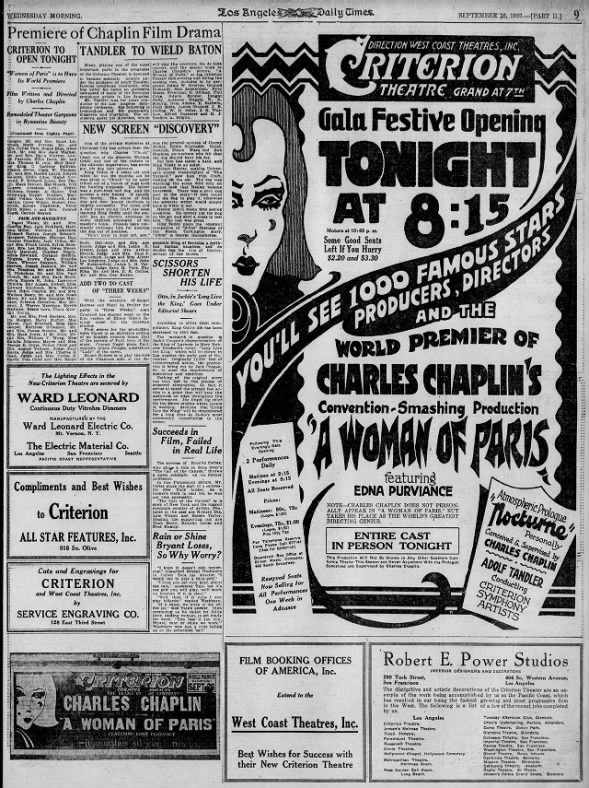
Here is a 1925 ad from the LAT:
http://tinyurl.com/mgyvnu
posted by ken mc on Sep 2, 2009 at 6:02pm
Another gem.

posted by Lost Memory on Sep 2, 2009 at 6:06pm
Comment
*

Notify me when someone replies to my comment?
Note: Please read our comment policy before posting. Comments which are off-topic, obscene, spam, or personal attacks will be removed. Help us keep the discussion productive!