
Granada Theatre
618 Kentucky Street,
Bakersfield,
CA
93305
618 Kentucky Street,
Bakersfield,
CA
93305
 4 people
favorited this theater
4 people
favorited this theater
Additional Info
Architects: Clarence Cullimore, Edwin J. Symmes
Firms: Symmes & Cullimore
Styles: Spanish Moorish
Nearby Theaters


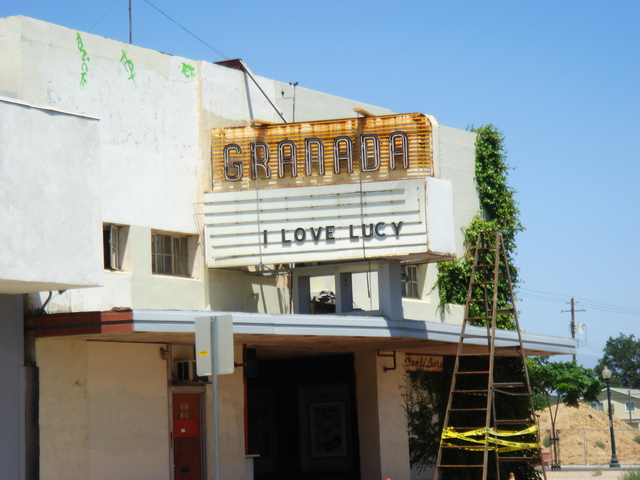
The Granada Theatre opened on January 31, 1929 with Bebe Daniels in “What a Night”. Around 1993 it was equipped with a 4 manual 24 ranks Robert Morton theatre pipe organ (originally installed in the California Theatre, Glendale, CA), which was linked to a Wurlitzer 2 manual console in the lobby. The Granada Theatre was closed in 2019 and was sold and gutted to become a funeral home. The building was vacant by 2020.
Contributed by
William Gabel
 Want to be emailed when a new comment is posted about this theater?
Just login to your account and subscribe to this theater.
Recent comments (view all 21 comments)
The L.A. Public Library misidentifies this 1928 photo as being of the California Theatre in Bakersfield. Given the Moorish detailing, suitable for a theatre called the Granada, I wonder if perhaps it actually depict this house. The size and shape of the facade is a good match for that of the Granada, which can be seen on this page as it looked long after its 1950 remodeling.
The Kern County Museum has an image of the Granada Theatre in Bakersfield: http://www.kcmuseum.org/stories/storyReader$1296
The photo to which Clara linked on July 25 clearly depicts the same building in the L.A. Library photo to which I linked on May 13. The distinctively-shaped attic vents above the arched windows to the sides are a dead giveaway.
@Joe Vogel: The photo you posted is, in my estimation, an early, if not original, depiction of the Granada Theater. According to an article in the Bakersfield Californian (1928 September 20, p. 11) construction of the theater had only just begun, and was to be completed by January 1, 1929. An article on January 30, 1929 states the theater was to open the following day (a Thursday), showing Bebe Daniels' film “What a Night.” While in 1928 it was planned to cost only $55,000, it turned out costing $20,000 more. The theater was owned by H.H. Brown, who, the article says, was a prominent apartment owner in this East Bakersfield neighborhood, and leased by Josephine and Paul Davini (later owners, I believe). It sat 754 people, giving it the largest seating capacity on a single floor of any theater in the city. It also featured a “crying room,” where mothers could take their babies so as not to disturb other guests, and a men’s lounge and smoking room. It was built in brick, with a stucco siding. This 1929 article provides more detail about decorations used. The architectural firm Symmes & Cullimore prepared plans for the building, which was done in a “Morisco-Spanish style.” William Eissler was the general contractor. Store display rooms were to be located on either side of the entrance. The 1928 and 1929 articles include a drawing (presumably by the architects) of the building, which looks strikingly like the “1928” photo you posted (it seems likely that the LAPL photo is dated incorrectly). A 1929 photo in a full-page ad for the opening of the theater (1929 January 30, p. 5) depicts the theater without the store window awnings and without the top sign, but otherwise very similar. I hope this helps.
JosephF: The information you provided is very helpful indeed. Learning the names of the architects led me to several interesting discoveries.
According to an item in the November, 1927, issue of the trade publication Architect & Engineer, Edwin J. Symmes and Clarence Cullimore had just formed their partnership, so the Granada was probably one of their first collaborations. The firm of Symmes & Cullmore designed a number of buildings in the San Joaquin Valley, many of them public schools. Symmes died in 1935, but Cullimore appears to have returned to an individual practice in 1932, designing primarily residential buildings after that. He was also noted for his research into the architecture and building of the Spanish and Mexican periods in California, which led to his 1948 book, Adobes of Santa Barbara.
This page at the web site of the Kern County Museum includes a partial list of buildings designed by Symmes and Cullimore, individually and in partnership. There are no theaters listed other than the Granada. The page also has a link to a small photo of the Granada ca.1941.
Google Documents provides an 2004 article called Spohn’s Old Granada Theatre, by Carla LaFong and Gilbert Gia. It includes a few period photos, history, and a fairly detailed description of the Granada at the time the article was written. The article can also be downloaded in pdf format from Gilbert Gia’s web site (follow the “persons” link.)
Walnut Hill Productions featured the Granada’s hybrid Robert Morgan/Wurlitzer theater organ on its web site in August, 2007. In addition to numerous photos and technical information, the page includes links to downloadable recordings made on the Granada organ.
January 31st, 1929 grand opening ad uploaded here.
Sadly I believe this theater was sold and gutted for use as a funeral home after Jim Spohn’s passing.
Coincidentally the July 2015 Google street view has “R I P” on the marquee…
A Google Street View timestamped 2020 shows it vacant, looking sad.
I was in the theatre in 2008. The owner at the time was Jim Spohn. Jim was an engineer and also restored and installed pipe organs. He had been involved with some famous names in the theatre organ world and had been involved with installing several organs in theatres that, once installed, were made unavailable by later managers. Jim said that he would never again install an organ in a theatre unless he owned it. So he bought the Granada, installed all his historic, professional projection equipment in it, stored his stock of original films. He then installed a 4-keyboard Robert Morton (that’s a brand) organ console and relays. He placed the organ blowers outside (which all experts said would not work but they did). He installed 13 ranks (sets) of Robert Morton pipes, 1 rank of Moller pipes, and 10 ranks of Wurlitzer pipes. having built rooms into the front of the theatre to contain the pipes. He then installed and wired in the Wurlitzer organ console that went with the Wurlitzer pipes and a historic Wurliter organ-roll player in the lobby. The entire organ was playable from the console in the theatre, the Wurlitzer was playable from the original console or the roll player. It was an incredible installation. He also had a small practice organ in an upstairs office over the lobby. He hosted conventions where people could come and play the organs, sleep in the theatre if they wanted and served food from the snack bar area. He had several of those that he called “Poor Man’s Conventions” in contrast to the very expensive formal organizational conventions. I was there in 2008 and played for that convention. Jim later became ill and died tragically. We have no idea what became of the organs, projectors, films and the considerable material on the history of the theatre that he had.