Search

Theaters News Links

Advanced search
 

Theater Guide

Now listing 27,650 theaters & 1,598 photos… more
Browse by...
 

Add Your Cinema Treasure!

Add Theater
Add Photo (offline)
Add Theater News


Recent Comments

Feb 09 Panorama Theatre (19)
Feb 09 Metro 4 (13)
Feb 09 Loyola Theater (78)
Feb 09 Michigan Theater (84)
Feb 09 Winter Gardens… (1)
Feb 09 Loew's Panorama… (4)
Feb 09 Fairmount Theatre (15)
Feb 09 Ziegfeld Theatre (3327)
Feb 09 Gaston Mall… (12)
Feb 09 Regal Riviera… (13)


  Discover. Preserve. Protect.

  This theater is featured in our companion book, Cinema Treasures. Find out more…

Also known as New RKO Roxy Theatre, RKO Center Theatre

Center Theatre

New York, NY
1236 Sixth Avenue
, New York, NY 10020 United States
(map)
Status: Closed/Demolished
Screens: Single Screen
Style: Art Deco
Function: Unknown
Seats: 3510
Chain: Unknown
Architect: Edward Durrell Stone
Firm: Hood & Foulihoux
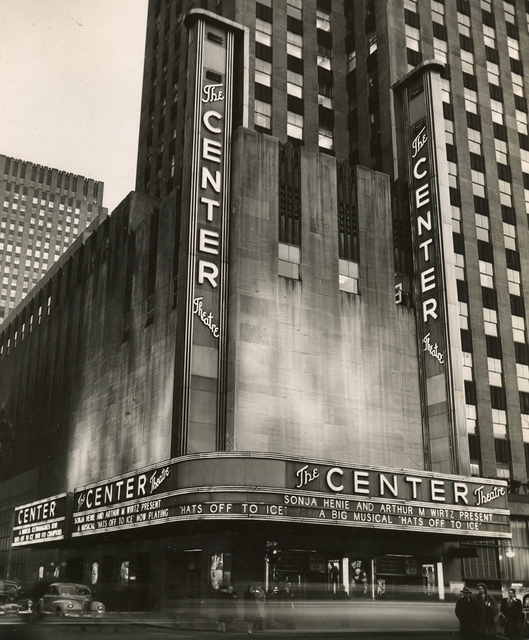
Center Theatre
Vintage postcard view of the New RKO Roxy Theatre (RKO Center Theatre)
Photo courtesy of the public domain
Known for most of its short life as the Center Theatre, this Art Deco style movie palace at 6th Avenue and 49th Street was owned by the Rockefellers and was built in the South Block of Rockefeller Center. It opened as the New RKO Roxy Theatre on December 29, 1932 with a stage show and the movie "The Animal Kingdom" starring Leslie Howard and Myrna Loy. Two days earlier, its larger sister theatre, Radio City Music Hall, had opened with a stage show only policy, again under the direction of 'Roxy' Rothafel.

The lobby had three ticket offices. The Grand Foyer was illuminated by day through five large exterior windows of opaque glass etched in relief. During darkness, the lighting was via three glass globes at ceiling height and two glass globes hanging lower. It was decorated in red and gold fabric with Bubinga mahogany walls and vermilion doors leading to the auditorium.

The auditorium had 75 foot high walls which were African mahogany paneled and a ceiling decorated with figures from Greek mythology. Centered over the orchestra section was a 400 bulb, 104,000-watt chandelier, 25 feet in diameter and a weight of six tons. Claimed as the largest of its kind, the fixture required its own fan cooling system. The proscenium opening was 60 feet wide and extended in height from stage floor to the ceiling. Like Radio City Music Hall, the New RKO Roxy Theatre had three shallow mezzanines, with respective seating capacities of 406, 655 and 559. The orchestra accomodated 1,890 giving the theatre a total capacity of 3,510. Like the Grand Foyer at Radio City Music Hall, the New RKO Roxy Theatre had a wide staircase and elevators to the top mezzanine, and a Grand Lounge in the basement. The theatre was equipped with a Wurlitzer organ of 4 manuals, 34 ranks.

In March, 1933, the New RKO Roxy Theatre shared the New York premiere engagement of "King Kong" with Radio City Music Hall. Both theatres supported the movie with a stage show, "Jungle Rhythms". After successful litigation by the owners of the original Roxy Theatre on 7th Avenue and 50th Street, the theatre was re-named the RKO Center Theatre in 1933 and it began to feature less costly second-run double bill film programmes. In 1934 RKO was dropped from the Center's name when it opened its first legitimate production, "The Great Waltz". When the show closed, the Center Theatre attempted showing films again. In February 1940, it hosted the New York premiere engagement of Walt Disney's "Pinocchio". Movies did not succeed here, and the Center Theatre returned to presenting live shows, including some 'Ice Spectaculars', until it closed and became an NBC studio in 1950.

In May 1954, NBC's lease expired and a decision had already been taken to demolished the theatre. The theatre was demolished in 1954, so that an office skyscraper (built to 'blend in' with the rest of Rockefeller Center) could be constructed on the site.
Contributed by William Gabel


YOUR COMMENTS

 
This theatre was part of Roxy's Radio City Complex and was to show movies with a stage show. If you will recall The Music Hall was to be just that with no movies. It is curious that Roxy (Rothafel) made such a critical mistake with the Music Hall and opened it w/o movies since his claim to fame was to introduce movies in every other theatre he managed. The Music Hall was a flop and closed several weeks later causing Roxy (who had a heart attack) to be removed as MANAGER. The Roxy Center Theatre was a very beautiful but simply designed theatre. A lawsuit from the original Roxy Theatre made them take off the name Roxy. The theatre had a lackluster performance and ended up with skating shows.
posted by Stannorton on Dec 8, 2001 at 3:08pm
This Theater is discussed in the book "Lost Broadway" by Hoogstraten as well as "Lost New York" by Silver.
posted by frenchjr25 on Dec 10, 2001 at 12:28am
I have an old mirror in the art deco style from RKO studios - It's about 9feet by 4 1/2 feet with RKO letters on top. It may have come from the old theater in New York. I'm looking for a photo of the original - any ideas?????
posted by Janie on Feb 4, 2002 at 6:52am
This picture is not the Roxy Theater in New York City. It is the Center Theater which is part of Rockerfeller Center. It has since been gutted and turned into offices. In later years it became a TV studio for NBC. I once saw the last of the Milton Berle TV showes there.
posted by John Keating on Oct 8, 2003 at 6:35am
I have in my possesion a full set of architectural drawings of the Roxy Theater of New York City. The drawing were done by my great uncle, Tom Moreford. Does anyone have anyone photos of the theater they could share?
posted by Unknown user on Oct 26, 2003 at 9:19pm
This theatre opened as the Roxy as stated above in the original post and in Stannorton's comment. The picture is of when it was known as The Center Theatre after the lawsuit from the original Roxy Theatre forced them to change the name.
posted by William on Oct 27, 2003 at 7:16am
My father(John Foy) Told Me that his Uncle "George Carroll" was the architect of the "Roxy Theatre" in New York City that was located near the Radio City Music Hall" this is 100% sure. George Carroll also designed "Kreske's" across the states. Could someone do some research and confirm this. Thank You.
posted by John Patrick Foy on Nov 17, 2003 at 3:22pm
In March, 1933, while still known as the New Roxy (a name successfully challenged by the original Roxy), it shared the New York premiere engagement of "King Kong" with Radio City Music Hall. Incredible though it might seem, both theatres supported the movie with a stage show, "Jungle Rhythms," though the version at the New Roxy was slightly less spectacular because it had a smaller resident company of performers and musicians than the Music Hall. But between them, about 400 people were employed as soloists, chorus, or orchestra players. The combined seating capacity of the two theatres was about 10,000, and each gave 5 complete (movie and stage) shows per day. Not surprisingly, with so many seats available, "King Kong" lasted only one week at the Music Hall, but continued (with stage show) for two more weeks at the New Roxy.
posted by Warren G. Harris on Jan 25, 2004 at 9:09am
The Grand Foyer of the the New Roxy was done in red and gold fabric wth mahogany walls. The 3,700 seat auditorium had 75 foot rich mahogany paneled high walls which supported a flat ceiling decorated with figures from Greek mysthology. Centered over the orchestra section was a 104,000-watt chandelier, 30 feet in diameter. Claimed as the largest of its kind, the fixture required its own fan cooling system. The theatre premeired on December 29,1932 (Two days after the Music Hall) with a stage show and the movie ANIMAL KINGDOOM starring Leslie Howard and Myrna Loy. After successful litigation by the owners of The Roxy Theatre on 7th Avenue & 50th street, the theatre was renamed the RKO Center in 1933 featuring less costly second-run double bill films. In 1934 the RKO was dropped from the Center's name when it opened with its first legitimate production,THE GREAT WALTZ. When the show closed, it attempted showing films again. When that failed, it returned to presenting live shows until it became an NBC studio in 1950. The theatre was demolished four years later (1954).
we renamed The RKO Center in 1933. Less costly second-run double bill movies were featured. The RKO was dropped from its name in 1934 when it got ready for its first legitmate booking, THE GREAT WALTZ. The Center attempted showing movies after this show closed, but when that failed, it returned to presenting live shows until becoming an NBC studio in 1950. The theatre was demolished four years later (1954) In 1950 for four years, the theatre was then demolished.
posted by ERD on Apr 13, 2004 at 10:10am
The Center's address was 1236 Sixth Avenue.
posted by Warren G. Harris on Apr 13, 2004 at 11:17am
The Center Theater was located at 48st.@6th,and was originaly built by Rockerfeller to house the Metropolitan Opera House, but somewhre allong the line the deal fell through and they tried a few shows which floped, "The American Way" was one such show. Then they turned it into an Ice Show venu, then they showed Disney's Pinnocio. Finally it became the Milton Berle TV studio. It was circular in design and had the signs of the zodiac embossed on the cieling along with twinkling lights.
posted by H on Sep 17, 2004 at 11:46am
H, what is your source for the claim that the Center was originally built to house the Metropolitan Opera House? I've never heard or read that before. I thought it was intended to be a smaller version of the Roxy Theatre, presenting a feature movie and a stage show. That was the Center's policy at opening, but it had to be changed to just movies and then to musical plays or ice shows to avoid conflict with its larger sibling, Radio City Music Hall. RCMH was intended to be a "live" venue, but flopped at opening and was quickly switched to a movie/stage show policy.
posted by Warren G. Harris on Sep 17, 2004 at 1:46pm
Warren: My source was my dad who worked down the street and asked what they were building, and the answer was "the new Met" That's the story I heard,and supposedly the prompters box was located in the middle of the cieling. But of course like all stories it could be wrong. Maybe Rockefeller center has an historian many corp. do.
posted by H on Sep 17, 2004 at 2:41pm
Warren: You'r right,I was wrong. The true answer can be found at http://archiverockefeller.edu/bio/jdrjr.php
posted by H. on Sep 19, 2004 at 9:35am
For a fascinating book about the concept of, the design and the building of Rockefeller Center, including Radio City Music Hall (originally known as the International Music Hall), the RKO Roxy and Samuel Lionel "Roxy" Rothapfel, get Great Fortune written by Daniel Okrent. The original idea of a theater in Rockefeller Center was indeed the new Metropolitan Opera House. The book may be purchased at Border's, Barnes and Noble and Amazon. For theater lovers as we are, it was truly fascinating to read about Rocketfeller Center's history.

posted by Organized on Sep 25, 2004 at 7:03pm
The Center Theatre was designed by Edward Durrell Stone, chief designer for Hood and Foulihoux, one member of the architectural team for Rockefeller Center (Associated Architects). When the Metropolitan Opera could not occupy one of the theatres (designed by their chief designer at the time - Joseph Urban) it was taken out of the project.

The Center Theatre used the same stage machinery as the International Music Hall (RCMH's orignal name) - an orchestra lift, 3 stage lifts with a turntable in the center. There wasa large pipe organ with twin consoles in niches on either side of the proscenium arch. the theatre also had the lighting control at the front of the orchestra pit (like Earl Carroll's Theatre) and a contour curtain based upon the Ted Weidhas patents.

There are incorrect attributions to design for the Rockefeller Center Theatres - Donald Desky was brought into the Music Hall after it been designed and provided oversight primarily for furnishings, the Roxy apartment and lounges, not shape and design for the auditorium. His partner, Eugene Schoen worked on the Center Theatre and had a greater input, primarily because it was not as far into the design process.
posted by ChuckClutzarchitect on Nov 1, 2004 at 12:39pm
www.deadprogrammer.com/archive..

Look at the incredible picture of the Center auditorium here.
posted by RobertR on Dec 15, 2004 at 9:15am
Kind of remarkable how there's been - and continues to be - so much talk about Radio City Music Hall and the Roxy, while the Center is largely forgotten...
posted by DBrenson/br91975 on Dec 15, 2004 at 11:29am
That circular auditorium was awesome, another NY treasure ground into dust :(
posted by RobertR on Dec 15, 2004 at 11:53am
RobertR: where on that page you sent as a link is the photograph?
posted by CConnolly on Dec 15, 2004 at 12:06pm
My random memories of the Center include a couple of visits to the ice shows staged there in the late ‘40s (I estimate in and after Fall, 1946, when I was four years old). By that time, I had already seen a few shows at RCMH with which to compare those at the Center. My most vivid recollection is of one scene deploying a transparent skrim, a revelation to my childish imagination as I wondered how we were able to “see through” an apparently tangible curtain.
Like RCMH, the Center had a cream-tan velvet contour curtain, but with ten folds rather than the fourteen at the larger theater. The walls were of mahogany veneer. The proscenium opening was 60’ with a stage depth of 44’. Like the one at RCMH, its stage had three elevators and a revolving platform. And like RCMH, the Center had three shallow mezzanines, with respective seating capacities of 406, 655, and 559. The orchestra accommodated 1,890. Total capacity was 3,509. Like the Grand Foyer at RCMH, it had a wide staircase and elevators to the top mezzanine, and its basement had a Grand Lounge. Its lobby had three ticket offices.
The preceding statistics come from the American Memory web page at the Library of Congress, Digital ID: ppmsca 05843 (I’ll later supply a precise URL if I can find it). I’m certainly not recalling them from childhood memory, but I definitely do retain vivid images of the Center and its impressive ambience. In 1950 I saw a live telecast of the Milton Berle Show there, and remember the stage as being too cluttered with camera equipment to get a good view of the action. I also attended a few radio broadcasts of NBC’s “The Big Show” on Sunday evenings there, hosted by Tallulah Bankhead. One took place in Spring ’51, with Ethel Merman and Edgar Bergen as guest stars.
The last time I remember seeing its façade was in December ’53 after seeing the Christmas show at RCMH; I took photographs of its lighted marquee. The theater was converted into office space and an indoor garage shortly after that.
posted by BoxOfficeBill on Dec 15, 2004 at 12:43pm
RobertR: That link works nicely...I know I've seen that picture before...I think it's in the book "Lost New York". I was so curious about this that I actually took a quick walk to see what went up in its place and I have to say that it's pathetic. A completely unremarkable black and glass building. Just take a look at the "lovely" building that took the place of the Roxy. If you stand on the southwest corner of 7th and 50th, you can clearly see where the Sports Illustrated building is nestled exactly where the Roxy once stood.

Can you imagine at the time this was done that the architects and builders thought this was progress?

From this site I'm learning so much about Rockefeller Center. So there were three theaters in the Center at one time. In addition to the Music Hall, there was The Guild and The Center. Amazing.
posted by CConnolly on Dec 15, 2004 at 1:30pm
CConnolly
Sad the Guild could not have stayed open. It was a good house but had gotten run down. After the Music Hall stopped showing movies they picked up alot of the Disney Films.

Rob
posted by RobertR on Dec 15, 2004 at 2:19pm

I could not follow the link posted by Warren (Hi! from Benjamin of the Nostalgia Boards) on Sept. 19th about this theater supposedly being intended to be the new home of the Metropolitan Opera, so I can't comment on the info on that website. BUT having read a number of histories of Rockefeller Center, I believe this is very much a mistake -- this theater was NOT designed to be a new home for the Metropolitan Opera.

(Two good books and a monograph I've read are 1) a popular history of Rockerfeller Center by . . . (the name escapes me for the moment, but it was written in the 1960s); 2) a more scholarly one by Carol Krinsky (from the mid-1970s); and 3) a scholarly monography by James Marston Fitch of the Historic Preservation program at Columbia. (Plus there is a relatively new comprehensive history, the Okrent book(?), which I haven't looked at yet.)

My guess, is that the misundertanding boils down to differing interpretations of the meaning of the phrase "built for."

The generally accepted story is that the original impetus for the ENTIRE CENTER was the desire of the Metropolitan Opera to have a new home. They got John D. Rockefeller, Jr. to buy up the leases on the land for them (he was to sell part of it and donate part of it, I believe) so they could build a grand opera house with a plaza in front (like the Paris Opera) and arcades and stores, etc. to provide a grand setting. But for a variety of reasons, including the stock market crash of 1929, this scheme didn't work out. So John D. Rockefeller who had already started working on this scheme -- and was left holding the bag, so to speak -- had to "fish or cut bait" and he decided to build Rockefeller Center instead of just letting the property just stay as it was ("low rent") while he was shelling out a premium to get all those leases under one ownership.

Had the original plans been followed, the Metropolitan Opera House would likely have been designed to stand on what was to become the centrally located site of the GE (originally RCA) Building -- facing a magnificent, large public square (which would have been located where the ice skating rink is today).

By the time plans were developed for Radio City Music Hall and the Center Theater at Rockefeller Center, the Metropolitan was long, long gone from the picture and these theater were designed with different objectives in mind -- and at locations more in keeping with their functions. Remember, although the Sixth Ave. "el" was scheduled to be torn down, Sixth Ave. was still a very seedy street -- not the greatest location for an opera house, while a location behind a large public square facing Fifth Ave. would have been considered ideal for an opera house.

As I understand it, the Center Theater was originally designed to function as Radio City Music Hall ultimately functioned during its heyday (a film interspersed with a stage show), and Radio City Music Hall was originally intended to be just that, an enormous "music hall," along the lines of the fabled "Palace Theater" (or the 3,000 seat, or so, George Carroll Theater, just a block down the street from Radio City Music Hall).

When the Music Hall flopped as a "music hall," it took over the film/stage show function and the Center Theater was left to search for a new format/use.

P.S. -- Carol Krinsky is trained as an art historian and, if I remember correctly, her book has nice little histories and pictures of Radio City Music Hall and the Center Theater.

posted by Benjamin on Dec 16, 2004 at 5:49pm

P.S. -- Sorry, I meant the Earl Carroll Theater, not the George Carroll Theater. By the way, this magnificent art deco theater, which I believe was built for revues along the lines of the Ziegfeld Follies, stood across the street from the (original) Roxy and was only relatively recently torn down. (For many years after it closed, its ground floor held a Woolworth's while the upper stories may have held a parking garage or been sealed off.) There are pictures of this theater, which I don't believe ever was a movie theater, in "Lost New York" and, maybe, "Lost Broadway" by Hoogstraten (which someone else mentioned above). (I think Hoogstraten or Christopher Grey, from the New York Times, talked the owners into letting him see the ghostly interior of the theater before it was torn down


posted by Benjamin on Dec 16, 2004 at 6:11pm
Somewhere around my house I have a copy of a magazine from about 1930, called Creative Art. It is an issue devoted to architecture and planning in New York City, and it contains sketches of early proposals for the Rockefeller Center site. At least one sketch does feature a new house for the Metropolitan Opera as the centerpiece of the design.

In another proposal, there would have been a 100' wide avenue opened about midway between Fifth and Sixth Avenues, to have run from 42nd Street to Central Park. The new opera house would have fronted on this thoroughfare. Hardly any of the proposals featured in the magazine ever got built. Instead, there was Robert Moses.
posted by Joe Vogel on Dec 21, 2004 at 6:08am
http://www.gabesplayerpianos.org/html/Center.html More photos of the Center here
posted by BWChicago on Dec 21, 2004 at 5:38pm
I got a good look at the former location of this theater and I've got ask again: how did they get such a grand theater on such a tiny piece of land? I'd love to see the blueprints of this place to see how it fit. They must've worked hard to get it in there...
posted by CConnolly on Dec 30, 2004 at 12:22pm
It's hardly a tiny plot of land. The ticket lobby on the SE corner of 6 Avenue and E. 49 Street (79'7" x 45'4", reverse symmetrical with the entrance of RCMH a block north) fed into a Grand Foyer rather narrower than that of RCMH. After the theater's demolition, this space became a large glass-walled demonstration room for RCA products. The length from far wall of the Foyer to the rear wall of the stage was the standard city block of 200'8". The stage wall abutted E. 48 Street, and measured 158' along the street beginning 79'7" from 6 Avenue. After demolition, it became a public garage and was topped by several stories of new office space. The reconstruction merged seamlessly with materials and style of the older building.
posted by BoxOfficeBill on Dec 30, 2004 at 1:29pm
I recently read some news coverage of the opening of the RKO Roxy that said that the screen measured 60 feet wide by 30 feet high. I guess that was overall, and that it was "masked" to suit the aspect ratio of the movie being projected.
posted by Warren G. Harris on Dec 30, 2004 at 1:41pm
BoxOfficeBill: For some reason, I thought the box office/lobby was on the SE corner of 48th and 6th, not 49th. On THAT corner (48th and 6th) there is a completely unremarkable building so I thought that was where The Center was. Also what made me confused was that the building on 49th (where you say The Center was) looks just like all the building's in Rock Center. When I looked at both areas, I thought that maybe it was on 49th because the plot looks larger. But you explained this and now I understand.

Good thing it's the holidays and I can afford to wander off my job a check this stuff out.

posted by CConnolly on Dec 31, 2004 at 7:01am
C--I surmised that you might have been confused about the location.
Warren-- The Center's proscenium opening was 60', so, yes, the screen likely covered the entire proscenium and was masked for movie ratio at, say, 36' x 27'. In my comment on 15 Dec above, I recounted my memory of a see-through scrim during an ice show there in '46. That scrim could well have been the movie screen. RCMH used its screen for see-through effects achieved through back lighting: e.g., the beginning of the Nativity with cloud-projection pierced by the back-lit angel singing "O Holy Night," and the entire Underseas Ballet with wave-projection fronting the back lit dance ensemble.
posted by BoxOfficeBill on Dec 31, 2004 at 7:30am
The Center theatre had a single console Wurlitzer organ of 4 manuals, 34 ranks. Radio City Music Hall has the two-console organ. The Center Wurlitzer had an Art Deco style console, not unlike RCMH, but had a rosewood veneer natural finish rather than the "Steinway Black" of RCMH. The organ was removed in the early 1950's and was installed in a roller skating rink in Alexandra, VA, where it remained for years. It was installed "unenclosed", meaning the pipes were out in the open, not enclosed in a chamber as is normal theatre organ practice. This made it LOUD for the skaters. It was removed in the late 70's-early 80's and sold to a collector in Phoenix, AZ. The instrument was broken up some time after that, and the console is now in the Berkley community auditorium, in Berkley, CA--controling a spectacular instrument based on the Toledo, OH, Paramount Wurlitzer, with choice Wurlitzer ranks added. The BCH is a "depression modern" auditorium, and the Center console fits that interior to a "T".
posted by john lauter on Jan 13, 2005 at 11:00pm

Chapter XIII of Carol Krinsky's book, "Rockefeller Center" has very detailed info and lots of great pictures about the history and development of both Radio City Music Hall and the Center Theater.

The portion of the chapter dealing with the Center Theater, pg. 187 to 195, has photos of the early clay models that were used to judge various proposed designs of both the interior of the auditorium (two photos) and the Sixth Ave. marquee (three photos). It also has a picture of the grand foyer, the women's lounge (two photos) and the men's lounge (two photos).

On page 195 there is a spectacular picture of the Simon and Schuster offices that were built on the roof: "In 1940 the roof of the theater was rented to Simon & Schuster, publishers, for twenty offices and reception rooms. Harrison & Fouilhoux, Reinhard & Hofmeister designed a one-story building there with a flat slab roof cantilevered over thin piers. Much of the building perimeter was made of 250 feet of plate glass, but the roof overhang of about three or four feet was great enough to shield the interior from the unpleasant effects of summer sun and winter wind. The tenants loved their rooftop perch and the charming views, through glass walls, of planting on the pavement around them. They admitred Edward Durrell Stone's simply-designed furniture which was finished in carefully-oiled natural tones of wood; such fittings were novel in corporate directors' offices at the time."

On page 109 there is a picture looking west along 49th St. showing the office building and the ground floor showrooms that replaced the Center Theater.

On pgs. 98 and 99 there are terrific before and after photos that show that the Center Theater before and after the neighboring U.S. Rubber Building was built to the south. So in the "before" photo you see a row of brownstones along Sixth Ave. "hemmed in" by the large blank walls of the ticket lobby "pavilion" (to the north) and the large auditorium (to the east). The "after" photo shows how seamlessly the design of the new U.S. Rubber Building worked with the existing Center Theater -- the ticket lobby "pavilion" of the Center Theater looks like a northern wing built to match a southern wing on the northeast corner of 48th St.

In the David Loth book, "The City Within a City," the endpapers have a map of Rockefeller Center that show the outlines of the Center Theater (where it now says "U.S. Rubber Co. Building Addition").

I believe the garage that was built in Rockefeller Center is NOT part of the building that replaced the Center Theater, the U.S. Rubber Co. Building Addition, but part of the Eastern Airlines Building to the east, instead. Krinsky describes how the garage came to be (pgs. 96-97): "The building [on the site of the Eastern Airlines Building] was to have a garage located between the office space and the Center Theater, an idea put forward as early as November 1936, taking advantage of a Zoning Resolution amendment of the preceding year which permitted certain parking garage construction in the Midtown retail zone. The garage was built for eight hundred cars, housed on three stories underground and three above. It used space that was hard to sell, and it halped to make visiting the Center easier for those who could not use mass transit."

Loth (pg. 140-141) also describes how the garage came to be: "[zoning] Negotiations finally won a variance in 1938. Six floors of space above and below ground had been left for a garage in the Eastern Air Lines Building, then under construction as next to last of the original structures planned for the Center . . . . Here room for seven hundred autombiles was provided early in 1939, an innovation for a New York office building." (He then goes on to describe how the garage had firemen's poles so the garage attendant's could get quickly down to the lower level. There's also a picture!)

There's also a great picture of the Center Theater in "New York 1960" by Stern, Mellins and Fishman. This photo (page 1102) looks eastward down 49th St. and shows what appear to be the five frosted and etched in relief(?) large glass windows of the foyer that fronted on 49th St. (These windows seem to be the exteriors of the windows shown on page 190 of Krinsky.)

The Center Theater is also mentioned in the WPA Guide to New York (1939) and gets about 17 lines -- compared to only 5 lines for the original Roxy!.


posted by Benjamin on Jan 16, 2005 at 7:55pm
In March, 1942, while RCMH was presenting DeMille's "Reap the Wild Wind" and its annual Easter show, the Center, then described as "America's First Ice Theatre," was presenting the 2nd edition of "It Happened on Ice," produced by Sonja Henie and Arthur Wirtz. During Easter week, there were two shows daily, at 2:40 PM and 8:40 PM, but normally there was a nightly show at 8:40, with matinees on Thursday, Saturday and Sunday at 2:40 (the house always went dark on Mondays). The price scale for an all "live" show was not much higher than at RCMH: 50 cents, $1 and $1.50 (plus tax). At every performance, evening or matinee, 501 seats were priced at 50 cents.
posted by Warren G. Harris on Jan 25, 2005 at 4:03pm
The Center was converted into a cinema again in February, 1940, with the New York premiere engagement of Walt Disney's "Pinocchio." I don't know how long the booking lasted or whether there were more films after that before the Center returned to the "legit" fold.
posted by Warren G. Harris on Feb 1, 2005 at 1:10pm
I have in my possession letters from 1938 of a radio personal reviewing the presentation of "aida" on may 24th with the Brema girls(opera)Sylvia and madam Zanitello (opera). There are letters written by George Cohen(composer)to Sylvia Brema which ties into Florence,Italy's Maggio Musicale 1938 with Maria Brema(opera). I am looking for information regarding these written letters which George Cohen ties into a marrige with Sylvia Brema and resides on Shakespear Avenue in Bronx, New York and later residing in Brooklyn. Parents on wedding announcement are listed as Mrs. Carph Berman and Mrs. Julius Cohen with children Sylvia and George to be held on Sundaqy the 15th of August 1943. I would like to know if anyone knows any information on these individuals whom were in the presentation of "Aida" back in 1938 at the Center Theatre in New York City. Sylvia's letter's also has her residing in Florence,Italy. Reporter's letter of May 24th,1924 states how Sylvia's blue eyes, throbbing notes and enthralling loveliness and Hungarian Enro Rappee overtures at Radio City Music Hall. I am trying to find out what if any historical value these letters may have or hold. Please
e-mail me if you have any information regarding these letters at unique79d. Thank you for your time.
posted by unique79d on Feb 3, 2005 at 5:53pm
During the engagement of Disney's "Pinocchio," the children's admission price every day of the week was 25 cents until 1 PM, and 40 cents thereafter. Adult prices were scaled from 40 cents to a top of 99 cents on weekends. Variety claimed that at those prices, the Center could gross $70,000 per week at full capacity. However, in its first week, "Pinocchio" grossed only $45,000, and $36,600 in the second week. I don't know how long the booking lasted after that, but in mid-March "Pinocchio" moved to the RKO circuit, with "The Saint's Double Trouble" as second feature.
posted by Warren G. Harris on Feb 14, 2005 at 10:36am
As we know from the posts above, the Center (a/k/a RKO Roxy) was built as a movie theater but it was also home to musicals, operettas, ice shows, operas, ballet and for one play, in addition to being an NBC Radio and television studio in the 1950s.
(The list below comes from the Internet Broadway Database.)

The Great Waltz
Musical
Lyrics by Desmond Carter; Book by Moss Hart; Music by Johann Strauss, Jr. & Johann Strauss, Sr.. Sep 22, 1934

The Great Waltz
Musical (with its re-written book)
Book by Caswell Garth, Ernst Marischka, Moss Hart, A. M. Willner and Heinz Reichert;
Lyrics by Desmond Carter; Music by Johann Strauss, Jr. and Johann Strauss, Sr..
Aug 5, 1935

White Horse Inn
Musical
Book by Hans Mueller; Lyrics by Irving Caesar; Music by Ralph Benatsky.
Oct 1, 1936

Virginia
Musical
Music by Arthur Schwartz; Book by Laurence Stallings and Owen Davis; Lyrics by Albert Stillman. Sep 2, 1937

The American Way
Play
Written by George S. Kaufman and Moss Hart.
Jan 21, 1939

The American Way
Play,
Written by George S. Kaufman and Moss Hart;
Background music by Oscar Levant.
Jul 17, 1939

Swingin' The Dream
Musical
Book by Gilbert Seldes and Erik Charell; Lyrics for "Oh, You Crazy Moon" by Johnny Burke; Lyrics for "Jeepers Creepers" by Johnny Mercer; Music by Jimmy Van Heusen; Lyrics by Eddie de Lange; Lyrics for "Hold Tight-Hold Tight" by Willie Spotswood; Lyrics for "My Melancholy Baby" by George A. Norton; Lyrics for "Way Down Younder in New Orleans" by Larry Clinton; Lyrics for "Ol' Man Mose" by Zilner T. Randolph.
Nov 29, 1939

Gizelle
Special, Original, Broadway Jan 12, 1940

It Happens on Ice
Special, Original, Broadway
Music by Vernon Duke, Fred E. Ahlert and Peter De Rose; Lyrics by Albert Stillman.
Oct 10, 1940

It Happens on Ice
Music by Vernon Duke, Fred E. Ahlert and Peter De Rose; Lyrics by Albert Stillman.
Jul 15, 1941

Stars on Ice
Ice revue
Jul 2, 1942

Carmen
Opera
Music by Georges Bizet. Apr 26, 1944

La Traviata
Opera
Music by Giuseppe Verdi; Libretto by Francesco Maria Piave.
Apr 27, 1944

Aida
Opera
Music by Giuseppe Verdi; Libretto by Antonio Ghislanzoni.
Apr 28, 1944

Faust
Opera
Music by Charles Gounod.
Apr 29, 1944

Rigoletto
Opera
Music by Giuseppe Verdi; Libretto by Francesco Maria Piave.
Apr 29, 1944

La Bohème
Opera
Music by Giacomo Puccini; Libretto by Giuseppe Giacosa and Luigi Illica.
Apr 30, 1944

Il Trovatore
Opera
Music by Giuseppe Verdi; Libretto by Salvatore Cammarano.
Apr 30, 1944

La Tosca
Opera
Music by Giacomo Puccini; Libretto by Giuseppe Giacosa and Luigi Illica.
May 1944

Cavalleria Rusticana
Opera
Music by Ruggiero Leoncavallo and Pietro Mascagni; Libretto by Ruggiero Leoncavallo, Giovanni Targioni-Tozzetti and Guido Menasci.
May 1944

Pagliacci
Opera
Music by Ruggiero Leoncavallo and Pietro Mascagni; Libretto by Ruggiero Leoncavallo, Giovanni Targioni-Tozzetti and Guido Menasci.
May 1944

Hats Off to Ice
Ice revue
Music by John Fortis and James Littlefield; Lyrics by John Fortis and James Littlefield. Jun 22, 1944

Icetime
Ice revue
Music by John Fortis and James Littlefield; Lyrics by John Fortis and James Littlefield. Jun 20, 1946

Icetime of 1948
Ice revue
Music by John Fortis and James Littlefield; Lyrics by John Fortis and James Littlefield. May 28, 1947

Carmen
Opera
Music by Georges Bizet; Libretto by Ludovic Halévy and Henri Meilhac.
Apr 14, 1948

La Traviata
Opera
Music by Giuseppe Verdi; Libretto by Francesco Maria Piave.
Apr 14, 1948

Rigoletto
Opera
Music by Giuseppe Verdi; Libretto by Francesco Maria Piave.
Apr 14, 1948

Madame Butterfly
Opera
Music by Giacomo Puccini; Libretto by Giuseppe Giacosa and Luigi Illica. Apr 14, 1948

La Bohème
Oprea
Music by Giacomo Puccini; Libretto by Giuseppe Giacosa and Luigi Illica.
Apr 14, 1948


The Barber of Seville
Opera
Music by Gioacchino Rossini; Libretto by Cesare Sterbini.
Apr 14, 1948

Aida
Opera
Music by Giuseppe Verdi; Libretto by Antonio Ghislanzoni.
Apr 14, 1948

Il Trovatore
Opera
Music by Giuseppe Verdi; Libretto by Salvatore Cammarano.
Apr 14, 1948

La Tosca
Opera
Music by Giacomo Puccini; Libretto by Giuseppe Giacosa and Luigi Illica.
Apr 14, 1948

Cavalleria Rusticana
Opera
Music by Ruggiero Leoncavallo and Pietro Mascagni; Libretto by Ruggiero Leoncavallo, Giovanni Targioni-Tozzetti and Guido Menasci.
Apr 14, 1948

Pagliacci
Opera
Music by Ruggiero Leoncavallo and Pietro Mascagni; Libretto by Ruggiero Leoncavallo, Giovanni Targioni-Tozzetti and Guido Menasci.
Apr 14, 1948

Faust
Opera
Music by Charles Gounod.
Apr 14, 1948

Howdy, Mr. Ice
Ice revue
Music by Alan Moran and Albert Stillman; Lyrics by Alan Moran and Albert Stillman.
Jun 24, 1948

Howdy, Mr. Ice of 1950
Ice revue
Music by Alan Moran and Albert Stillman; Lyrics by Alan Moran and Albert Stillman.
posted by Stepale2 on May 26, 2005 at 4:19pm
And below were some of the movies that played at the Center:

The film version of Philip Barry's play The Animal Kingdom, plus a vaudeville show was the opening attraction, but within six months, the "New" Roxy, as the theater was being advertised, dropped vaudeville as to not compete with the Radio City Music Hall.

Among the new movies to open at the "New" Roxy were No Other Woman, Song of the Eagle, and Diplomaniacs. Although King Kong opened at both Rockefeller Center theaters simultaneously, the RKO/New Roxy was soon reduced to showing second-runs. Little Women and State Fair moved over from the Music Hall and to add to the New Roxy's problems, the owners of the "old" Roxy (on Seventh Avenue) sued to force the "New" Roxy on Sixth Avenue to change its name -- a judge ruled that the Roxy name belonged to the theater, not the man! So the RKO Roxy became the RKO Center until RKO studios went into receivership in 1934. Then the the letters "RKO" were removed from the marquee and the Center became a legitimate theater.

posted by Stepale2 on May 26, 2005 at 4:33pm
Here's a night image from 1933, by which time the New Roxy had been re-named The Center and was showing single first-run features without stage revues:
www.i8.photobucket.com/albums/a18/Warrengwhiz/127-2755_IMG.jpg
posted by Warren G. Harris on Jul 18, 2005 at 10:35am
Circa 1933, the Center was also running "move-overs" from RCMH, but sans stage shows. During Christmas week, the Center showed "Little Women." This was followed by "Flying Down to Rio" as soon as it finished its Christmas holiday run at RCMH. The Center bookings were simultaneous with the RKO Albee in downtown Brooklyn, which still presented vaudeville with its movies.
posted by Warren G. Harris on Jul 24, 2005 at 4:51am
From the RKO house organ FLASH, here's a montage of images of the two Rockefeller Center showplaces when they first opened:
www.i8.photobucket.com/albums/a18/Warrengwhiz/132-3233_IMG.jpg
posted by Warren G. Harris on Aug 7, 2005 at 5:04am
Thanks Warren for the link to the FLASH pages :-) The picture of the Center's auditorium was interesting as one can see the contour curtain when it is down. Too bad they did not publish a matching shot of the Music Hall on the opposite page. Too late now....
posted by Stepale2 on Aug 7, 2005 at 10:02am
Here's a somewhat murky view of the interior after conversion to ice shows. Front rows of the orchestra seats were removed to extend the thrust of the skating rink. The stage opening was changed into a circusy tent with side boxes for chorus and musicians. The rest of the front walls seem to have been covered over with a mural or scenery. Though it might look that way from this camera angle, the central chandelier was NOT attached to the top of the stage canopy:
www.i8.photobucket.com/albums/a18/Warrengwhiz/136-3656_IMG.jpg
posted by Warren G. Harris on Aug 31, 2005 at 6:47am
Here is a page from Urban Archaeology's website. At the very bottom of the page are a set of light fixtures salvaged from the RKO Center that can be yours for $125,000.
posted by Bryan Krefft on Sep 25, 2005 at 5:30pm
The Ford Motor Company's 50th Anniversay TV Special was broadcast from the Center Theatre on June 15, 1953. Among the stars in the show were Bing Crosby, Frank Sinatra, and Marian Anderson. But two great ladies of the stage stole the show that evening: Mary Martin and Ethel Merman. Fortunately, a little over twenty minutes of this broadcast (actually aired jointly over CBS and NBC!) are available in a DVD (From a Kinescope transfer) currently on the market. It is sad to note that in a little less than a year, the Center would be gone, even after such star-studded personages as Merman and Martin had trod its stage.
posted by John Clark McCall, Jr. on Dec 10, 2005 at 8:17am
Betty Gould and Raymond Bohr were among the organists to preside at the Center's large Wurlitzer organ.
posted by John Clark McCall, Jr. on Dec 10, 2005 at 8:20am
I am given to beleve that some of the "Your Show of Shows originated from the Center. . .does anyone know for sure?
posted by Matt Spero on Mar 21, 2006 at 9:03am
When the Center's (RKO Roxy) first presentation opened it was a success and the(International)Music Hall's presentation a failure. The Center seemed to become a "sacrificial lamb" to save the Music Hall. When it was demolished in 1954 after having been an NBC TV studio theatre, New York lost a beautiful distinctive architectural edifice.(As it did with so many other buildings.) I realize that this was a "practical" move, but it still saddens me just the same.
posted by ERD on Mar 21, 2006 at 10:04am
A photo taken while the New Roxy's auditorium was nearing completion:
www.i8.photobucket.com/albums/a18/Warrengwhiz/newroxy.jpg
posted by Warren G. Harris on Mar 27, 2006 at 4:59am
In February, 1933, dancer Eleanor Powell performed in the stage show at the New Roxy one week, and then moved to the stage show at Radio City Music Hall the following week:
www.i8.photobucket.com/albums/a18/Warrengwhiz/showplace33.jpg
posted by Warren G. Harris on Jun 27, 2006 at 9:37am
I'm posting nice movie material that are also mostly for sale.
http://s110.photobucket.com/albums/n94/irajoel/

you can also view my entire inventory at
www.cinemagebooks.com
I have over 5,000 items including many books in non-film such as
gay and lesbian, African American, posters, graphic design, fiction, poetry and much more.
and email irajoelirajoel@yahoo.com
posted by ij on Jul 23, 2006 at 11:10am
An opening day ad from May, 1933, with a feature-length documentary supported by a stage show. The smaller ad above that shows the program that opened the previous day at RCMH:
www.i8.photobucket.com/albums/a18/Warrengwhiz/roxyspeaks.jpg

posted by Warren G. Harris on Aug 7, 2006 at 7:42am
This ad is from the same link that Brian Wolf posted on Dec 21, 2004 at 8:38pm. The opening date is given as December 29, 1932. The movie featured was "The Animal Kingdom". The name of this theater in the ad is New ROXY RKO THEATRE. I believe that the word "New" is a descriptive word and was not part of this theaters name in that ad.

posted by Lost Memory on Aug 11, 2006 at 3:31pm
Disney classic (February, 1940):
www.i8.photobucket.com/albums/a18/Warrengwhiz/centerpin.jpg
posted by Warren G. Harris on Aug 12, 2006 at 5:49am
The RKO ROXY is the focus of a 1933 animated short OPENING NIGHT. It is part of a pre-code DVD compilation called CARTOON CRAZIES - BANNED & CENSORED which we found in the library. Check it out.
posted by 42nd Street Memories * Jerry Kovar on Jan 1, 2007 at 10:43am
Here is a short article about the demolition from Time magazine dated 11/2/53:
http://tinyurl.com/yarhm7
posted by ken mc on Jan 3, 2007 at 6:53am
Here's a rare view of the 49th Street side of the building. The theatre had two verical signs, one at each end of a marquee that wrapped around the corner of Sixth Avenue and 49th Street. Since none of the signage said "New Roxy," it's easy to see why the management of the original Roxy succeeded in forcing a name change that would end the confusion: www.i8.photobucket.com/albums/a18/Warrengwhiz/rcroxy49.jpg
posted by Warren G. Harris on Jan 19, 2007 at 5:40am
He's Loose! And He's Coming Thursday!:
www.i8.photobucket.com/albums/a18/Warrengwhiz/rc12833.jpg
posted by Warren G. Harris on Feb 3, 2007 at 6:39am
Here is a higher resolution version of the auditorium photograph Warren linked above from 1932.
http://www.shorpy.com/node/1366?size=_original
posted by J.F. Lundy on Jul 28, 2007 at 12:34pm
Stage shows were dropped in May, 1933, when the RKO Roxy was reduced to being one of the RKO circuit's subsequent-run theatres, according to a report in The New York Times on 5/24/33. Admission prices were also reduced for the new policy, with programs changing twice weekly. "The Silver Chord," previously shown at Radio City Music Hall, started the new policy, followed by "Song of the Eagle," a move-over from the Paramount Theatre. The change left RCMH as RKO's only first-run theatre in New York. RKO had recently dropped the Mayfair, and shifted the Palace to subsequent runs.
posted by Warren G. Harris on Nov 4, 2007 at 12:27pm
Today makes the 75th Anniversary of the opening of the RKO Roxy, with THE ANIMAL KINGDOM.
posted by TomR on Dec 29, 2007 at 10:55am
I just noticed that Edward Durrell Stone was the architect of both Radio City and The Center Theater. Radio City, of course, is one of the most beautiful theater palaces ever built and The Center appeared to be a stunner as well. It appears that Stone did not design any other theaters (according to my architect search on CT). I wonder why not. I assume both of these theaters (certainly Radio City) were universally acclaimed by architecture critcs at the time. I would assume that Edward Durrell Stone would have been deluged with theater commission offers. I guess the depression would have greatly dampened the demand, but nonetheless, I still find it surprising that he never designed another theater. Any insights are appreicated.
posted by LuisV on Jan 1, 2008 at 11:25am
Stone's contributions to both theatres, as well as to Rockefeller Center, are controversial. I never saw Stone credited as architect of RCMH and the New Roxy/Center until I joined Cinema Treasures. His name isn't even mentioned in "The Center: A History and Guide to Rockefeller Center," written by Walter Karp and published by American Heritage in 1982. David Naylor's book, "Great American Movie Theaters" does not give an architect for RCMH, but credits Donald Deskey as "designer." Naylor reports Reinhard & Hofmeister as architect(s) of the New Roxy/Center.
posted by Warren G. Harris on Jan 1, 2008 at 1:40pm
Thanks Warren. Your point would make sense. That would most likely account for why we don't see any other theaters designed by Stone. He may, in fact, not have had as big an impact into the design of Radio City and The Center as CT implies with the credit above.
posted by LuisV on Jan 1, 2008 at 2:05pm
A quick Internet search indicates Stone designed the exterior of RCMH.
posted by HowardBHaas on Jan 1, 2008 at 3:49pm
Link,
http://eng.archinform.net/projekte/64.htm
posted by HowardBHaas on Jan 1, 2008 at 3:51pm
Thanks Howard!

Shouldn't Donald Desky be added as a joint archtitect to both Radio City and The Center? It is now apparent that Edward Durrell Stone only designed the exterior of both theaters and, though significant, it is the Interiors of these theaters that are the true treasures. Donald Desky should be given his due, if only on this website. Doanld Desky does not appear as an architect for any other theater on this website.
posted by LuisV on Jan 1, 2008 at 5:08pm
LuisV, see November 1, 2004 post above.
posted by HowardBHaas on Jan 1, 2008 at 5:29pm
So, should Hood & Foulinex be added as the archtictural firm under the Radio City site? Currently, Stone is listed as architect, but the firm is listed as unknown.
posted by LuisV on Jan 1, 2008 at 6:51pm
Most websites seem to simply list Stone for RCMH, or at least for the exterior. One site says THREE architecture firms hired Stone! so maybe just leave it as is....
posted by HowardBHaas on Jan 1, 2008 at 7:08pm
Donald Deskey was not involved with the New Roxy/Center. He had more than enough to cope with at RCMH, a commission that he received due to the influence of Mrs. John D. Rockefeller, who greatly admired work that he'd done for her and others in their New York residences.
posted by Warren G. Harris on Jan 2, 2008 at 7:39am
Edward Durrell Stone was the architect of the 1949 "modernization" of the Victoria Theatre (ex-Gaiety) at 1547 Broadway, according to William Morrison's "Broadway Theatres: History and Archtecture."...Morrison also credits the archtiecture of the New Roxy/Center to Reinhart & Hofmeister; Corbett Harrison & MacMurray; and Hood & Foulihoux. One of the flaws of the Cinema Treasurea listing system seems to come from confusion over "Architect" and "Firm." Architects are not necessarily individuals. They can be firms, as in the case of Rapp & Rapp. I think that the "Firm" category should be eliminated.
posted by Warren G. Harris on Jan 2, 2008 at 8:34am
Officially, the RKO Roxy/Center & Radio City Music Hall were designed by the Associated Architects. Edward Durrell Stone was the staff architect that was assigned the job of designing the theaters. Unfortunately, he was fired before the theaters opened due to the fact he took an outside job while on the Rockefeller Center payroll.

While Donald Deskey handled the interior decortaion of the Music Hall, Eugene Schoen had that job at the RKO Roxy/Center.

I was really disappointed that the New York Times did not dedicated its entire The City section of the Sunday paper to the 75th anniversary of the both theaters, 2 weeks ago. When the Chrysler and Empire State Buildings turn 75, the entire section was dedictaed to those great New York City icons. Hopefully they are planning on honoring all of Rockefeller Center this year. The RCA/GE Building will be 75 this spring.
posted by TomR on Jan 6, 2008 at 8:08pm
Great thought TomR. I would hope that a celebration of Rock Center's 75th anniversary would include Radio City as well. I would doubt that the Center Theater would even be mentioned as so few people even know that it ever existed. I only found out about it after discovering the CT website a few years ago.
posted by LuisV on Jan 7, 2008 at 7:04am
Better than a photograph, this 1933 sketch shows how the auditorium's huge chandelier was more than just decorative: www.i8.photobucket.com/albums/a18/Warrengwhiz/roxycenter.jpg
posted by Warren G. Harris on Feb 4, 2008 at 8:16am
This photo must date to about 1950, as the marquee announces the imminent arival of NBC television productions in the theatre.
posted by Joe Vogel on Feb 11, 2008 at 11:17pm
Another from the Library of American Broadcasting shows the Center's big stage when the house was billed as "America's only ice theatre.
posted by Joe Vogel on Feb 11, 2008 at 11:23pm
The date given for this photo is April 26, 1964, which is undoubtedly wrong. Not only was the the Center long gone by then, but "The Voice of Firestone" aired on NBC only from September, 1949 until June, 1954.
posted by Joe Vogel on Feb 11, 2008 at 11:37pm
I heard from a contact at Rockefeller Center that plans are in the works for their 75th anniversary. Hopefully, they will includes this theatre in their celebrations.
posted by TomR on Feb 12, 2008 at 6:28pm
This rare ad from January 1st, 1933, shows the two Radio City theatres with their original presentation policies: www.i8.photobucket.com/albums/a18/Warrengwhiz/radioduo.jpg
posted by Warren G. Harris on Feb 20, 2008 at 1:46pm
While I always went to Radio City Music Hall as a child, I am sorry that I never went to the Center theatre before it was demolished.
I guess the reason was because it was an NBC studio by that time, and my parents never got any tickets for the shows broadcasted there.
posted by ERD on Feb 23, 2008 at 8:45am
E.D. Stone was not the architect of either the Center or RCMH. He was merely one of the supervisory architects of the entire Rockefeller Center project. William Morrison's "Broadway Theatres" credits the firms of Reinhart & Hofmeister; Corbett, Harrison & MacMurray; and Hood & Foulihoux, as architects of the Center. Nicholas Van Hoogstraten's "Lost Broadway Theatres" gives only "Reinhart & Company" as architect.
posted by Warren G. Harris on Feb 23, 2008 at 9:12am
I'm also very sorry that I never got to see this theater. It appears from the photos posted on this thread that this truly was a spectacular theater. I love that chandelier! To think that The Center, The Roxy,The Capitol and Radio City were all within a block of each other is truly incredible.
posted by LuisV on Feb 23, 2008 at 11:32am
According to Daniel's Okrent's Great Fortune: The Epic of Rockefeller Center, Edward Durrell Stone was the architect of the theaters.

When I visited the Archives Office at Rockefeller Center, I saw many photos of the theaters with his name as the architect.
posted by TomR on Feb 24, 2008 at 4:34pm
Photo captions often turn out to be incorrect. I still stand by my claim that he was only one of a number of supervising architects of the entire Rockefeller Center project, and that he was not the architect of RCMH or the New Roxy/Center.
posted by Warren G. Harris on Feb 25, 2008 at 5:54am
I agree with Warren if for no other reason that if Edward Durell Stone had actually designed these two spectacular theaters we would have seen him commissioned to design others around the country and, alas, he was not. This leads me too believe that he did not actually design these theaters, but instead was one of many contributors of which he was the most well known.
posted by LuisV on Feb 25, 2008 at 8:23am
A vintage postcard of the Grand Foyer, Center Theatre. Photographed possibly at opening in 1932:
http://flickr.com/photos/kencta/2302530326/
posted by KenRoe on Mar 1, 2008 at 8:48am
My mother and I drove from our home in Maine to New York to meet her brother, a Music Professor at Robert College in Istanbul, Turkey, who was returning to the USA on sabattical leave. Before returning to Maine he and we attended a performance at the Center Theatre of "The Great Waltz" on 10 September 1935. Recently, in a long-forgotten file, I came across my like-new copy of the Playbill for that performance. I cannot but wonder if it may be a "collector's item" worthy of hanging onto or, at least, passing on to our grand daughter. Any thoughts?
In the years since I have met many a New Yorker but have yet to meet even one who was aware that such a threatre ever existed.
posted by Chuckles on May 24, 2008 at 8:41pm
By popular demand, here are renewed links to previously posted images:
http://i8.photobucket.com/albums/a18/Warrengwhiz/127-2755_IMG.jpg
http://i8.photobucket.com/albums/a18/Warrengwhiz/132-3233_IMG.jpg


posted by Warren G. Harris on Dec 23, 2008 at 7:30am
I'm doing a research project about a theater at a small college in the south which has the stage lifts and turn table from the Center Theater.

this site has been great reading! thank you all!

Someone wrote above (a few years ago) that they had the blue prints. I would love to see them! Can you contact me if you still read this?

Does anyone else know of any pictures of the lifts in action? Or know who made the lifts? or know anything else that might be useful to me?
posted by Richard Streeter on Mar 11, 2009 at 6:51pm
The stage equipment was supervised and built under the direction of Peter Clark, Inc, and the stage and orchestra elevators and revolve were built by Otis Elevator, Inc. The archives of these firms may have the shop drawings and photos of their installations. They are both in existance.

Other potential sources of information are the Library at Lincoln Center and the Avery library at Columbia University. Architectural magazines of the time: Architectural Forum and Architectural Record. If you can gain access to the Rockefeller archive, they may help. Nelson Rockefeller was the brother actively involved with the two theatres.

Edward Durrell Stone's archive at the University of Arkansas (I believe) may have some information since he was actively involved in the interior design, not the exterior as some have claimed.
posted by ChuckClutzarchitect on Mar 13, 2009 at 10:29am
According to Daniel Ockrent, author of Great Fortune: The Epic of Rockefeller Center, Edward Durell Stone was not involved in the design of the Center Theater (RKO Roxy). Eugene Schoen was the interior designer of the the theater (after he came in second to Donald Deskey on the interior design of the Music Hall.)

Christine Rousel is the archivist of Rockefeller Center. The archives has many binders of photos of the Center Theater.

Didn't the stage end up at Bob Jones University when the theater wqas demolished?
posted by TomR on Mar 13, 2009 at 8:30pm
Yes, I am with Bob Jones. I work at the stage and see the lifts being used on a daily basis. I'm doing a heritage type program about our theater and the people who were involved in the early days. I think the story of the lifts is interesting and wanted to find out which is what brought me here to this blog.

thank you to ChuckClutz for the info.
posted by Richard Streeter on Mar 14, 2009 at 2:36pm
Are there pictures of the lifts in action in any of the books mentioned above? Or a stage diagram/floor plan which shows the layout?

posted by Richard Streeter on Mar 14, 2009 at 2:38pm
Richard,

When I had access to the archives, I only saw the binders with pictures of the theater. I don't recall seeing any of pictures of the stage lifts in action, but would not doubt that they are there. As for floorplans and architectural drawings, I did not see them, although I did not have access to an adjoining room. I would seem logical that they would have the the Associate Architects original plans of the theater.
posted by TomR on Mar 15, 2009 at 8:41pm
How does it work with the archives? Can I call them up and ask for them to look for something and make a copy or take a picture or do I need to pay something or go in person? Let me know what you think. thank you!
posted by Richard Streeter on Mar 18, 2009 at 6:01pm
Richard,

You would have to pay a fee to use any of the photos they have. But you should probably contact them to discuss what you are looking for.
They may another option for you. Hope that answeres the question.
posted by TomR on Mar 18, 2009 at 6:46pm
Renewing link.
posted by Ed Blank on Mar 30, 2009 at 8:06pm
The Center auditorium can be seen here:

http://www.flickr.com/photos/32912172@N00/2849785165/
posted by AlAlvarez on Jul 4, 2009 at 11:59am
The foyer here:

http://www.flickr.com/photos/kencta/2302530326/
posted by AlAlvarez on Jul 4, 2009 at 12:02pm
Some B&W stills and very brief newsreel footage of the grand opening of the New Roxy Theatre can be viewed here: http://www.efootage.com/stock-footage/15874/1930sthirtiesblackandwhitevintage35mm35
posted by Tinseltoes on Nov 30, 2009 at 9:13am
Comment
*

Notify me when someone replies to my comment?
Note: Please read our comment policy before posting. Comments which are off-topic, obscene, spam, or personal attacks will be removed. Help us keep the discussion productive!