
Midwest Theatre
16 N. Harvey Avenue,
Oklahoma City,
OK
73102
16 N. Harvey Avenue,
Oklahoma City,
OK
73102
 2 people
favorited this theater
2 people
favorited this theater
Additional Info
Previously operated by: Stanley-Warner Theatres, Warner Bros. Circuit Management Corp.
Architects: John Adolph Emil Eberson
Styles: Atmospheric, Spanish Renaissance
Nearby Theaters


The Midwest Theatre opened August 1, 1930 with Richard Barthelmess in “The Dawn Patrol”. Seating was provided for 1,700 and it was equipped with a Wurlitzer theatre organ. It was operated by Warner Brothers Theatres. The architect was John Eberson who designed the auditorium in a Spanish Renaissance/Atmospheric style. Publicity at the time of opening also credited M.C. McKee as the designer of the the theatre. In 1947 the World Premiere of “Black Gold” was held at the theatre with the star of the movie Anthony Quinn making a personal appearance. On December 1, 1960 the World Premiere of “Cimarron” starring Glenn Ford was held at the Midwest Theatre.
Following a period of playing X-Rated porn movies, the Midwest Theatre closed in 1975 and was demolished in 1976. A parking garage now stands on the site.
Contributed by
Chuck Van Bibber
 Want to be emailed when a new comment is posted about this theater?
Just login to your account and subscribe to this theater.
Recent comments (view all 67 comments)
Midwest Theater Architect, Designer John Eberson’s information added to Photo Section.
Pic of Midwest’s stage being outfitted with latest sound componet system of it’s time added to Photo Section.
1970 street view on N Harvey showing Midwest in pic by Jeff Chapman added to Photo Section.
“Never On Sunday” Playing at Midwest Theatre in Sept. / Oct. 1960 which featured Melanie Mercouri, playing a Prostitue with the next movie playing was Butterfield 8, starring Elizabeth Taylor, a part time call girl…Was playing when I began as an Usher.. Ironic as the first run followed with high gross features like Cimarron, Longest Day, etc and ended life X rated porn features in the mid 70’s..Sad ending for a grand theatre..See ad pic’s of above in Photo Section.
Photo of Maria Schell & Anne Baxter, Cimarron Premiere added to pic. section.
Photo of Midwest just prior to grand opening in 1930 added to pic. section.
Photo of Midwest Theatre grand opening nite 1930 showing of “The Dawn Patrol” added to pic section.
Pic of Midwest playing “Pardners” added to photo section.
3 Pictures added to photo section are of statues that were removed and sold prior to Midwest demolished.
Grand opening ad: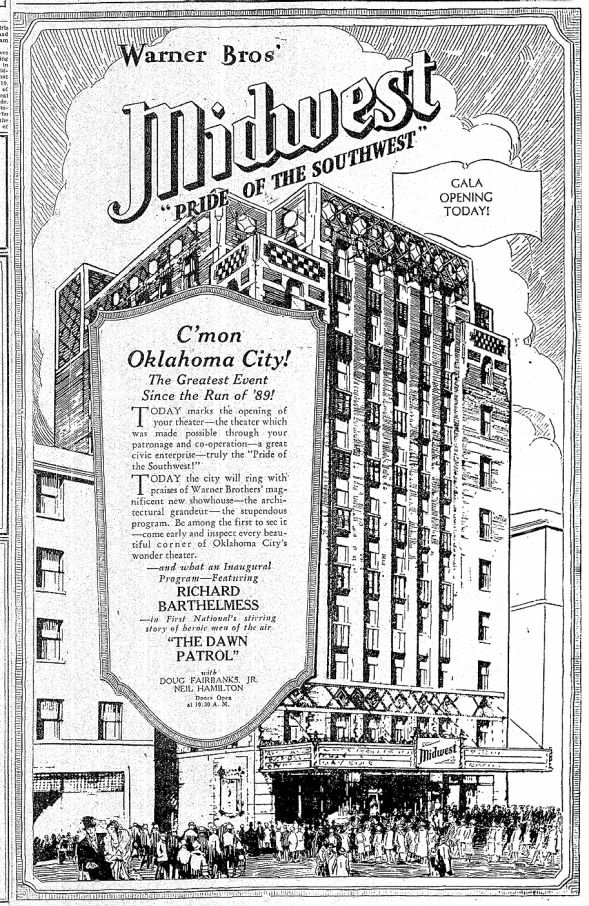 Midwest theatre opening Fri, Aug 1, 1930 – 29 · The Daily Oklahoman (Oklahoma City, Oklahoma) · Newspapers.com
August 1st, 1930