
5th Avenue Cinema
66 5th Avenue,
New York,
NY
10011
66 5th Avenue,
New York,
NY
10011
 5 people
favorited this theater
5 people
favorited this theater
Showing 1 - 25 of 29 comments
Grand opening as Cinéma de Paris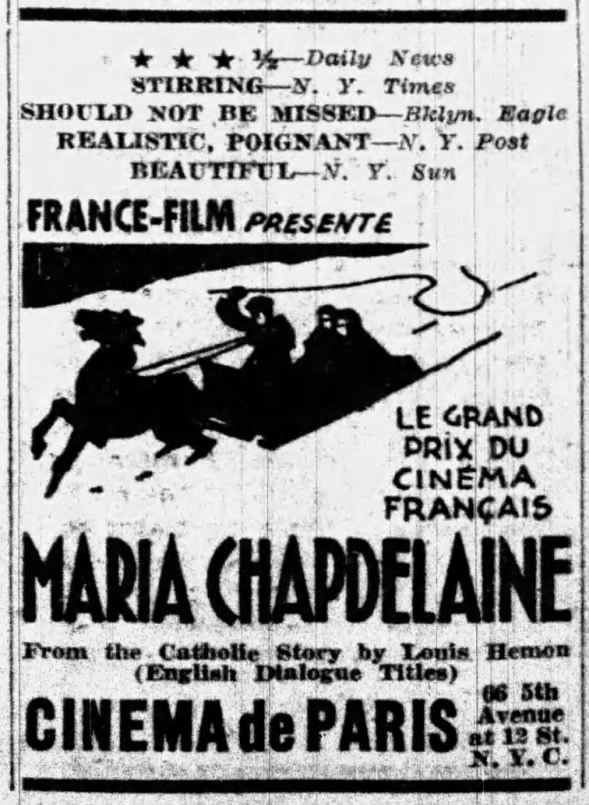 France-Film Cinéma de Paris Sat, Sep 28, 1935 – 15 · The Tablet (Brooklyn, New York) · Newspapers.com
It was called Cinema de Paris alternatively from 1935 to 1942 depending on the product being run.
It was Cinema de Paris for at least eight years.
This was with the France-Film circuit, which was based in Montreal, QC in the 1930’s.
Found on Newspapers.com
They also built Cinemas de Paris cinemas in Montreal, Quebec, Sherbrooke, Trois Rivieres. As of the time of this writings they own the St. Denis in Montreal.
The closing date is incorrect. The cinema closed in September 1974. After seeing two mentions here of a purported 1973 closing date, I recalled that the last thing I’d seen there was the closed circuit broadcast of the second Ali-Frazier fight — which took place in January 1974. A look into the New York Magazine archives showed the theater was open into the following September. The last showing was apparently a double bill of two erotic French films, Going Places (Les Valseuses) and Le Sex Shop.
Any sign of the Hirshfeld mural?
My mom and I saw Dr.Strangelove here, after my Saturday morning children’s theater group at Mills College of Education, and lunch at the Schraffts 13th st. We saw other films, but Dr.Strangelove created the memory. The mural was fascinating to look at, at least for a child.
I lived @ FIFTH AVENUE CINEMA mid-1960s-70s. Living 4 blocks south, at the Hotel Marlton 5 West 8th St., it was the movie theater of choice—-the Art and the 8th St.Playhouse were for the fairies & débutantes at NYU and the bridge-&-tunnel mutts who got off on “Rocky Horror Show” [hawk-ptoo]. I saw a double-bill here that can’t be beat—–“L'Aventura” / “Last Year At Marienbad”. Saw them again recently—-after all the jokes, these two are among the very few from the ‘60s to have survived, their power intact. The snapper here is that not only has Parson School Of Design taken over the 5th Ave. for an auditorium, they’ve taken over my old home, the Hotel Marlton for dorms !!! Am I to be spared nothing ??
Renewing link.
This stopped showing films in 1973.
It was called 5th Avenue Playhouse, according to Kristin Thompson!
An elephant at the Fifth Avenue Cinema in 1954.
This Rugoff coffee house cinema always had creative double bills, insuring packed audiences. A memorable pair were “The Girl With the Green Eyes” & “Billy Liar”. Apart from the Hirschfield mural, a rather plain venue, but the features were truly memorable. Is Parsons still using the space as an auditorium?
Warren— Thanks for the info on the Freudian double-bill, timely for this week’s celebration of Sigmund’s 150th birthday. As an unabashed Freudian, I delighted in it. One of my movie-going buddies from the ‘60s wrote an homage to Freud in last week’s Wall Street Journal, which tickled me even though it missed the point. We owe a lot to F because his approach (though not conclusions) were so wonderfully counterintuitiveâ€"a healthy psyche is not always a happy psyche, but its tensions are good because the simplistic alternative is worse.
“Secrets of a Soul†is a 1927 film directed by GW Pabst about a grown man’s phobia of knives (sounds silly, but Pabst is, well, Pabst and appropriately named for his papally blue ribbon distinction). “Eternal Mask†is a 1937 Swiss film about guilt obsession directed by Werner Hochbaum (I don’t know whether phallic Hochbaum is appropriately named). In both cases, the psychoanalysis is dumb (there is no talking cure). Freud’s social theory is what sets him apart, and a good reason to celebrate his 150th. Cheers to the Fifth Avenue for celebrating him.
Lost Memory: Lamb, the architect of the Fifth Avenue? The mind boggles.
It was showing movies from at least November, 1926, starting with a re-release of THE CABINET OF DR. CALIGARI followed by the first run of MIKAEL (AKA, Chained, The Invert) a German gay drama about aging painter Rodin, his male model and the woman who gets in their way. (Only the village would accept THAT plot line in 1926!)
This was the 5th Avenue Playhouse while the Proctor house on 28th Street operated as the 5th Avenue Theatre.
“The mind boggles at this 1941 double feature”
That kind of “psychoanalytical film program” also made its way into many of the “today only” Thalia offerings of the 1950s, and perhaps before and after.
I remember going to this cinema only once, however, unfortunately I cannot remember what film I saw. What I really want to ask is does anyone remember the Cinemabilia bookstore that was located on 12th street? This was a great bookstore dedicated to films. Books, current and out-of print, magazines, posters, and thousands of stills. Originally, they were located on Corneila Street in the Village. A great place where I spent a lot of time.
View link
This is 66 Fifth Avenue as it appears today. I saw no trace of a Hershfeld mural anywhere in the lobby area.
It is now the entrance to one of The New School’s buildings.
THESE THEATRE ADS appeared in a program booklet “Stadium Concerts Review” for Lewisohn Stadium, College of the City of New York, for July 29 to August 4, 1936. The concerts were by the Philharmonic-Symphony Orchestra. The small ads tout what was playing at several New York movie theatres. One of them was the Cinema de Paris, which, given the address, seems to have been another name for the 5th Avenue Cinema/Playhouse.
Agreed. The pronunctiation of Apu, incidentally, is something like “Aw-poo” in Bengali. I once went to a 16mm showing of Satyajit Ray’s Pather Panchali at R.I. College where it was listed as “Father Panchali.” You know him, the parish priest! I’m sure you know the title means “Song of the Road.” Long after the film was made, composer Ravi Shankar, who did the haunting score, became famous internationally and was even one of the performers at Woodstock in 1969.
The Apu trilogy really is sublime. Remember how at the end of “Manhattan” Woody Allen, suicidal beyond repair, makes a list of things that would help to keep him alive? The Apu trilogy ranks high on the list, and generates a laugh because of its funny sound in Allen’s Brooklynese pronunciation. But its inclusion is so appropriate.
Pather Panchali made an overwhelming impression on me when I first saw it at the Avon in Providence in 1959, and I was still in high school! I kept going back. It is still one of my favorite films of all time. I understand it played the Fifth Avenue for six months or more.
The Bergman anecdote is hilarious.
Here’s a Showbill program from the Fifth Avenue Cinema in March, 1960:
View link
View link
Some of Bergman’s best films opened in NYC within a period of three years or so: “Smiles of a Summer’s Night,†“The Seventh Seal,†“Wild Strawberries,†“The Magician,†and “The Virgin Spring.†The buzz about them was loud enough, but I remember that many movie-goers were still caught off-guard. I recall sitting in the Beekman at “Wild Strawberries†and over-hearing a middle-aged couple behind me mid-way through the film: Heâ€"“How long is this picture anyway?†Sheâ€"“And why hasn’t Ingrid Bergman come on yet?â€
I O.D.’d on these films pretty quickly, and was reaching the point of fatigue with “The Magician,†but that didn’t prevent me from scribbling all over my program all sorts of profound thoughts that I believed I’d found in the film. I remember seeing “The World of Apu†later that year at the Fifth Avenue Cinema. I’d already seen (or would soon see) “Pather Panchali†at the Thalia; but neither film made much of an impression on me then. Nearly thirty years later I would view all three films of the Apu trilogy in one sitting, when they finally hit me for what they are worth. The impact was staggering. For days afterward, I found it hard to concentrate on anything else.
An ad for 10/5/52 lists this as the 5th Ave Playhouse, so i guess they used that name also. They were showing a double bill of Charles Laughton in “The Private Life of Henry VIII” and “Catherine the Great”.
Box OfficeBill…Thanks for the update on the mural. Glad that it made it into the 90’s and may still be around. As I recall it was on the right wall of the lobby pretty near where you entered the lobby after buying your ticket. You then had to walk past the mural toward the back of the lobby to enter the auditorium through an entrance on the left, which was close to the screen. In other words the auditorium and the lobby were parallel to each other. It would be interesting to find out how this layout compared to the original 5th Avenue Playhouse.