Search

Theaters News Links

Advanced search
 

Theater Guide

Now listing 26,505 theaters & 1,598 photos… more
Browse by...
 

Add Your Cinema Treasure!

Add Theater
Add Photo (offline)
Add Theater News


Recent Comments

Nov 07 The Theatre (2)
Nov 07 Emory Theatre (38)
Nov 07 Rustic Tri-View… (34)
Nov 07 Empire Theatre (1)
Nov 07 Studio Theater (2)
Nov 07 Manassas Cinema (3)
Nov 07 Thalia Hall (6)
Nov 07 Monogram Theater (2)
Nov 07 Milda Theater (7)
Nov 07 Marion Theatre (1)


  Discover. Preserve. Protect.
Also known as Grauman's Metropolitan, Paramount Downtown

Paramount Theatre

Los Angeles, CA
323 W. Sixth Street
, Los Angeles, CA 90014 United States
(map)
Status: Closed/Demolished
Screens: Single Screen
Style: Art Deco
Function: Unknown
Seats: 3600
Chain: Unknown
Architect: William Lee Woollett
Firm: Unknown
Paramount Theatre
Vintage evening view of the Paramount Theatre
Photo courtesy of William Gabel
Opened as Grauman's Metropolitan in January 1923, the Paramount was the largest movie theater in Los Angeles for many years. Not only did it have one of the largest balconies ever built, its projector had the longest projection throw in the city.

When it was acquired by the Publix theater chain in 1929, the theater was renamed the Paramount. And to help distinguish it from other Paramount theaters in LA, the theater was also known as the Paramount Downtown.

In 1963, the Paramount was torn down to make way for a parking lot. In the early 1980's, a bank was built on this same lot.

Today, if one stands in front of the Arcade theater and look southwest towards the corner of Broadway and 6th Street, near the second or third building from the corner, you will see a faded sign for the old Paramount, the only trace of the theater still visible.
Contributed by William Gabel


YOUR COMMENTS

 
In 1938 I attended a combination movie/stage show at the Paramount Downtown--the movie long ago left my memory, but the stage show was a never-to-be forgotten experience--In Person, Mae West, Edgar Bergen and Charlie McCarthy. What a bill! In a vaudeville-type sketch, Bergen and Charlie played doctors as Miss West entered seeking medical advice. It was wonderful.
posted by RichardJensen on Jul 24, 2001 at 7:38pm
I remember seeing Bing Crosby and Danny Kaye in "White Christmas" at the Paramount Downtown in 1954. Also a stage show with Carmen Miranda!! For a photo of the interior: http://jpg2.lapl.org/theater3/00015543.jpg
exterior: http://jpg2.lapl.org/theater3/00015538.jpg
posted by David Thompson on Jan 13, 2002 at 2:28pm
With the recent Warner release on DVD of "House of Wax". You can see about 4 minutes of footage from the 24 hour "House of Wax" premiere. Yes, They held a round the clock series of premieres for the house. This theatre ran many 3D features during the 50's like "House of Wax" , "Bwana Devil"....
posted by William on Oct 20, 2003 at 6:57pm
Before it was demolished in 1963, the Paramount Theatre Downtown had the longest marquee in the city. Today the Rialto Theatre at Broadway and 8th street has the logest marquee.
posted by William on Oct 20, 2003 at 7:01pm
This theatre was located at 323 West 6th Street.
posted by HarryLime on Oct 21, 2003 at 12:03pm
To see a 1953 photo of the Paramount Downtown's final marquee (LA's longest) go here: http://jpg2.lapl.org/theater3/00015540.jpg
To see a sad 1961 photo of the Paramount Downtown during demolition go here: http://jpg2.lapl.org/theater3/00015542.jpg
posted by David Thompson on Nov 19, 2003 at 6:46pm
The Metropolitan was the world's first air-conditioned movie theater, as designed by Willis Carrier.
posted by G.E. Nordell on Jul 10, 2004 at 9:26am
I have two photographs of my father, William Thompson, directing traffic on the corner in front of the Paramount Theatre. He joined the Los Angeles Police Department in 1948. This photo is from 1949 as the movie "Tokoyo Joe" (with Humphrey Bogart) is on the marquee and the preview was to be at 8:30 that night. One of the photos shows incredible detail in artchitecture, store fronts, street lights, period clothing and hairstyles of pedestrians, automobiles. This particular photo shows both of the marquees at it is taken directly on the corner. I do not know who the photographer was or why they were taken. My father is no longer alive and I cannot ask him. The detailed photo is really a large negative. I need to have it developed. The other is a print. If I can find a place that can develope the negative, would you be interested in posting it on the website? It would honor my father and the bustling life the Paramount once knew. I am a member of the National Trust and an avid historic preservationist and I am appalled that this theatre was torn down. You can reach me at on-camera@sbcglobal.net

Cynthia Thompson
posted by Cynthia Thompson on Aug 8, 2004 at 11:59am
I don't know if the Metropolitan's architectural style has a name, but it wasn't Mission Revival. The exterior of the building was a simple form of art deco. Pictures I've seen of the interior of the auditorium reveal a strange melange of elements recalling both pre-Columbian Central America and the ancient near east, along with what might be taken as a sort of proto-zigzag modern. The massive cast-stone proscenium arch, with its angular segmentations, was particularly stunning.

I have been told that I was in this theater a couple of times when I was very young, but I have no memory of it. The only downtown theaters of which I have early memories are the Warner and the RKO Hillstreet. Many years later, when I began going downtown on my own, I returned to many of the theaters I had attended as a child. The Paramount was still open, but there never seemed to be anything playing that I wanted to see. In its last years, the theater seemed to have become exclusively the domain of "B" movies downtown. Had I known that the place was so soon to be demolished, I'd have gone anyway, just to get a look inside.

The marquee was an impressive sight, made all the more so by the narrowness of Sixth Street. It extended out nearly the entire width of the sidewalk, and the entrance lobby seemed like a cave carved into the side of a dim, narrow canyon, shaded on even the brightest days. It was quite the most dramatic spot on all of Sixth Street, with the hurrying crowds, the sound of rushing traffic and honking horns, and the smell of diesel bus fumes mingling with the scent of popcorn wafting out from the thickly carpeted lobby. I was astonished to find one day that the theater had been closed, and was to be demolished. The big movie palaces seemed so entrenched a part of Los Angeles in those days that it was inconceivable that they would ever be lost.

The building which eventually rose (or, more accurately, eventually squatted) on the site of L.A.'s most strikingly original downtown theater was an edifice designed for the wholesale jewelry trade- a surprisingly marginal use for a key location in a major city. The one amenity the new structure offers to the public is a pedestrian portico under which the destitute may huddle cheek by jowl with waiting bus patrons, while, running the length of the ceiling of the portico, there is a piece of public art consisting of a series of plastic tubes containing lights which change color, presumably to reflect the anxious moods evoked in the passing pedestrians by a streetscape at once both bland and vaguely hostile. It is no more than a city which would allow a monument such as the Parmamount to be razed deserves.

posted by Joe Vogel on Nov 30, 2004 at 3:01am
After the Paramount Theatre in Los Angeles was torn down a parking lot sat there for many years till that building that Joe Vogel just posted about.
posted by William on Dec 14, 2004 at 12:46pm
The story I heard (from the manager of the Long Beach Imperial Theater at the time) was that the Paramount was so well-built, that the demolition company went out of business tearing it down. And -- they only tore it down to the street level in 1963, leaving it as a parking lot. When the property was redeveloped in 1980, the remaining Paramount basements still had to be dealt with.
posted by jerry4dos on Mar 11, 2005 at 10:08pm
The story is true that the Paramount Theatre (Metropolitan) Downtown Los Angeles was so well-built that the demolition company did go out of business tearing it down. I remember a story my father told me about by in the Paramount Theatre during a earthquake, that the pillars that were next to the proscenium swayed alittle during the quake.
posted by William on Apr 13, 2005 at 8:34am
The projectionist at this theatre from the day it opened in 1923 as Grauman's Metropolitan until the day it closed was Earl C. Hamilton (1887-1989) It's not a lot of guys that you'll meet who can say they were too old for both WW1 and WW2!
posted by filmbreak on Aug 6, 2005 at 6:46am
Courtesy of the LA Library:

http://jpg1.lapl.org/pics39/00039481.jpg
posted by ken mc on Oct 18, 2005 at 1:41pm
CALLING ALL THEATRE / MOVIE ENTHUSIASTS!!!

T'he Los Angeles Theatre' on South Broadway, LA is playing host to the UK television show 'Dead Famous LIVE'. We are currently looking for people who would like to come along as part of the studio audience.

'Dead Famous LIVE' is a studio entertainment show all about Hollywood History and the paranormal. We will be welcoming celebrity guests on to the show and investigating famous locations around Hollywood which are rumoured to be haunted including the Los Angeles Theatre itself.

This is an invaluable chance to get access to the Los Angeles Theatre, the place where Charlie Chaplin's 'City Lights' premiered in 1931 and to have a thoroughly great day out! (And its free!!)

We're transmitting 'Live' back to the United Kingdom so expect it to be exciting and fun!

We will be filming on three days from 11th - 13th November between 11.30am - 4pm. If you are interested in coming on one or all of these days then email me for tickets!

george.hughes@twofour.co.uk

I look forward to your responses!
posted by UKuser on Nov 2, 2005 at 12:47am
One more of the marquee:

http://jpg2.lapl.org/theater3/00015539.jpg
posted by ken mc on Nov 29, 2005 at 3:14pm
The Paramount/Metropolitan is the kind of theatre that only gets more intriguing the more one learns about it. The picture links above are totally fascinating. More would be very welcome, if anyone knows of any.

Does anyone know why Sid Grauman sold out so soon after it was built? Perhaps to fund the later Chinese?

William Lee Woollett's design is fantastic, savage, bizarre, intimidating, legendary, and totally wonderful. I'm delighted to learn that the old babe gave its demolishers a hell of a time in '63. Reminds me of when the Orpheum in Seattle was razed, which took a very long time, so well built was it.
posted by Gooper on Nov 30, 2005 at 2:58pm
From the 1930s:

http://jpg1.lapl.org/pics17/00008074.jpg
posted by ken mc on Dec 1, 2005 at 4:33pm
Did Sid Grauman build the Million Dollar, the Chinese, the Egyptian and the Metropolitan all at the same time? Wasn't this shortly before the Depression? I wonder how he managed the financing.
posted by ken mc on Dec 1, 2005 at 4:35pm
This is the order in which Sid Grauman acquired his theatres in Los Angeles: The Million Dollar was opened in 1918. In 1919, he acquired Quinn's Rialto and had it remodeled (by William Woolett, architect of the Million Dollar and the Metropolitan.) In 1922, he opened the Egyptian Theatre in Hollywood. The Metropolitan opened in 1923. The Chinese was the last of his Los Angeles area theatres, opening in 1927.

Los Angeles grew rapidly during this period, the populations of both the city and the metropolitan area just about doubling in the decade before the onset of the depression in 1930. Financing was easily acquired for all sorts of building projects, and the tremendous popularity of both vaudeville and movies made big theatres a very profitable investment at the time.
posted by Joe Vogel on Dec 1, 2005 at 5:14pm
I knew you wouldn't let me down. Here is a picture from 1926:

http://jpg1.lapl.org/pics49/00044405.jpg
posted by ken mc on Dec 2, 2005 at 3:34pm
I don't think it can be understated about Sid Grauman: the man REALLY knew what he was doing! His excellent taste, his eye for detail, and his mission to elevate his audience into a higher quality bracket were all high water marks in the history of showmanship. Those are things that make the Metropolitan such a stunner.

Loyal fans, keep those photos coming, however obscure!
posted by Gooper on Dec 2, 2005 at 5:06pm
Sorry folks, in the previous message I meant to say, I don't think it can be OVERSTATED about Sid...
posted by Gooper on Dec 2, 2005 at 5:08pm
Sid forgives you.
posted by ken mc on Dec 2, 2005 at 8:24pm
I have an old pinback with the name of M.J. Benjamin - Paramount Theatre Building - Room or office number 514. Can anyone shed light on who this may have been? A vendor, salesperson etc. I can provide a scan. Thanks for any info,
Andy
posted by andypcl on Jan 8, 2006 at 9:38am
andypcl: The Paramount Theatre Building in Los Angeles was just an ordinary office building wrapped around two sides of the theatre. I don't know if the Paramount Theatre Circuit had any offices of its own in the building or not. The company's headquarters was in the New York City Paramount Building.

There were other office buildings connected to other Paramount Theatres in other cities, too-- Oakland and Palm Beach (though the last only had two floors, so wouldn't have had a room 514), that I know of for sure, and there were probably many others. Unless your object specifically names the Paramount Theatre Building in Los Angeles, Mr. Benjamin's office might have been in some other city.
posted by Joe Vogel on Jan 8, 2006 at 1:56pm
Joe,
Thanks for the great response. It says: M.J. Benjamin - 514 - Paramount Theatre Building - 323 W. 6th - Los Angeles. If you have a direct email, I'll send a scan along. I tried to post it here but as I figured, we can't add pics.
Thanks again,
-Andy
posted by andypcl on Jan 8, 2006 at 2:49pm
For some reason, my E-mail address doesn't display on my user info page here (I thought it did.) I don't know how secure Cinema Treasures message board pages are from address-collecting bots, so I don't want to post it here. You can use the E-mail address I have posted on this page at LiveJournal.
posted by Joe Vogel on Jan 8, 2006 at 6:35pm
The Downtown Paramount Theatre building was a six story building.
posted by William on Jan 17, 2006 at 9:31am
The Grauman's Metropolitan Theatre opened on Jan. 26th, 1923. It featured a Wurlitzer 4/32, style 285, opus 534 organ. From it's opening till 1929 this theatre also featured 3 marquees. The main marquee was located on Sixth Street a second was located on the Hill Street side and one at the long forgotten Broadway entrance. The Broadway entrance was developed and remained in use only till 1929. If you entered the Broadway lobby the patrons were brought to the mezzanine via a bridge over the alley on the east side of the theatre. Not many theatres in 1923 could boast of an escalator. Sid Grauman sold his interest in his Downtown theatres to Paramount Pictures in July of 1924. Upon renaming the theatre Paramount, they refitted the marquees with light bulbs and in the early 1930's Fanchon & Marco took over management of the theatre. Soon after they took over management they had the marquee and vertical signage restyled in neon. After the Fanchon & Marco term finished in the early 50's the Downtown Paramount Theatre was given a remodel. During this remodel the Paramount received a total make-over. Everything in the loby and mezzanine got hidden behind dropped ceilings or got painted over. The auditorium received a repainting scheme of Red and White. During the theatres final years the chain trashed the theatre with poor bookings till the end.
The auditorium had a depth of 135 feet, a width of 125 feet and a height of 78 feet to the trusses. The working stage opening was 52 feet by 32 feet.
posted by William on Mar 29, 2006 at 1:51pm
The Fanchon & Marco management also included the Paramount Theatre in Hollywood during 30's to the early 50's.
posted by William on Mar 29, 2006 at 2:50pm
This is a photo of the Broadway entrance, which Ken Roe has said existed from only 1923 to 1929:
http://tinyurl.com/jua7f
posted by ken mc on Jun 26, 2006 at 4:36pm
This is another LA Library photo from the 1930s:
http://jpg1.lapl.org/pics17/00008028.jpg
posted by ken mc on Jun 26, 2006 at 4:43pm
Here is another photo from 1926 that shows the marquee on Broadway:
http://jpg2.lapl.org/pics49/00059101.jpg
posted by ken mc on Jun 28, 2006 at 2:49pm
ken mc, where does "Ken Roe say the Broadway entrance existed from only 1923 to 1929" on this thread?
posted by William on Jun 28, 2006 at 3:10pm
I read your comment above after I posted that. No slight was intended to your fine recap of the theater's history. I originally posted the USC photo on the Broadway theater page. That's where Ken Roe mentioned the Broadway entrance. Apologies for my oversight.
posted by ken mc on Jun 28, 2006 at 3:53pm
Not a problem, I thought I missed something. Great work with the pictures.
posted by William on Jun 28, 2006 at 3:57pm
Here is another USC photo looking north on Broadway:
http://tinyurl.com/nchzj
posted by ken mc on Jul 10, 2006 at 2:14pm
In that last shot you can see the Metropolitan's vertical sign for the Broadway entrance.
posted by William on Jul 10, 2006 at 2:31pm
Here is a photo of the Hill Street entrance. This had me fooled for a while as I didn't realize the theater had three entrances at one time or another. William's post above mentions the Hill Street entrance:
http://jpg2.lapl.org/pics03/00011006.jpg
posted by ken mc on Jul 18, 2006 at 3:35pm
Here is a better photo of the Hill Street entrance:
http://jpg2.lapl.org/pics03/00011007.jpg
posted by ken mc on Jul 18, 2006 at 3:42pm
In 1978 there was a story in the Downtown Los Angeles News about a construction company that had difficulties breaking up these huge bell shaped concrete foundation casings that were found fifty feet down after digging up a parking lot so that an office tower could be built on the site. The concrete casings were finally blasted apart with explosives. Could that have been the former site of the Paramount theatre or was it the former site of the Sunkist building on West 5th at Flower? I'm confusing the two locations because both were being developed at the same time and it happened so long ago.
posted by LawMann on Aug 7, 2006 at 4:04am
I remember reading that story in the same newspaper and seeing a published picture of the excavation pit. It was the concrete foundation for the Sunkist bldg where the 45 story Wells Fargo bldg was later constructed. Well's Fargo later sold the building to Citi-Group and moved a few blocks south into the newly constructed 45 and 55 story Wells Fargo twin Towers. As far as I know there was no problem excavating the Paramount site where the International Jewelry Center bldg now stands.
posted by Denny906 on Aug 10, 2006 at 5:12am
The Paramount Downtown was a well built theatre. That the demolition company lost money and later went out of business because it was a far bigger job than they had planned or could handle.
posted by William on Aug 10, 2006 at 6:13am
Here is a 1960 photo showing the Hill Street and 6th Street marquees:
http://tinyurl.com/f6vqd
posted by ken mc on Sep 1, 2006 at 4:04pm
Here is a re-post of the 1925 photo showing the Grauman's sign, as the link has expired:
http://tinyurl.com/q2ht5
posted by ken mc on Oct 3, 2006 at 4:05pm
Here is an undated color photo:
http://tinyurl.com/lscke
posted by ken mc on Oct 7, 2006 at 1:07pm
Here is a 1926 photo from the USC archive:
http://tinyurl.com/jvgch
posted by ken mc on Oct 11, 2006 at 3:08pm
There is a photo above which shows the Paramount around the time of the pre-demolition auction. There is a sign on the building advertising an office tower. But my understanding was that the theatre was a parking lot for years after being torn down. Was there a plan for an office building which later fell through?

posted by Life's too short on Oct 11, 2006 at 5:03pm
The proposed office tower at 6th and Hill, designed by Chuck Luckman, (this might have been his very first solo project after dissolving his partnership with Bill Periera) would have been the tallest building in Los Angeles at that time, had it been built. The Paramount was razed specifically to make way for the office development, but the deal did indeed fall through and the site was used as a parking lot for years, until the Jewelry Center was finally built there. It's possible that one of the reasons the deal fell through was because of the unforeseen delays in the demolition of William Woolett's rock-solid building. I'd like to think that it was.
posted by Joe Vogel on Oct 11, 2006 at 5:30pm
Here is a photo taken during demolition in 1961:
http://jpg2.lapl.org/theater3/00015541.jpg
posted by ken mc on Oct 12, 2006 at 2:42pm
It was in such decent shape. What a shame.

posted by Life's too short on Oct 13, 2006 at 2:39pm
From You-are-here.com, a recent photo of 551 S. Broadway, the Metropolitan Annex which was the location of the Broadway entrance to Grauman's Metropolitan in the 1920s. This is the last remaining part of a once great theatre.
posted by Joe Vogel on Oct 29, 2006 at 3:10am
I didn't know that was part of the theater. I've walked by that building enough times.
posted by ken mc on Oct 31, 2006 at 5:31am
ken mc: I've only just found it out myself, when I ran across that picture. I've been up and down that block at least a hundred times and never had a clue. Its hard to believe they were able to cram all this into that space though.
posted by Joe Vogel on Oct 31, 2006 at 1:50pm
Booo:
http://tinyurl.com/yaxv3n
posted by ken mc on Dec 15, 2006 at 1:47pm
Here is a view of the Metropolitan marquee from the other end of Broadway in 1926:
http://jpg2.lapl.org/pics49/00059101.jpg
posted by ken mc on Dec 27, 2006 at 3:06pm
Here an interesting suit involving the Paramount from the anti-trust days:
http://tinyurl.com/sbrzx
posted by ken mc on Jan 15, 2007 at 7:50am
Here is a recent photo of the sign on 6th and Broadway:
http://tinyurl.com/ygnpsn
posted by ken mc on Jan 15, 2007 at 9:02am
Here is a photo dated 1940 from the LAPL:
http://jpg3.lapl.org/pics35/00067422.jpg
posted by ken mc on Feb 3, 2007 at 3:53pm
Was the Paramount equiped to show 8 perf vistaVision? I think
the 1956 version of "The Man Who Knew Too Much" played there.
posted by BobHarlow on Feb 17, 2007 at 8:29am
Here is a good shot of the two marquees in 1944:
http://jpg2.lapl.org/pics21/00045491.jpg
posted by ken mc on Mar 9, 2007 at 7:16am
No, the Paramount Downtown was not one of the Special 8 perf VistaVision theatres. The Stanley-Warner Theatre (aka Warner Beverly Hills) was so equipped to play the 8 perf VistaVision engagements. Most theatres played standard flat (4 perf) prints of the films. The quality of the Technicolor reduction prints was so good that they appeared sharp and grain free on large screens. The Paramount Hollywood Theatre played "The Man Who Knew Too Much".
posted by William on Mar 9, 2007 at 8:03am
That undated color photo is after 1958, since we see buses with the color scheme of MTA Mark I, which started in March 1958. Also, before the theatre was torn down in 1961, so photo is 1958 to 1960.
posted by ScottS. on Apr 28, 2007 at 8:37pm
Here's an article about this theater. I guess the plans for the office building went from 12 stories down to 6 at some point.

http://farm1.static.flickr.com/198/501057427_bc3ec24385_b.jpg
posted by vokoban on May 16, 2007 at 7:16am
This would be the Sixth Street side of the building:
http://jpg3.lapl.org/pics37/00068268.jpg
posted by ken mc on May 18, 2007 at 2:39pm
That photo is from around July of 1950, the film playing is "My Friend Irma Goes West".
posted by William on May 18, 2007 at 2:55pm
Ken: That picture you linked to today shows the Hill Street side of the building. That fancy decoration around the second floor windows was continuous only on the Hill Street side. On the 6th Street side, only the end window got that ornate frame. See the 1944 photo you linked to on March 9.
posted by Joe Vogel on May 18, 2007 at 6:24pm
I stand corrected.
posted by ken mc on May 19, 2007 at 9:26am
Here is a recap of the sale by Grauman in March 1923, from the LA Times:

DOWNTOWN PLAYHOUSE NOW SOLD
Grauman and Lasky Turn Over Metropolitan Theater to New Owners

Grauman's Metropolitan Theater, Sixth and Hill Streets, with the property on which it stands, was sold yesterday by Sid Grauman and the Famous Players-Lasky Corporation to a syndicate of local and San Francisco business men headed by A.C. Blumenthal of A.C. Blumenthal and Company, for $4,000,000, according to announcement last night of Mr. Grauman.
posted by ken mc on May 26, 2007 at 3:15pm
The beginning of the end, from the LA Times dated 12/12/58:

Paramount Theater Building Purchased

Sale of the Paramount Theater building, 323 W. 6th Street, to David Shusett, Beverly Hills real estate developer, by Cal Par Theaters, Inc, of New York, was announced yesterday. The transaction, said to be one of the largest property transfers in downtown Los Angeles in recent years, reportedly involved more than $2,000,000.

Shusett declared that the building would operate under current methods for the present. Rumors have circulated in recent months that the building was to be torn down to make way for a modern skyscraper. The building, which has 240 square feet of frontage in the Pershing Square area, houses the 3300-seat Paramount Theater and contains more than 100 offices and suites.

The Cal Par group, which also includes American Broadcasting-Paramount Theaters, Inc, was represented in negotations by its vice-president, Paul Levin of New York.
posted by ken mc on Jun 14, 2007 at 6:55pm
Here is a July 2007 photo of the annex:
http://tinyurl.com/yogbb7
posted by ken mc on Jul 28, 2007 at 10:09am
Here are some photos from one of the Theater Historical Society's annuals. The graininess is due to the LA library's cheap photocopiers:
http://tinyurl.com/3cg4el
http://tinyurl.com/2onepe
http://tinyurl.com/2rbwdh
http://tinyurl.com/2utmul
http://tinyurl.com/2j62pg
http://tinyurl.com/2mnq9k
http://tinyurl.com/3239ky
http://tinyurl.com/3y73ox
posted by ken mc on Aug 11, 2007 at 8:56pm
Here is a July 1948 ad from the LA Times:
http://tinyurl.com/2mgnxv
posted by ken mc on Sep 14, 2007 at 9:35pm
Here is a July 1925 ad:
http://tinyurl.com/ywu9h8
posted by ken mc on Oct 5, 2007 at 7:03am
Ads for some of the 3-D titles that played at the Paramount are featured as one of the segments on an awesome 3-D trailer collection DVD that was relased from Sabu-Cat.

http://www.3dfilmfest.com/store.html
posted by hdtv267 on Oct 15, 2007 at 10:06am
Here is a re-post of the 1960 photo from the USC archive:
http://tinyurl.com/2tkego
posted by ken mc on Oct 31, 2007 at 7:48pm
I didn't like the photo the last time it was posted.

posted by Lost Memory on Oct 31, 2007 at 7:59pm
Neither do I. Depressing, isn't it?
posted by ken mc on Oct 31, 2007 at 8:23pm
Ha ha! You can still advertise that you are selling "Havana Cigars."

Maybe one day again.
posted by ScottS. on Dec 4, 2007 at 2:57am
From the USC archives:
http://tinyurl.com/39uhyy
posted by ken mc on Dec 28, 2007 at 8:57am
I never got to visit this theater, but -- on the strength of the photos I've seen -- describing its style as Art Deco is way off the mark.

Since it's a convention to list a theater on Cinema Treasures by its current (or most recent) name, one would expect, by analogy, that a theater's style would be the current or most recent one. Yet, while the Paramount-era marquees might be thought to have some element of art moderne, I don't believe the original decor of the auditorium or public spaces was significantly altered.

But how should such a startlingly unique melange of pre-Columbian and East Asian elements be classified? Of the categories offered by Cinema Treasures, I'd go with East Indian or Oriental.
posted by stevebob on Feb 21, 2008 at 11:21am
As far as I know, nobody has ever come up with a satisfactory descriptive term for the style of the Paramount, or for the many other movie palaces which sported unique combinations of historic styles that were often supplemented with additional stylistic inventions by their architects or decorators. The terms "exotic" and "eclectic" both come to mind on viewing such designs, but neither seems to me fully adequate.

The problem with calling the Paramount's style either East Indian or Oriental is the same as the problem with calling it Mission (which was how it was originally described on this page); the majority of its elements would be unrecognizable when compared to the elements of buildings actually built in East Indian or other oriental styles. Too much is left out of the conventional terms.

The Paramount's design did, in fact, share some elements in common with Mission style as it was conceived by the late 19th century followers of the Arts and Crafts movement (rough, somewhat crude finishes, for example, and murals- by Woollett himself- evoking Spanish and Mexican California), but these elements were subsumed in the overall stylistic frenzy.

I've always been dissatisfied with the term Art Deco being applied to the Paramount as well, but the more photos I've seen of it the more it does appear- both inside and out- to be characteristic of the early 20th century stylistic experimentation with an eclectic mix of exotic styles and modernist, machine-age fantasies which eventually produced what came to be called Art Deco. Still, calling the Paramount "Art Deco" outright further stretches a term that is already used too broadly.

But I do think that the style could be accurately (though incompletely) described as proto-Art Deco, and that the building can certainly be recognized as kin to such acknowledged Art Deco architectural icons as Buffalo City Hall, which was built a decade later.

It would be interesting to know what William Lee Woollett called the style, but I've never found any of his published articles- only citations of them in the California Index. I believe that his grandson, Joseph L. Woollett, may still have a practice in Orange County, California, he being the fourth generation of Woolletts to follow the profession of architecture. Perhaps he would know? One thing he would undoubtedly know, by the way, is that Cinema Treasures misspells his family name as Woolett. It's spelled Woollett, with three double letters.
posted by Joe Vogel on Feb 21, 2008 at 8:17pm
A correction to my above post: Joseph Woollett represented the 5th, not the 4th, generation of the Woollett family to practice architecture.
posted by Joe Vogel on Feb 21, 2008 at 10:43pm
There exists a theater which has interior details influenced by the Metropolitan/Paramount. This is the Parkway in Oakland, designed by Mark T. Jorgensen. This theatre still operates independently as a fulltime movie theater. It was twinned "cross-wise" in the late 60s, but the forward auditorium, with the original proscenium is where the obvious influence of Grauman's Metropolitan is seen, albeit filtered through and combined with distinct Egyptian detailing.

The proscenium itself is a full arc much like that of the Metropolitan, and although the detailing is different, it has a zig-zag plasterwork "valance" within it that is very obviously copied from the Metropolitan. There are pharaoh-headed sphinxes flanking the proscenium, but instead of having the hindparts of lions, they exhibit the curling tails of the "Snail Deer" creature which was featured in the lobby of the Metropolitan. Flanking all this are a pair of doorways which have plasterwork surrounds copied from the Metropolitan's doorways which led from the mezzanine to the balcony.

It should also be noted that the Parkway's organ grille is modeled after the ceiling sunburst of Grauman's Egyptian (Meyer and Holler), as were similar ceiling features in many other subsequent Egyptian style theaters.

Plainly, the Parkway's design stands on its own, but the influences on architect Jorgensen from Woolett's motifs used in the Metropolitan are obvious.

A trip to a movie at the Parkway is worthwhile if one is ever in Oakland. To find out what's playing:

www.speakeasytheaters.com

No, I don't work for them. The Theatre Historical Society is planning on stopping by the Parkway during our Conclave/Tour in July '08.
www.historictheatres.org

posted by Gary Parks on Feb 22, 2008 at 12:14pm
I didn't realize until now that the style category can contain more than one term, as would be appropriate for stylistic melanges or situations where a building, auditorium and marquee are actually of differing styles. It's especially useful for atmospheric theatres, too, in permitting a description of the specific atmospheric ambiance. (I just noticed that the Pacific 1-2-3 is listed as Atmospheric, Moorish, Renaissance Revival and Spanish Baroque!)

Unfortunately, a frustratingly large number of theaters are incorrectly designated "Style: Unknown." While that term legitimately describes theaters that no longer exist and of which no one has any accurate recollection, it’s also become a catch-all for theatres that don’t fit any of the designated labels or are otherwise difficult to categorize.

The RKO Hillstreet, for example: "Style: Unknown" even though its twin, San Francisco's Golden Gate, is described as Art Deco and Gothic Revival! (I've never seen pictures of the Golden Gate's auditorium, but the Hillstreet's seems rather Adamesque to me in its original form.) There's enough photographic documentation of the Hillstreet –- and enough members like Joe Vogel with long memories! -- that "Unknown" isn't really appropriate. It's certainly not useful for anyone browsing the database by style.

Or consider Westwood Village's ill-fated Mann's National. Obviously, its style isn't "Unknown," but no appellation like Mid-Century Modern (or the like) is available. "Unknown" seems to be chosen by default, for lack of a more suitable catch-all term like "Miscellaneous" or "Other."

I have no idea how often people actually browse the Cinema Treasures database by style or other criteria. But, all things being equal and to the extent possible, it would be nice for the listings to be as accurate and complete as possible. In the case of the Paramount, I do think at the very least that East Indian should be added to Art Deco.
posted by stevebob on Feb 22, 2008 at 1:17pm
Here is a January 1935 ad from the LA Times:
http://tinyurl.com/yp8p57
posted by ken mc on Feb 26, 2008 at 7:07am
More of these? The Lives of a Bengal Lancer was released in January of 1935 in Los Angeles.

posted by Lost Memory on Feb 26, 2008 at 7:10am
A few revealing remarks from the LA Times:

(July 24, 1920)
THEATER PLANS PROGRESS.
Various rumors having circulated that the construction of the Grauman Metropolitan Theater building at Sixth and Hill streets was being purposely delayed, Sid Grauman now comes forward with a denial that such a thing has happened, or is liable to happen. "The evolving of a cinema theater with the conscious aim of making it superior is something that cannot be done over night. I rejected six different sets of plans before finally accepting a scheme of architecture and decoration that satisfied me," said Mr. Grauman yesterday. "In fact," he continued, "I don't mind saying that I've changed my mind not once, but several times, regarding various ideas to be incorporated in the Metropolitan. For some time I was 'on the fence' regarding the advisability of having an office building above the theater, and of having stores on the ground floor, but finally decided that both ideas are practical and economically advantageous. "In my lifetime, it is hardly possible that I will ever conceive an instituiton that will surpass the Metropolitan. Therefore, it is logical that this theater, representing my life's ideal to me, should be given tremendous consideration. For a time I felt that an office building would mar the artistic values of the Metropolitan, but a way was pointed out to me by which art and practicality could be easily wedded, and I agreed. My contractors now promise me that I can count on the opening of the Metropolitan by May 1, 1921." Mr. Grauman added that work will be begun within two weeks on the construction of Grauman's Hollywood Theater, which he states will probably be opened before the Metropolitan, probably in February. He added that there was also a possibility of his taking over another local theater in the near future, but would not state which house he had been offered.
posted by vokoban on Feb 26, 2008 at 7:53am
Here are a few drawings from the newspaper on May 22, 1921. Click on 'download the large size' to see the details:

http://flickr.com/photos/vokoban/2293429579/sizes/l/

I'll post the text of the article soon.
posted by vokoban on Feb 26, 2008 at 8:06am
Here is the article that goes with the graphics above:

(May 22, 1921)
PLAN INTERIOR OF PLAYHOUSE.
Local Architect Designing Hill-Street Theater.
____
Oriental Decorations Will be Principal Motive.
-------
Expect to Complete Structure by January First.

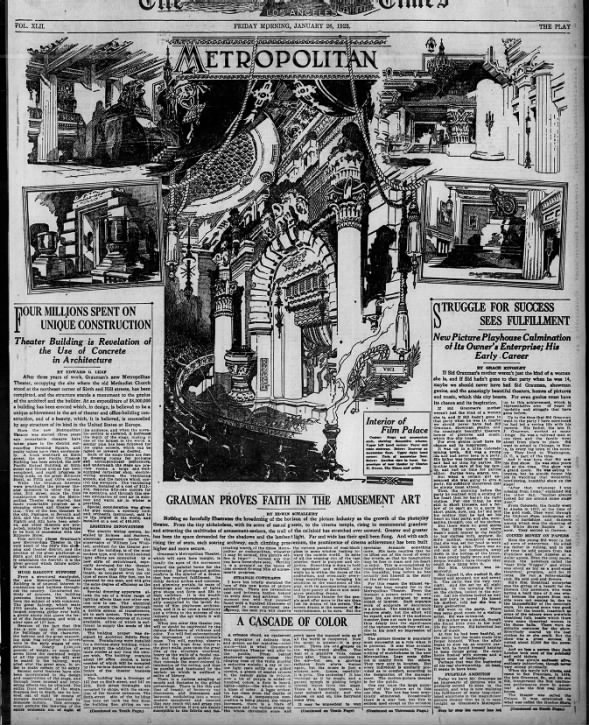
Under the supervision of Architect William Lee Woollett, plans have practically been completed for the interior of the big theater which will form a part of the twelve-story building now under construction at the northeast corner of Sixth and Hill streets by the Hill Street Fireproof Building Company, Mr. Woollett, as the architect of the theater, which will be known as Grauman's Metropolitan Theater, will have charge of the interior decoration, of the paintings and murals, hangings, furniture and electric fixtures, all of which will be designed and installed under his supervision. Mr. Woollett was the designer of the interior of Grauman's Million Dollar Theater at Third and Broadway. In coloring and motive the architecture of the theater will be derived principally from the architecture of Egypt and the Orient. The lobby entrance, from the Sixth-street side of the building, will be flanked by massive columns, while the interior of the main lobby, 46 by 59 feet, will be patterned after the rock-cut tombs of Egypt and Arabia. The floors will be constructed of hand-made tile, each of which will depict phases of the development of Western America. On each side the main lobby will be flanked by a grand staircase leading to the mezzanine floor, which will command a view of both the main lobby and theater auditorium. The concrete surfaces of the interior of the theater will be partially exposed, but it is planned to treat these surfaces with color and gold ornamentation. The same type of decoration will be carried out in the theater auditorium. The great concrete trusses over the audiorium will be partially exposed, but as in the lobby and mezzanine, these tresses will be richly treated with color. A feature of the proscenium arch will be the great canopy, hanging without visible support. This canopy will be decorated with a composite of oriental and occidental designs. Suspended from the ceiling there will be an immense flat dome, which will be made of perforated plaster, and ornamented richly with embossed bronze and gold designs, with medallions in the center large enough for mural paintings.
THE FOUR HORSEMEN.
The screen will be surmounted with monumental figures of the Four Horsemen of the Apocalypse. The horses, modelled from life, will be made of porcelain, with the colors burned in them. The curtains will be held in especially designed bronze screen frames and will be operated by burnished bronze chains which will move on especially constructed swivels which will make them noiseless. The organ to be installed will be one of the largest and finest in the country, it is claimed. Plans for this organ, which is being especially designed for the theater, will include a disappearing console, which can automatically be raised up into the view of the audience upon demand. The theater will have a seating capacity for 4000 people. More than 400 workmen, it is stated, are now employed on the building, and it is planned to have the structure completed and ready for occupation by January 1 of next year. In the construction of the building, according to Brook Hawkins, chief engineer of the Winter Construction Company, there will be used 5,000,000 pounds of steel, mor than 100,000 sacks of cement, and over 2,000,000 feet of lumber in the falsework. The immense cantilever which will support the balcony will weight 1100 tons.
posted by vokoban on Feb 26, 2008 at 8:28am
I guess the organ cost $1 per pound. This is the beginning of an excruciatingly detailed and long article about the organ:

(Jan. 21, 1923)
ORGAN IS LARGEST OF KIND
Complicated Instrument Installed in Metropolitan Theater
One hundred thousand dollars for a musical instrument! A stupendous apparatus of a multitudinous number of small parts correctly assembled! That is the new Hope-Jones unit orchestra Wurlitzer organ that is now installed in Grauman's Metropolitan Theater, the largest instrument of its type in the world. This intstrument was built under the direction of James H. Nuttlall, world-famous builder of fine organs, and the man who was most closely associated with the manufacturer, Hope-Jones. In showing the writer through the organ and explaining the many parts and novel features, Mr. Nuttall said that the instrument is in many ways like the human body. "As the brain is the center of distribution for the body and connecting impulse with the various organs is conveyed through the spinal column with fine nerves, so the console or keyboard is the distributing end of the instrument and the impulse of the various parts of the mechanism is conveyed through a cable on insulated wires. This cable may be ten feet or two miles in length and instantaneous response can be obtained from the console. "The total weight of the instrument is 100,000 pounds," Mr. Nuttall said. "The space necessary to contain the instrument consists of ten independent chambers, each measuring twenty feet long and eleven feet wide................
posted by vokoban on Feb 26, 2008 at 8:52am
Excitement a few days before opening.....

(Jan. 21, 1923)
LOS ANGELES' NEW PLAYHOUSE
Sid Grauman's Metropolitan Theater
ON FRIDAY evening, the 26th inst., will occur the opening of Sid Grauman's gorgeous Metropolitan Theater, to which William Lee Woollett, architect, has contributed his genius. Identified with the West beginning in San Francisco, whence come so many of the world's theatrical celebrities, from David Belasco to David Warfield, Sid Grauman has made himself an international figure as a premiere exhibitor and director of theatrical attractions. Owing to the enormous interest aroused in the event, the opening night will necessarily be more exclusive than is usual in picture presentation. A process of elimination has been imposed upon the director by reason of the overwhelming demands for seats. Though there are possible, reservations for 4400 persons this number is inadequate to accomodate the applications. Mr. Grauman makes announcement of the following plan: Stars, producers, directors and other film celebrities are requested to communicate to the Metropolitan the number of reservations desired on the opening night. It is Mr. Grauman's intention to make this a gala event. "The Metropolitan Theater is to be the very center of the motion-picture universe," says Mr. Grauman, "and it is fitting, I think, that arrangements be made for the accommodation of representatives of the industry, even if the general public is forced to wait for the second night, which really is the inauguration of the theater's career, when the opening program will be repeated.
PROFESSION IS FIRST
" I am asking stars, producers, directors, players, writers and promoters of picture industries to communicate their needs to the boxoffice and make the required reservations. I am asking the public's co-operation also to buy at the boxoffice and not from speculators. I have done all that I could to keep tickets for the opening night out of the hands of 'scalpers.' I hope that my endeavors in the regard will be supported vigorously by the public." As a foretaste of what may be expected on the opening night Mr Grauman announces the following uncompleted program:
To begin with, there will be a demonstration outside the big theater. Details of this are all worked out but are not to be made public. The opening number will be "The Star Spangled Banner," played by a great symphonic orchestra under the direction of Ulderico Marcelli and with Henry Murtagh at the console of the mighty organ. A chorus of 500 voices will be heard. A flag, said to be the largest in the world, will be unfurled at this time and will be the signal for the beginning of a gorgeous patriotic pageant. Then will follow the big orchestral number, the overture to "Tannhauser," by Richard Wagner. It will be directed by Marcelli and the Pilgrim's Chorus will be sung by grand choir of 500 voices. Schubert's "Ave Maria" will be played as a solo number by forty violinists, accompanied by eight expert harpists. Before and after this number will be dancing acts in which a ballet of 200 artists will be employed. Coming direct to the Metropolitan for this engagement are Waring's Pennsylvanians, the greatest syncopaters this jazz country has thus far produced. They come from a successful New York season. All this and more will be the prelude to the feature picture, Gloria Swanson in "My American Wife." A supporting cast of brilliance will appear with the star and will include Antonio Moreno and Walter Long.
posted by vokoban on Feb 26, 2008 at 9:14am
Here is a fairly florid LA Times article written a few days after the opening of this theater. It's pretty long but I'll post it since it contains a lot of details about the decoration and architecture.

(Jan. 26, 1923)
NEW GRAUMAN A WORLD APART
-----
All Activity From Outside Ends at the Threshold
-----
Masterpiece in Cement is Architect's Reward
-----
Beauty and Simplicity Are Keynotes of Creation
By Kenneth Taylor

Swing wide the portals, step over the threshold and, as the doors of the new Grauman Metropolitan Theater close softly behind you, find yourself in a world apart.
Nothing about the theater will remind you of the outside world from which you have just come. The light of day never enters the building while it is open to the public. The noises of the street are shut out just as surely as are the sights of hurrying crowds and vehicles. The architecture is of no one style. Here is a bit of the Greek, there is something Egyptian. Ideas have been borrowed from the Romans, from the Chinese. Beauty alone has been the keynote, and beauty alone is the result.
To just what extent this feeling of aloofness from the world has been sought for we found out just a week ago today when a party of men from The Times was shown through the theater. Even the windows are made of black, opaque glass, and shut out every ray of natural sunlight from the beautiful lounging and rest rooms as well as from the auditorium.

NEW LAND IS REVEALED
Here is a new land: a land that invites inspection and excites imagination. Before you rich velvet draperies hide a full view of the stage and auditorium, although glimpses of the great curtain, on which is painted a travesty of H. G. Well's "Outline of History," are visible occasionally as the crowds in front move down the aisles.
On each side of the foyer, stairways lead to the mezzanine floor and the balcony. As if guarding the staircases, stand two huge statues in gold. They do not balance but, on the contrary, prove striking contrasts in size and significance. On the right is an allegorical, grotestque image which has an enigma as deep as the sphynx and as undiscoverable. On the left is the Snail-Deer. The graceful neck of a deer is attached to the centrifugal folds of earth's most slothful traveler, the snail. Symbolic of romance, tenderness, grace, beauty and aspiration, the deer is held from accomplishment by the sluggish, slimy crawl of the snail.
Beauty of painting and building are in evidence everywhere. Gorgeous hanging, highly valued, adorn the walls. Mural paintings by the score are revealed. The mezzanine floor seems a treasure house of beauty. Artistic arches, carved figures, velvety curtains, highly colored paintings all lend, too, a mystic air.

COMPOSITE BEAUTY STRIKING
Overembellished, you say? Perhaps. But let the composite beauties of the house sink in. go out into the auditorium and see the hugeness of the place. And as the eyes hunt out one innovation after another, they will find that this is not an overdecorated theater; it is, perhaps, reminescent of the Stone Age: the structure is primitive in its massive simplicity.
Stand a moment on the very brink of the balcony on the west side of the house. Below on one hand yawns the cavernous mouth of the auditorium: above on the other hand stretches the vast expanse of balcony.
See what a glance around the temple will reveal.
On the left the great proscenium arch, apparently roughly hewn from naked rock, shields the stage, flanked on either side by great stone columns surmounted by grotesque images. Perched on the column at your side is a carving representing Mirth; on the opposite column another representing Tragedy. In the very center of the arch Gabriel occupies a secluded niche of his own. Hanging from the proscenium, as well as from other parts of the ceiling all over the auditorium, are great pendants, oddly shaped and weighing tons.
And now glance across the auditorium to the opposite wall, where hangs a tapestry or two. The gray monotony of the unfinished cement is relieved here and there with niches, some large, some small. Some contain images.

THREE SPHERES
In the first tall niche hangs an object like a totem pole made of an opaque glass, representing three spheres----of the earth, of the air, of the spirit. Colored lights arranged back of this throw the design in silhouette.
The wall across the back of the balcony is also unique. It is arched all the way across, giving the impression of great distance beyond the actual physical limitations of the auditorium. Perhaps it suggests an ancient aqueduct, serving the needs of a primitive civilization. But the effect is not allowed to predominate, for in the center of the wall, closely hugging the ceiling, are the tell-tale, square openings of the projecting room, for all the world, from the distance at which you stand, like a group of pueblo stone dwellings perched high on a mountain side.
Overhead hangs a great circular design, ninety feet in diameter, which covers the greater part of the ceiling. Never mind its technical name: it has been dubbed the "doily" by the men who have watched the theater rise from the ground. And like a great doily it is, with its latticed, golden strips forming a network behind which thousands of different colored incandescent lamps produce varied effects.
And as you look up, beyond the doily, the beams of the room themselves, covered with cement to be in keeping with the rest of the structure, are visible. Here is an example of the courage and originality of William Woollett, the architect. For instead of covering from view the crude looking braces and rafters with a false ceiling, and suspending false beams from that in order to produce the effect of strength and solidity, he has utilized the same beams that the construction engineer used for the actual work of holding up the roof.

CEMENT AGE IS HERE
Inspect closely the construction of the theater. You will be struck with the thought that the cement age is here at last, for everywhere you turn, that material has been used almost exclusively. It is, in fact, a most deceptive theater.
Mr. Woollett had an inspiration. He insisted that he could use cement to the exclusion of practically all other materials and make it look like anything he wished.
As a result, the wonderful stone and marble work inthe lobby is not stone and marble work at all; it is cement. The great stone pillars on either side of the proscenium are not stone: they are cement. The plush cloth covering the bases of these pillars is not plush: the pillars have merely been painted to resemble that texture of cloth.
And the columns on the stage itself? Ah, you think, there at least is something that is cement and looks like it from all over the house. But approach them and discover that once more you have made a mistake, for upon investigation you will find that what looks like cement is not. It is wood. This was done in order that by a very simple, mechanical operation the entire stage is inclosed in a wooden shell, which acts as a sounding board when the orchestra is heard in concert numbers.
For the most part, the cement has been left unfinished. The walls are rough, revealing the grain of the boards used for molds. Edges of the material protrude where it has oozed out between these boards. Not only are the crude edges still left to view, they are emphasized with gold leaf.
And you turn to sum it up. Huge and massive it is. Beautiful, simple-----and finely primitive.

posted by vokoban on Feb 27, 2008 at 10:55am
Here is a photo from the LAPL, circa 1922. The man in the suit is the architect, William Woollett:
http://jpg1.lapl.org/pics42/00040808.jpg

These are some usherettes:
http://jpg3.lapl.org/pics18/00028694.jpg
posted by ken mc on Apr 13, 2008 at 10:50pm
This is a July 1938 ad.

posted by Lost Memory on Jul 25, 2008 at 1:59pm
Here is an ad for Sally Rand at the Paramount in 1938.

posted by Lost Memory on Jul 28, 2008 at 9:14am
Here is an undated interior photo from the LAPL:
http://tinyurl.com/68jkhg
posted by ken mc on Aug 16, 2008 at 1:03pm
Sorry, that was the New York public library. Force of habit.
posted by ken mc on Aug 16, 2008 at 1:04pm
If you link to the source, you wouldn't have to explain where the photo comes from.

posted by Lost Memory on Aug 16, 2008 at 1:05pm
Here's a photo of the interior of the Metropolitan:

Click here for photo

posted by Bway on Oct 16, 2008 at 12:39pm
Ooops, I just noticed Ken just linked to the same photo...
posted by Bway on Oct 16, 2008 at 12:40pm
Google Images has some interior photos of the Paramount in 1952, when they were having 3D screenings of "Bwana Devil". Interesting shot of the formally attired peeps in the balcony:

http://tinyurl.com/5hqpdy
posted by misterboo on Dec 4, 2008 at 12:48pm
If it was in Hollywood, it was probably at the Paramount/El Capitan on Hollywood Boulevard.
posted by ken mc on Dec 4, 2008 at 12:54pm
Thanks for sharing that misterboo.

posted by Lost Memory on Dec 4, 2008 at 12:54pm
Yes, that shot is from the Paramount Theatre in Hollywood.
posted by William on Dec 4, 2008 at 1:01pm
Post it on this page:

http://cinematreasures.org/theater/17/

posted by Lost Memory on Dec 4, 2008 at 1:13pm
Here is part of an LA Times article dated 5/28/52:

Hostesses in evening dress will greet numerous actors, Mayor Bowron and throngs of theatergoers at the Paramount Theater's reopening at 8 p.m. tomorrow.

Improvements totalling $250,000 at the theater include a new marquee, lobby, foyer, new seats and rocking-chair loges. There will be new lounge rooms and a large television screen. Top motion pictures will be shown as well as stage shows when they become available, said Jerry Zigmond, United Paramount western division manager.

Two employees have been with the theater since it opened 29 years ago as Grauman's Metropolitan. They are Earl C. Hamilton, 61, chief projectionist, and Vic Hayes, 60, doorman. The two remember the theater's initial opening when "My American Wife"m starring Gloria Swanson and Antonio Moreno, was presented.
posted by ken mc on Dec 22, 2008 at 7:51pm
Here is a 1941 ad from the LA Times:
http://tinyurl.com/cgednr
posted by ken mc on Apr 7, 2009 at 3:06pm
This is a 1923 ad from the LA Times. I thought it was interesting as it shows Sid Grauman's influence at that time, as he owned the Metropolitan, the Egyptian, the Million Dollar and the Rialto. The Chinese was not yet built.
http://tinyurl.com/dg3wre
posted by ken mc on Apr 8, 2009 at 10:04am
Looks like the same ad posted on the Million Dollar Theatre listing.

posted by Lost Memory on Apr 8, 2009 at 10:09am
Here is a photo from May 1946, may have been previously posted from another venue, here it is:
http://www.flickr.com/photos/metrolibraryarchive/3483045451/
posted by J.F. Lundy on Apr 29, 2009 at 7:23am
In December 1938 they were staging basketball games on the theater stage, according to this LA Times ad:
http://tinyurl.com/dzjzv4
posted by ken mc on Apr 29, 2009 at 7:42pm
The Three Stooges Fan Club is trying to document a 1957 personal appearance of Joe Besser, Moe Howard and Larry Fine as The Three Stooges at the Paramount. This would be the only personal appearance by Besser with the Three Stooges. Any documentation, such as a newspaper ad or review would be greatly appreciated. My email address is: fereighter@aol.com Thanks, Frank Reighter
posted by Frank Reighter on Jun 7, 2009 at 6:03pm
Here is a January 1949 ad from the LA Times:
http://tinyurl.com/ngfejz
posted by ken mc on Jul 14, 2009 at 10:20pm
Here is a 1943 ad:
http://tinyurl.com/mvp9a4
posted by ken mc on Jul 23, 2009 at 9:41pm
The Metropolitan/Paramount was the second largest movie palace ever built on the West Coast the largest was the Fox in San Francisco. My friend Dick who worked for Disney and United Artists said this was the most impressive Movie Palace in LA. brucec
posted by brucec on Aug 5, 2009 at 10:23pm
When the theater went to screening B films in the late 50s a basement bar called the Metro that was a gay scene opened just east of the box office on 6th next to the alley. Also a post razing Wm.Reagh photo of the necktie stand @ the corner of Hill and 6th- it's in the picture catalog of California State Library - search terms: Reagh and Hill ( he didn't i.d. the site )
posted by rmechtly on Aug 17, 2009 at 8:20pm
Comment
*

Notify me when someone replies to my comment?
Note: Please read our comment policy before posting. Comments which are off-topic, obscene, spam, or personal attacks will be removed. Help us keep the discussion productive!