
Astor Theatre
176 Tremont Street,
Boston,
MA
02108
176 Tremont Street,
Boston,
MA
02108
 7 people
favorited this theater
7 people
favorited this theater
Additional Info
Architects: John Bailey McElfatrick, William C. Riseman, Abraham Woolf
Firms: William Riseman Associates
Previous Names: Tremont Theatre
Nearby Theaters


News About This Theater
- Oct 6, 2010 — Happy 50th, "Spartacus"
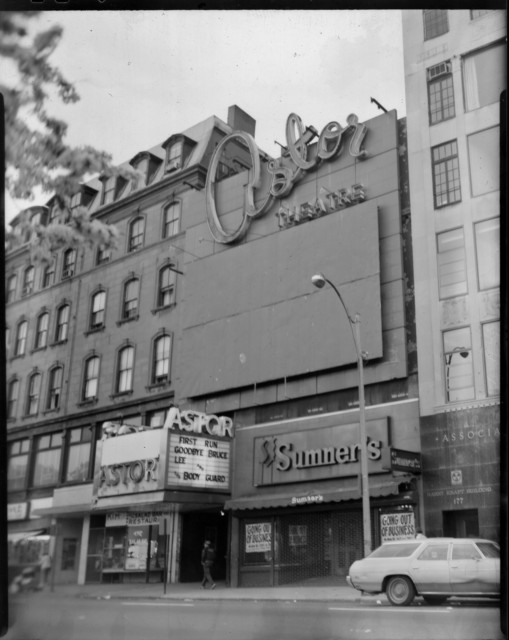
The Tremont Theatre was opened on October 14, 1889, and was the third Tremont Theatre to be built on the site. It was designed by architect John Bailey McElphatrick.
In November 1947 it was remodelled to the plans of architectural firm William Risemen Associates, and reopened as the Astor Theatre. One of the premiere first run movie theatres in Boston’s past. It was located opposite the Boston Common on Tremont Street. It was where De Mille’s “The Ten Commandments” played in the 1950’s.
Demolished in July 1983, the Loews Boston Common multiplex now occupies the same general spot.
Contributed by
Gerald A. DeLuca
 Want to be emailed when a new comment is posted about this theater?
Just login to your account and subscribe to this theater.
Recent comments (view all 125 comments)
Yes,the Astor was very old (1889). I admired it on the outside, on Avery Street and the wide alley which ran along its east side. As a kid, I had an interest in old theatres and rail stations. I thought the Astor was really interesting, until I bought a ticket and went inside. What a disappointment ! (I was about 15 at the time). There was a fire (not major) inside about 1915, and one or more small fires in the outer lobby circa 1980. During demolition you could see traces high up on the auditorium walls of some fancy gilt decoration.
Boston theatre histories credit the Tremont/Astor as the first building in Boston actually designed from its outset for stage performances. Seems incredible all the interior changes to it were never documented as it transitioned to film presentation. At least we still have the Colonial and the Majestic as living history. Thanks to all who shared memories of the Astor.
RogerA: It seems highly unlikely the Astor (or any venue) would’ve booked only prints with a magnetic soundtrack for an entire decade (save for the one example you cited). Even the Gary, which played more roadshows than the Astor, didn’t play mag exclusively. I think the closest example of a decade’s worth of mag-only titles would’ve been the Boston Cinerama.
Go back and check the records like I did and see what you can find but they ran a lot of 70mm in those ten years. Spartacus, Ryan’s Daughter, The Ten Commandments (re-release),2001 House of Wax 70mm 3D I’m not sure what CinemaScope movies they ran but it was common practice for A class theaters to get a print with mag sound. There was a mag only print of The Exorcist that played at the 57. The Gary ran a lot of mag it might have all been mag or 70mm. I know for a fact there were mag prints of Mary Poppins. It didn’t have to be roadshow to have mag prints. Mag was really popular in that era especially in the cities.
The mag pickup heads at the Astor were worn down to where they were flush with the plastic 35 and 70 on both machines. The only mag heads in good condition were the ones made special for House of Wax. The four track 35mm heads were worn worse than the 70 heads no high frequency. The original mag heads from the Saxon and the Gary were worn down to nothing too.
The Astor was the only theater where the 70mm picture was wider and taller than the Scope picture. The liked to book 70mm pics there but it was obvious they ran a lot of 35mm mag films too.
The Astor’s 70mm and roadshow engagements are noted in this new article on Boston’s large format and roadshow history.
Good list. There was a lot of mag back in the day.
Has anyone found photographs of the Tremont/Astor interior?
On November 18, 1925, the Tremont Theatre became national headlines when both the theater management and Boston Police ejected 30 members of the Harvard University football team from the theater’s lobby, depicting them as “half-fried party boys”. The squad were forced to walk to the nearest police station to demonstrate their sobriety after then-manager Stanley Osborn lined the players up on the sidewalk and invited several lieutenants to check on them.
On December 12, 1934, the Tremont Theatre was one out of four theaters, two in Boston, that suffered damage by an exploding bomb. It was in connection of disputes between rival theatrical union workers.