Search

Theaters News Links

Advanced search
 

Theater Guide

Now listing 27,647 theaters & 1,598 photos… more
Browse by...
 

Add Your Cinema Treasure!

Add Theater
Add Photo (offline)
Add Theater News


Recent Comments

Feb 09 Gaston Mall… (10)
Feb 09 Ziegfeld Theatre (3326)
Feb 09 Regal Riviera… (13)
Feb 09 Star Theater (22)
Feb 09 Fox Theatre (8)
Feb 09 Jewell Theatre (4)
Feb 09 Crawford Theater (7)
Feb 09 Hi-M Drive-In (4)
Feb 09 Hill Theatre (9)
Feb 09 Cameo Theatre (1)


  Discover. Preserve. Protect.
Also known as 5th Avenue Playhouse, Cinema de Paris

5th Avenue Cinema

New York, NY
66 Fifth Avenue
, New York, NY, United States
(map)
Status: Closed
Screens: Single Screen
Style: Unknown
Function: Learning Center
Seats: 273
Chain: Unknown
Architect: Thomas W. Lamb
Firm: Unknown
Add a photo for this theater!
A premiere art house in the Greenwich Village area of New York for many decades where the offerings were always synonymous with high quality. Satyajit Ray's PATHER PANCHALI was introduced to New York moviegoers in this small venue. Pasolini's ACCATTONE had its first commercial run here. The theatre building is now part of the New School for Social Research.
Contributed by Gerald A. DeLuca


YOUR COMMENTS

 
The 273-seat theatre was located at 66 Fifth Avenue and originally known as the Fifth Avenue Playhouse. The change to "Cinema" was probably in the 1950s, when that became an "in" word.
posted by Warren G. Harris on Mar 15, 2004 at 9:52am
I recall this little gem of a theater from the mid 50's, which was located on Fifth Avenue at 12th Street. At the time they ran two series of revivals of early talkies under the umbrella title of "OK For Sound". It was there as a teenager that I was introduced to "Freaks", "Imitation of Life" (1934), "The Lottery Bride" (an early Jeanette MacDonald vehicle, "The Great Gabbo", "Seven Sinners"
and numerous other gems from that early era.
The most striking feature of the theater was a small cafe setting in the lobby with a b/w wall size mural in the background done by the late Abe Hirschfeld. It depicted charactertures of numerous Hollywood celebrities sitting at tables in an outdoor cafe. As I recall Chaplin was in the center holding a red rose, which was three dimensional and the only touch of color. Does anyone know if this mural still exists in the present space where the Fifth Avenue Cinema once existed?
posted by ErwinM on Jun 6, 2004 at 2:22pm
This sorely missed little cinema was programming art and specialty fare even in the 1920s, showing films like Lang's "Dr. Mabuse," "Madre" ("Cenere") with Eleonora Duse, "The Legend of Gosta Berling" with Greta Garbo. Between 1958 and 1960 they premiered the three films of Satyajit Ray's Apu trilogy, "Pather Panchali," "Aparajito," and "The World of Apu." For some reason I particularly remember seeing Adolfas Mekas' zany "Hallelujah the Hills" here in 1963 and a revival of Herbert J. Biberman's "Salt of the Earth" another time. I'd love to have complete list of everything that played here. The Fifth Avenue Playhouse/Cinema belongs in the pantheon of art houses. The only negative I can recall is that the sight-lines were not always the best because of minimal raking in the auditorum and a lower-than-optimal ceiling.
posted by Gerald A. DeLuca on Jun 6, 2004 at 5:21pm
The mural that was created by Al Hirschfeld (not Abe, as mentioned above in error) for the 5th Avenue Cinema was done in 1954 and was called "The History of Hollywood". Evidently, the old 5th Avenue Playhouse must have undergone a massive renovation around that time. As I recall, when I attended the revival series in the mid 50's, the theater appeared to be new and modern.

Does anyone know if the mural has survived the theater being taken over by the New School for Social Research?
posted by ErwinM on Sep 16, 2004 at 8:29am
Erwin-- I visited the New School for a conference about twelve years ago and I believe I saw the mural there then (even though I didn't recall its setting in the original theater). Among films I remember seeing there in the mid-late-'50s was Ingmar Bergman's "Magician."
posted by BoxOfficeBill on Sep 16, 2004 at 8:39am
Box OfficeBill...Thanks for the update on the mural. Glad that it made it into the 90's and may still be around. As I recall it was on the right wall of the lobby pretty near where you entered the lobby after buying your ticket. You then had to walk past the mural toward the back of the lobby to enter the auditorium through an entrance on the left, which was close to the screen. In other words the auditorium and the lobby were parallel to each other. It would be interesting to find out how this layout compared to the original 5th Avenue Playhouse.
posted by ErwinM on Sep 16, 2004 at 11:01am
An ad for 10/5/52 lists this as the 5th Ave Playhouse, so i guess they used that name also. They were showing a double bill of Charles Laughton in "The Private Life of Henry VIII" and "Catherine the Great".
posted by RobertR on Jun 7, 2005 at 6:36am
Here’s a Showbill program from the Fifth Avenue Cinema in March, 1960:

http://i4.photobucket.com/albums/y116/petrarch/cinematreasures/magician-1.jpg

http://i4.photobucket.com/albums/y116/petrarch/cinematreasures/magician-2.jpg

Some of Bergman’s best films opened in NYC within a period of three years or so: “Smiles of a Summer’s Night,” “The Seventh Seal,” “Wild Strawberries,” “The Magician,” and “The Virgin Spring.” The buzz about them was loud enough, but I remember that many movie-goers were still caught off-guard. I recall sitting in the Beekman at “Wild Strawberries” and over-hearing a middle-aged couple behind me mid-way through the film: He—“How long is this picture anyway?” She—“And why hasn’t Ingrid Bergman come on yet?”

I O.D.’d on these films pretty quickly, and was reaching the point of fatigue with “The Magician,” but that didn’t prevent me from scribbling all over my program all sorts of profound thoughts that I believed I’d found in the film. I remember seeing “The World of Apu” later that year at the Fifth Avenue Cinema. I’d already seen (or would soon see) “Pather Panchali” at the Thalia; but neither film made much of an impression on me then. Nearly thirty years later I would view all three films of the Apu trilogy in one sitting, when they finally hit me for what they are worth. The impact was staggering. For days afterward, I found it hard to concentrate on anything else.
posted by BoxOfficeBill on Jul 13, 2005 at 9:26am
Pather Panchali made an overwhelming impression on me when I first saw it at the Avon in Providence in 1959, and I was still in high school! I kept going back. It is still one of my favorite films of all time. I understand it played the Fifth Avenue for six months or more.
The Bergman anecdote is hilarious.
posted by Gerald A. DeLuca on Jul 13, 2005 at 10:40am
The Apu trilogy really is sublime. Remember how at the end of "Manhattan" Woody Allen, suicidal beyond repair, makes a list of things that would help to keep him alive? The Apu trilogy ranks high on the list, and generates a laugh because of its funny sound in Allen's Brooklynese pronunciation. But its inclusion is so appropriate.
posted by BoxOfficeBill on Jul 13, 2005 at 11:42am
Agreed. The pronunctiation of Apu, incidentally, is something like "Aw-poo" in Bengali. I once went to a 16mm showing of Satyajit Ray's Pather Panchali at R.I. College where it was listed as "Father Panchali." You know him, the parish priest! I'm sure you know the title means "Song of the Road." Long after the film was made, composer Ravi Shankar, who did the haunting score, became famous internationally and was even one of the performers at Woodstock in 1969.
posted by Gerald A. DeLuca on Jul 13, 2005 at 2:58pm
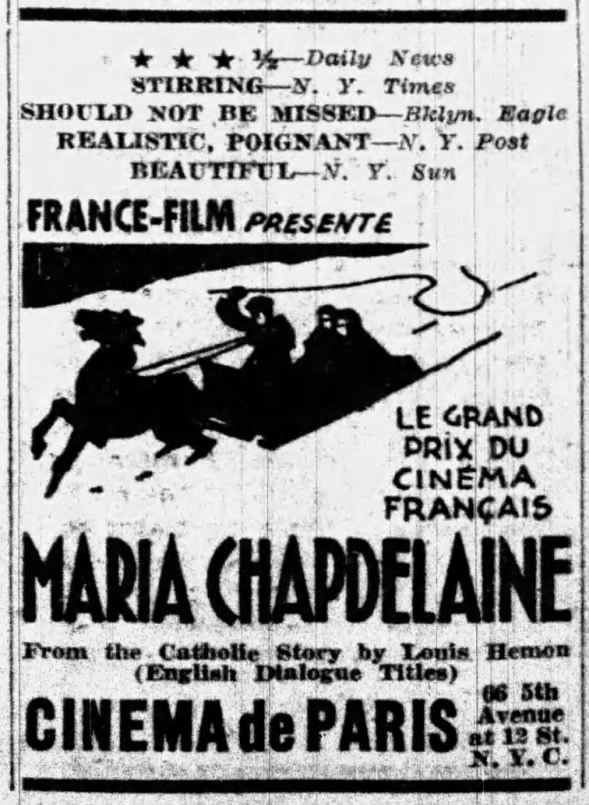
THESE THEATRE ADS appeared in a program booklet "Stadium Concerts Review" for Lewisohn Stadium, College of the City of New York, for July 29 to August 4, 1936. The concerts were by the Philharmonic-Symphony Orchestra. The small ads tout what was playing at several New York movie theatres. One of them was the Cinema de Paris, which, given the address, seems to have been another name for the 5th Avenue Cinema/Playhouse.
posted by Gerald A. DeLuca on Sep 25, 2005 at 2:45am
http://i21.photobucket.com/albums/b254/davebazooka/FifthAve.jpg

This is 66 Fifth Avenue as it appears today. I saw no trace of a Hershfeld mural anywhere in the lobby area.

It is now the entrance to one of The New School's buildings.
posted by davebazooka on Nov 19, 2005 at 7:17pm
I remember going to this cinema only once, however, unfortunately I cannot remember what film I saw. What I really want to ask is does anyone remember the Cinemabilia bookstore that was located on 12th street? This was a great bookstore dedicated to films. Books, current and out-of print, magazines, posters, and thousands of stills. Originally, they were located on Corneila Street in the Village. A great place where I spent a lot of time.
posted by JohnG409 on Nov 29, 2005 at 2:34am
1st Surrealist Film Program (December 31st, 1941):
www.i8.photobucket.com/albums/a18/Warrengwhiz/5th41.jpg
posted by Warren G. Harris on May 5, 2006 at 5:31am
The mind boggles at this 1941 double feature, which apparently was inspired by the popularity of the Broadway musical, "Lady in the Dark":
www.i8.photobucket.com/albums/a18/Warrengwhiz/5thave1941.jpg
posted by Warren G. Harris on May 12, 2006 at 7:32am
A December 14, 1925 c/o shows a 284 seat theater at this address. It doesn't state movie theater. An October 18, 1926 c/o shows a 284 seat motion picture theater at this address. On that c/o the architect is Thomas W. Lamb. Today this address is listed as Parsons School of Design.

posted by Lost Memory on May 12, 2006 at 7:59am
"The mind boggles at this 1941 double feature"
That kind of "psychoanalytical film program" also made its way into many of the "today only" Thalia offerings of the 1950s, and perhaps before and after.
posted by Gerald A. DeLuca on May 12, 2006 at 8:38am
It was showing movies from at least November, 1926, starting with a re-release of THE CABINET OF DR. CALIGARI followed by the first run of MIKAEL (AKA, Chained, The Invert) a German gay drama about aging painter Rodin, his male model and the woman who gets in their way. (Only the village would accept THAT plot line in 1926!)

This was the 5th Avenue Playhouse while the Proctor house on 28th Street operated as the 5th Avenue Theatre.
posted by AlAlvarez on May 12, 2006 at 8:38am
Warren-- Thanks for the info on the Freudian double-bill, timely for this week’s celebration of Sigmund’s 150th birthday. As an unabashed Freudian, I delighted in it. One of my movie-going buddies from the ‘60s wrote an homage to Freud in last week’s Wall Street Journal, which tickled me even though it missed the point. We owe a lot to F because his approach (though not conclusions) were so wonderfully counterintuitive—a healthy psyche is not always a happy psyche, but its tensions are good because the simplistic alternative is worse.

“Secrets of a Soul” is a 1927 film directed by GW Pabst about a grown man’s phobia of knives (sounds silly, but Pabst is, well, Pabst and appropriately named for his papally blue ribbon distinction). “Eternal Mask” is a 1937 Swiss film about guilt obsession directed by Werner Hochbaum (I don’t know whether phallic Hochbaum is appropriately named). In both cases, the psychoanalysis is dumb (there is no talking cure). Freud’s social theory is what sets him apart, and a good reason to celebrate his 150th. Cheers to the Fifth Avenue for celebrating him.

Lost Memory: Lamb, the architect of the Fifth Avenue? The mind boggles.
posted by BoxOfficeBill on May 13, 2006 at 4:00am
I was also surprised to see Thomas W. Lamb as the architect. If anyone is interested in seeing the c/o with Lamb's name on it I would be happy to email it to them. I'm still wondering if this was a movie theater in 1925 or did it open as a vaudeville theater and switch to movies in 1926.
posted by Lost Memory on May 13, 2006 at 5:27am
Thomas Lamb had a large company with many architects working under him. Lamb himself was often not the actual achitect of projects that have been credited to his company.
posted by Warren G. Harris on May 13, 2006 at 5:32am
This Rugoff coffee house cinema always had creative double bills, insuring packed audiences. A memorable pair were "The Girl With the Green Eyes" & "Billy Liar". Apart from the Hirschfield mural, a rather plain venue, but the features were truly memorable. Is Parsons still using the space as an auditorium?
posted by Astyanax on Jul 11, 2006 at 5:49am
An article about pioneer "art" theatres in a 2005 issue of Film History Magazine claims that this was a "legit" playhouse prior to opening as a cinema in late 1926. Michael Mindlin, who'd been a stage producer, received encouragement from the then powerful National Board of Review of Motion Pictures, which had its headquarters in the building next door. The first program consisted of an educational one-reeler from Germany, "The Parasol Ant"; Chaplin's three-reel comedy, "A Dog's Life"; a short about early French cinema, and a revival of "The Cabinet of Dr. Caligari."
posted by Warren G. Harris on Aug 11, 2006 at 5:40am
An elephant at the Fifth Avenue Cinema in 1954.
posted by Gerald A. DeLuca on Mar 23, 2007 at 5:42am
It was called 5th Avenue Playhouse, according to Kristin Thompson!
posted by Claudia from Italy on Jan 2, 2008 at 8:28am
The name varied over the years between "Cinema" and "Playhouse." And more often than not, "Fifth" was used instead of "5th."
posted by Warren G. Harris on Jan 2, 2008 at 8:57am
This stopped showing films in 1973.
posted by AlAlvarez on May 16, 2008 at 7:50pm
Renewing link.
posted by Ed Blank on Mar 30, 2009 at 6:55pm
Comment
*

Notify me when someone replies to my comment?
Note: Please read our comment policy before posting. Comments which are off-topic, obscene, spam, or personal attacks will be removed. Help us keep the discussion productive!