
Rhode Center for the Arts
514 56th Street,
Kenosha,
WI
53140
514 56th Street,
Kenosha,
WI
53140
 4 people
favorited this theater
4 people
favorited this theater
Related Websites
Rhode Center for the Arts (Official)
Additional Info
Previously operated by: Essaness Theaters Corp., Saxe Amusement Enterprises, Standard Theaters Management Corp.
Architects: George W. Leslie Rapp
Firms: Rapp & Rapp
Functions: Live Theater
Styles: Art Deco
Previous Names: Rhode Opera House, Gateway Theatre, Lake Theatre, Lake 1 & 2
Phone Numbers:
Box Office:
262.657.7529
Nearby Theaters


News About This Theater
- Dec 20, 2007 — Rhode Opera House in Kenosha now has heat!
- Jul 3, 2007 — New heating and a/c for Rhode

The original Rhode Opera House was opened in 1891 and was destroyed by fire in 1896. A new opera House was built on the site and was screening motion pictures by 1901. In 1924 it was taken over by Saxe Amusements. They demolished the theatre in 1926.
In 1927 they built the Gateway Theatre on the site, which opened on December 29, 1927 with Bebe Daniels in “She’s a Sheik”. It was equipped with a Barton theatre organ. The theatre had 1,800-seats. In 1963 Standard Theatres leased the theatre and it was renamed Lake Theatre, reopening on April 28, 1963 with Jackie Gleeson in “Papa’s Delicate Condition”. On March 12, 1976 it was twinned and renamed Lake 1 & 2. It closed on March 14, 1984 with Paul Newman in “Harry & Son” & Rachel Ward in “Against All Odds”.
From 1988 it became home to the Lakeside Players, a community theater group. In 1989, they purchased the building and it was re-named Rhode Center for the Arts.
Contributed by
Pete Christy
 Want to be emailed when a new comment is posted about this theater?
Just login to your account and subscribe to this theater.
Recent comments (view all 53 comments)
After those windows were replaced now work has proceeded on relighting the front chandelier which has been pretty much hidden from view for years and left dark. The plan from what I hear is to have it on a sensor so it turns on at night, lighting the center front window through out the night. Currently a lone bulb is in it and turns on with the other lights. Not heard a timeline for when this will occur. There has been other small improvements occurring backstage such as dressing room improvements/painting and improving the backstage bathrooms.
The GATEWAY Theatre’s 90th Anniversary last Friday passed without a word of observance from the current occupants … not a good sign, in my opinion.
“The Wizard of Oz” world-premiered at the GATEWAY Theatre on this night eighty years ago, and again, there’s been no observance of that history in any manner.
Opening as Lake on April 26th, 1963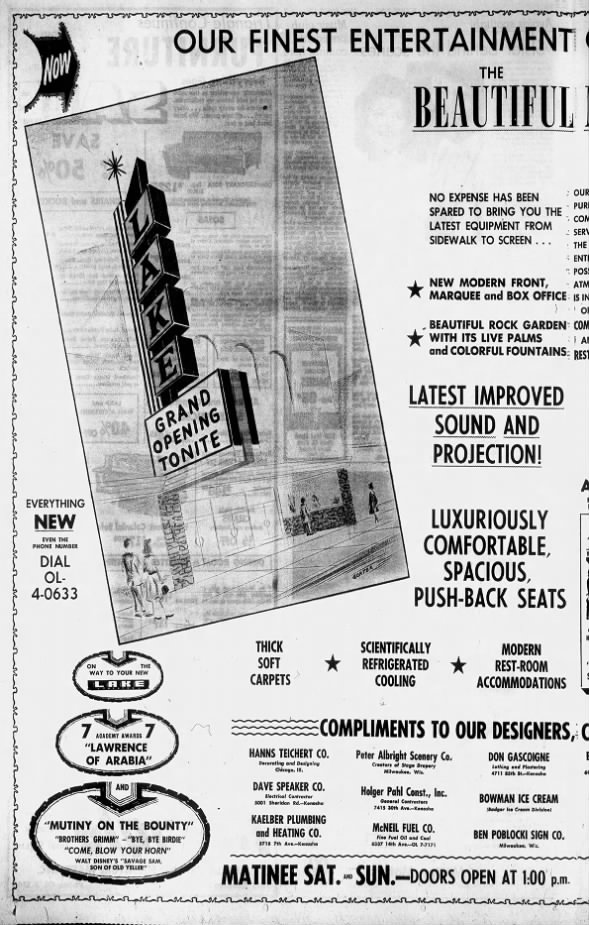 Lake theatre opening 1 Fri, Apr 26, 1963 – 8 · Kenosha News (Kenosha, Wisconsin) · Newspapers.com
and
Reopened as the Lake 1 & 2 on March 12th, 1976. Grand opening ad posted.
(October 25, 1927: Kenosha Evening News) New Gateway Theater Near Opening Date - Saxe Amusement House Enclosed Plans for Opening Early in December
With construction work rapidly nearing a completed stage, opening of the new Gateway theater as the splendid new Saxe Amusement company enterprise which is now rising on the site of the old Rhode theater on Fifty-sixth street traversing the block from Fifty-sixth to Fifty-fifth has been set for early December and means the addition of another beautiful and modern playhouse to the list of fine amusement places in Kenosha. While the building is not finished there is every evidence that the competed project will fill the owners and interested citizens with pride for unique appeal and excellent entertainment service which will be rendered.
Construction work has reached the point where nearly eighty men are employed in the various crews of craftsmen. The plasterers are rushing their work, much of which is a very difficult type with its panelling and staff molding.
Building Is Enclosed - The building is fully enclosed and any amount of inclement weather will offer no obstacle to rapid completion. It is expected by Manager J. L. Morrissey of the Saxe Amusement company’s local enterprises that the last days of November will find the building complete except some of the small items which cannot be done until occupancy begins. Manager Morrissey stated today that nothing is being overlooked and no expense spared to make the theater the last word in construction convenience and service. He said: We have employed Rapp and Rapp as architects because they have to their credit such notable theaters as the Oriental, McYicker’s, Roosevelt, Uptown and Norshore in Chicago. The $16,000,000 theater marvel of this generation which is the Paramount in New York City was constructed by them. “The architects are specialists in ventilation, a much desired feature for any building where thousands of patrons are handled in relatively short periods.
Name Gateway Appropriate
“The Gatewav, so named because of the location of Kenosha in relation to the rest of Wisconsin, is being equipped with a $50,000 refrigerating plant which will keep the temperature at any desired degree regardless of the prevailing weather outside. If necessary the plant could make ice. “A special ventilating engineer will be in constant charge of the equipment which will insure a pure fresh air to every patron of the house.” Manager Morrissey says the stage will be the largest in the state with the exception of the Milwaukee Auditorium. Its dimensions are 36x110 feet which will permit the house to cue for any type of attraction. All seats with the exception of a small number in the mezzanine balcony are on the lower floor. Manager Morrissey said that the experience of the Saxe Amusement company and the forty-two houses it controls in the state of Wisconsin indicates that the vast majority of theater-goers want to sit on the lower floor. For that reason over fifteen hundred may be accommodated in this manner in the new Gateway and about two hundred in the balcony.
Acoustics Planned With Care
The theater is compact and cozy with every seat so arranged that all may see and hear. The acoustics are further enhanced by the small balcony and arched ceiling. The seats are to be of latest design, well cushioned and very comfortable. The entire theater is planned to be soundless and considerable pains have been taken to work out this arrangement. A $50,000 Barton organ is to be installed which will be an exact duplicate of the Wisconsin theater organ in Milwaukee. The two organs are the largest in the state. Though Manager Morrissev could not announce the policy of the Gateway until later, he assures Kenosha theater goers that there will only be pictures of greatest merit, saying “By the control of many theaters, the Saxe Amusement company has the pick of pictures and the best will be shown at the Gateway.”
Staff Now in Training
The entire staff of the new theater is now in training at the Wisconsin theater in Milwaukee. It is the desire and intention of the company to duplicate the service of the Milwaukee house in every particular. The same form of presentation in practice there will be used in Kenosha. Besides the theater itself, entrance of which is on 56th street, there are two stores, both of which are about completed and will soon be leased. The theater covers an area in the middle of the block bounded by 6th and 5th avenues and 56th and 55th streets. It runs the entire length of the block and neither the store building on 6th avenue nor that on 56th street are connected by entrance to the theater.
Local Musician to Leave City (9-20-1930)
After exactly two years in Kenosha, Leonard M. Salvo, well known piano teacher of the city and popular organist at the Gateway theater, together with Mrs. Salvo, is returning to Chicago on Monday to make his future home.
All arrangements for the change have been completed. This week Mr. Salvo turned over his plano pupils to Miss Margaret Schmitt, popular music teacher, since both he and Miss Schmitt teach the Leschetisky system of piano study. Sunday will be his last uday at the theater.
In Chicago. Mr. Salvo will start work in about two weeks for the Essaness Theater Corporation, playing at the Chateau theater at Grand and Broadway on the north side. The theater is now being remodeled, re-decorated and sound installed and will be ready for re-opening in about two weeks,
Mr. Salvo was brought to Kenosha two years ago this month by the late Charles Mensing, at that time manager of the Gateway theater here, and he has been organist at the Gateway ever since, organising piano classes of his own.
Prior to coming here, he was organist at the Capitol theater in Chicago, and has a wide circle of friends both in Chicago ard Kenosha to wish him good luck in his new venture.
Last downtown picture show closes
By DON JENSEN Staff Writer, Kenosha News (3/14/1984)
The Lake Theater in downtown Kenosha will show its last film Thursday.
After 58 years as a movie theater, it will close its doors for lack of business.
It is the last remaining downtown movie house, and the largest of Kenosha’s grand old movie houses to remain in business.
Jack Belasco, executive vice president of Essaness Theaters Corp., Chicago, which owns the theater at 514 56th St., cited “terrible losses” and a generally poor business climate in the downtown area.
Essaness also owns the Keno and MidCity outdoor theaters here.
“We’d like to operate, but not at the losses we’ve suffered,” Belasco said.
He indicated the firm would try to sell or lease the building.
For many years the theater was in competition with the also-large Kenosha and Orpheum theaters for downtown’s substantial movie business, along with one or two smaller houses off Sixth Avenue. Only the Roosevelt Theater on the city’s west side, built on a smaller scale, still remains as an example of the old-fashioned movie theaters stylish before television, and now videotaped movies, came on the scene.
There has been a theater located at the Lake Theater site since 1891 when Peter Rhode built his first opera house.
In 1926, the Saxe Amusement Co. of Milwaukee purchased the old opera house, tore it down and constructed a half-million dollar movie palace, the Gateway Theater.
The theater, opulently decorated, had a reputation for having perfect line-of-sight vision of the large screen from any seat in the house, and for its near-perfect acoustics.
It remained the Gateway until a remodeling in the late 1950s, when it was renamed the Lake Theater. (Ed.: 1963)
In 1976, another renovation resulted in the dividing of the large auditorium into two smaller theaters each seating about 480 persons.
AEC Group Inc. Architectural Engineering Division SUMMARY OF INVESTIGATION & FINDINGS KENOSHA/RHODE THEATRE STUDY MARCH 27, 1989
Investigations indicated a local theatre market area consisting of Kenosha and Racine counties in Wisconsin, population 258,000, and Lake County, Illinois, population in excess of 500,000, provides a potential local market of ¾ million people. Organized bus tours and effective tourism promotion can extend a theatre’s market area to over a 50 mile radius. This extended market area is especially important for a dinner theatre. This size market area has the potential to support both a performing art theatre and a dinner theatre. Through a questionnaire Kenosha and Racine counties were surveyed. Source of Lake County information is a 1987 art study. Questionnaires were circulated in Walworth County through the newspapers and a few by direct mailing with no success.
The questionnaire survey was conducted as follows: 1. Newspapers: Display ads in the Kenosha News, the Midweek Bulletin, the Kenosha News Courier and the Messenger. 2. Direct Mailing #1: Selection of individual’s names at a pre-determined interval established so that 406 selected names would span the entire Kenosha, Wisconsin Bell telephone directory. 3. Direct Mailing #2: Individual names (1048) selected from the Racine Theatre Guild mailing list. 4. Services and Professional Organizations: Members of nine organizations, Kiwanis, Lions, Rotary clubs and the County Bar and the County Dental associations; completed questionnaire during their meetings.
Provide for a concession area in the main lobby and on the mezzanine level.
Redesign the dressing areas below and to the east of the stage creating stage storage behind the stage and new, more flexible dressing facilities below the stage.
The Kenosha Theatre and the Rhode Opera House both are capable and worthwhile to restore. The structural systems are sound in each building. Each have good design details that, when fully restored, will provide a House of Enchantment for theater goers of all ages. However, to be a viable asset to the community each theater must meet certain criterion.
Alterations over the years:
The major alterations are the twinning of the House, the abandoned balcony, and alterations to the mezzanine foyer. The marquee is not original. Original construction drawings have not been located, so all original features cannot be identified.
Decorating: The theatre has been cleaned and there has been limited use of the facilities. As a dinner theatre, complete renovation and decorating would be required.
The study has identified definite local support and persuasive reasons as to why the Kenosha Theatre and the Rhode Opera House have the potential to play a supportive role in the redevelopment of the Lakeshore and the revitalizing of the adjacent business district. The two theatres would support a lakeshore recreation/entertainment image and enhance the culture image of Kenosha. By expansion of the local entertainment facilities many area people will be able to participate and/or enjoy theatre art more often. The previous quoted comment is only one of many expressing this desire. The theatres, properly managed and promoted, will also bring people into the lakeshore area. New higher income housing in the immediate and adjacent areas will be an asset to the theatres.
General atmosphere after renovation/restoration: Spacious, ornate, impressive lobby and staircase. The House; more intimate relationship with performance, a more relaxed atmosphere, with well designed, orderly, decorative features.
Current general conditions: In considerably better condition. Some decay due to inadequate maintenance during recent years. Can be restored to original splendor.
Size - Seating, can influence the price of tickets for some events. 1,100/1,200 seating capacity on main floor and small balcony. Existing seats can be restored. Seats have been removed in balcony.
Once operated by Essaness Theatres. The Lake 1 & 2’s actual closing date is March 14, 1984 with “Harry & Son” in Screen 1 and “Against All Odds” in Screen 2.