
Harris Theatre
226 W. 42nd Street,
New York,
NY
10036
226 W. 42nd Street,
New York,
NY
10036
 8 people
favorited this theater
8 people
favorited this theater
Additional Info
Operated by: Shubert Brothers Theater Company
Previously operated by: Cinema Circuit Corp.
Architects: Thomas White Lamb
Styles: Italian Renaissance
Previous Names: Candler Theatre, Cohan and Harris Theatre, Sam H. Harris Theatre, The Academy
Nearby Theaters


News About This Theater
- Oct 12, 2014 — The Nitehawk celebrates the Deuce
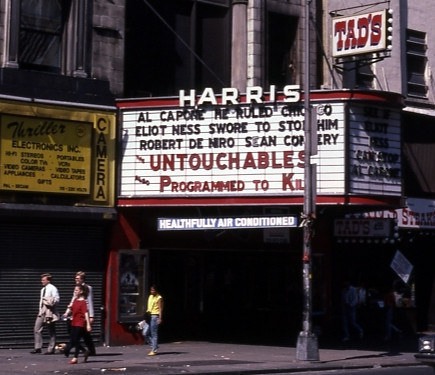
The Candler Theatre was an early work of architect Thomas W. Lamb who designed the theatre which was at the rear backing onto W. 41st Street at the side of the five story Candler office building. The 28-story Candler Building facing W. 42nd Street was designed by architectural firm Willauer, Shape & Bready and for a while was the tallest building on W. 42nd Street. The theatre was built with a projection booth at the rear of the balcony, and opened as a movie theatre on May 14, 1914 with the Italian version of “Anthony and Cleopatra”. It was located between two larger and longer-established W. 42nd Street theatres, the Liberty Theatre and New Amsterdam Theatre.
Its main entrance on W. 42nd Street meant that its lobby ended up being long and narrow, leading to the auditorium, which was closer to W. 41st Street. It also meant that the exterior wall of the W. 41st Street side of the Candler Theatre was banal, and devoid of details, other than then fire escapes which criss-crossed it.
Built in the Italian Renaissance style, the Candler Theatre could seat 1,125 in an auditorium which, though not overly large, gave the impression of being much more spacious than it actually was, due to Lamb’s ingenious design. There were 625-seats in the orchestra and 500-seats in the balcony.
Its ceiling contained an elliptical shallow dome, ringed by Art-Nouveau style chandeliers, in a floral theme, similar to those at the neighboring New Amsterdam Theatre. The two-story auditorium, with a balcony and two sets of opera boxes flanking the proscenium arch, was minimally decorated, but did include gilded plasterwork around the proscenium and a general color scheme of ivory and gold.
Its 25-foot wide lobby, with its liberal use of marble and more gilding, also had 17th Century style wall panels, decorated in floral patterns. Its foyers were decorated with tapestries depicting scenes from Shakespeare (as this was a playhouse, after all).
Built by Asa Candler and the Candler family, of Coca-Cola fame, they leased the theatre to impresarios Sam H. Harris and George M. Cohan, who would operate the Candler Theatre as a legitimate house. The first stage production came on August 19, 1914 when George M. Cohan starred in the hit show “On Trial”.
In 1916, the theatre was renamed the Cohan and Harris Theatre, and the showmen continued their string of successes into 1921, when Cohan left the partnership. Harris took full ownership of the theatre, and it was thereafter known as the Harris Theatre.
A year later in November 1922, the Harris Theatre made history, with John Barrymore portraying Hamlet and 101 nights in a row, beating Edwin Booth’s old record by one. In 1926 it was purchased by the Shubert Brothers Theater Company who rented it out to other producers.
Throughout the next few years, the Harris Theatre had many more long running stage hits. The last live shows were “I Loved You Wednesday” which had Henry Fonda and Humphry Bogart in its cast and the final show in late-1933 was “Pigeons and People” produced and starring George M. Cohen which was not successful. Soon afterwards, the Harris Theatre, like so many of its neighbors, was converted into a motion picture house.
For 55 more years, the Harris Theatre remained a first-run movie house, losing most of its original décor as the years went on, including the tapestries, the chandeliers, the side boxes and its large rooftop signage, which had been added during the Harris Theatre’s 1920’s heyday.
Relegated in later years to a grind-house policy, it finally went dark in 1994. There was hope that it might perhaps be restored for legitimate, or stage show use, as the nearby New Amsterdam Theatre was, by the Walt Disney Company.
However, with only its W. 42nd Street facade retained, the Harris Theatre was demolished in 1997. From 2002 to 2020 it became part of the site occupied by McDonalds restaurant taking up three floors in the Candler Building. Since the closure of McDonalds and into 2026, the space in the Candler Building has been vacant and available as a ‘retail and office opportunity’.
On the right-hand side there is a narrow doorway in the facade, which was once the entrance to the Candler Theatre and serves as an exit from the adjacent Madame Tussaud’s exhibition.
Contributed by
Bryan Krefft
 Want to be emailed when a new comment is posted about this theater?
Just login to your account and subscribe to this theater.
Recent comments (view all 56 comments)
The Apollo also operated for a while as the concert venue known as The Academy into the mid ‘90’s. The entrance to the Academy was through the 43rd street exit doors, so one walked pretty much directly into the auditorium. When I saw Santana play there around ‘94 or so, there were no seats in the orchestra, which was leveled for general admission standing room. However, the HBO show Russel Simmons Def Comedy Jam was taped there, and I seem to recall shots of the crowd in their seats. In any event, the house was in pretty good shape, as I recall. The Lyric was probably in reasonable shape as well, since it remained to the end one of the classier first run oriented theaters on the block, like the Selwyn and Harris.
The lobby on the 43rd Street side wasn’t even 8 feet deep.
Building is empty. Boxy marquee from the museum, albeit devoid of signage, is still in place. The Candler name still remains on the building.
From the photo pictured this would have been an ideal intimate theatre to bring back to live use. Such a pity.
According to their website, the wax museum is still located at 234 W. 42nd Street.
It was Ripley’s Believe it or not that closed.
yup, looks like Madam Tussaud’s is still operating, but there is no New York location listed on the Ripley site.
How…odd.
Hello-
I want to make sure I have the correct info- the Harris Theater was in perfectly renovatible shape they just chose not to.
The boxy marquee was not from Madam Tassauds, but the McDonalds that operated at street level for many years. It was closed in favor of the one in the Bow Tie Building (the old Criterion Center) and the one on the northwest of 8th & 42nd across from the PABT.